Most quality-control testing facilities across North America overspend on thermal hardware that does far more than their daily verification routines demand.
Deciding between a tube furnace vs TGA vs muffle furnace comes down to three operational factors: gas atmosphere containment, sample capacity, and required data resolution. Selecting the correct system eliminates shift bottlenecks, protects your capital budget, and ensures full standard compliance.
Review the executive comparison table below to identify the ideal setup for your facility.
Executive Comparison: Tube Furnace vs TGA vs Muffle Furnace
| Performance Attribute | Muffle Furnace (QualiMF™ 300) | Tube Furnace (QualiCBCT™-200) | TGA (QualiTGA™ Series) |
|---|---|---|---|
| Primary Analytical Output | Final ash content, loss on ignition (LOI), volatile matter fraction | Carbon black percentage, pyrolysis residue, thermal synthesis | Continuous thermal degradation curves, onset temperatures, multi-step breakdown |
| Atmosphere Control | Ambient room air, natural chimney exhaust, non-sealed | Completely sealed, dual-line automatic gas switching (N2, air/O2) | Micro-volume sealed cell, automated programmable multi-gas switching |
| Mass Tracking Method | Discrete manual weighing on external bench balance | Discrete manual weighing on external bench balance | Continuous in-situ tracking via integrated internal microbalance |
| Typical Sample Mass | Bulk material (grams to several hundred grams depending on crucible choice) | Moderate volume (multi-gram testing across 4 sample boats) | 5 mg to 20 mg standard load (10 mm × 6 mm crucibles; optional 10 g and 50 g macro setups; 18 to 20 positions in proximate carousels) |
| Maximum Operating Temp | Up to 1000 °C (±1 °C control precision) | Up to 1150 °C (high-temperature alloy wire elements) | Room temperature up to 1000 °C (covering analytical and proximate configurations) |
| Operator Skill Demand | Entry-level technician with basic procedural training | Entry-level technician using automated touchscreen recipes | Trained analytical chemist or materials characterization specialist |
| Primary Facility Setting | Production QC, raw material receiving, industrial metallurgy | Standard-compliant polymer testing, lot-release inspection | Advanced material R&D, failure analysis, polymer deformulation |
Core Thermal Technologies Overview
1. The Muffle Furnace: Bulk Ashing and Calcination
A muffle furnace is an insulated chamber built for high-temperature thermal processing, calcination, material heat treatment, and standard loss-on-ignition runs. In our view, the muffle furnace remains the premier workhorse for high-volume quality control.
A modern industrial build, such as our Muffle Furnace – QualiMF™ 300, features a 298 mm × 203 mm × 121 mm chamber built with high-quality insulation materials and premium heating elements capable of ramping at up to 100 °C per minute. The system reaches setpoint temperatures up to 1000 °C with ±1 °C control precision and 1 °C resolution, operating on a 3.5 kW electrical rating while maintaining an exterior temperature close to room level.
In standard factory testing, muffle furnaces draw from ambient atmospheric air. An operator places the material into ceramic, silica, or platinum crucibles, calculates starting weight on a separate analytical balance, runs the thermal cycle, and re-weighs the residual ash once cooled.
2. The Tube Furnace: Sealed Atmosphere Processing
A tube furnace replaces the box-style chamber with a heated cylindrical shell enclosing a central process tube made of quartz, high-grade ceramic, or specialty alloy. The core advantage of this layout is an airtight seal with continuous purge-gas circulation, an operational feature that standard muffle furnaces lack. Operators can sweep out ambient room air and introduce high-purity nitrogen, argon, or controlled air at programmed stages of the test cycle.
Because of this sealed, linear path, tube furnaces are the industry benchmark for pyrolysis, chemical vapor deposition, and polymer testing where oxidation must be strictly prevented. For instance, determining carbon black content in polyethylene gas pipes and electrical cable jacketing requires heating the sample in a pure nitrogen stream so the base resin volatilizes without scorching the carbon black.
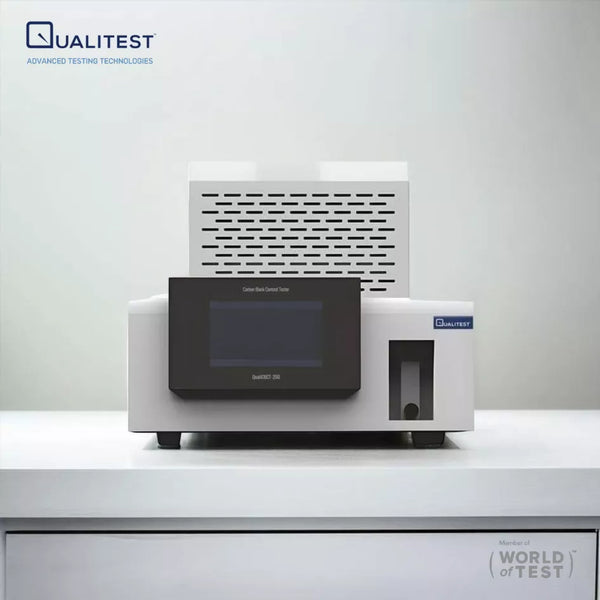
A dedicated instrument like our Carbon Black Content Tester QualiCBCT™-200 automates this process. Built specifically for standards such as IEC 60811-4-1, it utilizes a 45 mm diameter by 300 mm process tube with a 250 mm heated zone, high-temperature alloy wire elements reaching 1150 °C with 0.1 °C sensor sensitivity, and dual-line automatic gas switching between nitrogen pyrolysis and air combustion.
3. The TGA: Real-Time Dynamic Mass Tracking
A Thermogravimetric Analyzer integrates a miniature furnace directly around an internal microbalance that records weight changes down to fractions of a milligram under controlled gas flow. Rather than relying on before-and-after manual weighing, a TGA monitors sample mass continuously as the temperature changes.
Our TGA Thermogravimetric Analyzer Series addresses both analytical research and production screening through specialized configurations up to 1000 °C. For advanced material research, the QualiTGA-1000C platform provides 0.01 mg resolution (with an optional 0.1 µg ultra-microbalance) and programmable heating rates from 0.1 °C to 80 °C per minute to plot precise degradation kinetics under international thermal analysis standards.
For multi-sample industrial testing, systems like the single-furnace QualiTGA™ 6000A, the dual-furnace QualiTGA™ 6000, and the high-throughput QualiTGA™ 1200 incorporate automated carousels with 0.0001 g balance resolution to monitor moisture, volatile matter, LOI, and ash across dozens of samples.
Tube Furnace vs Muffle Furnace: Atmosphere and Capacity
When evaluating a tube furnace vs muffle furnace, the fundamental decision centers on gas control versus chamber volume.
Atmosphere Control and Char Quality
The primary dividing line in the tube furnace vs muffle furnace comparison is the circulation of an inert gas stream.
Research confirms that the fundamental operational difference between a tube and a muffle furnace is this continuous inert gas circulation, which standard muffle units do not provide. Tube furnaces operate under controlled inert environments (such as pure nitrogen), whereas muffle furnaces rely on atmospheric conditions that promote oxidation.
This atmospheric difference directly alters product chemistry. In comparative carbonization studies, tube furnaces maximize pyrolysis, resulting in higher carbon yields (78.3%) compared to muffle furnace chars (75.2%). Muffle furnace products show significantly higher oxygen content and greater formation of oxidized compounds, alongside inorganic elements like magnesium, phosphorus, and sulfur.
If your testing demands pure pyrolysis without oxidation, an open muffle furnace cannot match a tube unit. Dedicated systems like the QualiCBCT™-200 solve this by incorporating dual-line automatic gas-circuit switching to move seamlessly from inert nitrogen to air, complete with an integrated exhaust filtration device to capture pyrolyzed vapors.
Consider how this distinction applies to North American municipal infrastructure. Extrusion plants in manufacturing corridors like Ohio, Pennsylvania, and Texas produce high-density polyethylene pipe for natural gas distribution.
Under US Department of Transportation (DOT) pipeline safety rules and Plastics Pipe Institute (PPI) guidelines, resin processors must verify carbon black retention between 2.0% and 3.0% to guard against ultraviolet breakdown.
Running this verification in an open, uncovered dish inside a muffle furnace exposes the polymer to ambient air and burns off a portion of the carbon black before it can be weighed. While ASTM D4218 works around this in a muffle furnace by using a covered, oxygen-deficient dish to restrict air contact, ASTM D1603 and international cable standard IEC 60811-4-1 eliminate the oxidation variable entirely by sweeping high-purity nitrogen through an airtight process tube.
Thermal Mass and Chamber Dimensions
Because both the QualiMF™ 300 and the QualiCBCT™-200 are electrically heated systems, efficiency and testing turnaround are governed by thermal mass rather than fuel consumption.
In an electric muffle furnace, temperature uniformity across the chamber requires careful engineering. Research shows that uneven thermal distribution can lead to porosity, cracking, and inconsistent test results unless heating element spacing is specifically optimized.
The QualiMF™ 300 addresses this across its 298 mm × 203 mm × 121 mm chamber using balanced heating elements and high-quality insulation materials to deliver ±1 °C control precision. However, because that enclosed chamber is designed to trap heat, the interior retains elevated temperatures long after heating stops, requiring dedicated cool-down intervals between runs.
In contrast, an electric tube furnace concentrates thermal energy within a narrow heated zone with significantly lower thermal mass. The QualiCBCT™-200 utilizes this compact geometry alongside a dedicated rapid cooling system to return from 900 °C to room temperature in 20 minutes or less.
Where the muffle furnace holds an unmistakable advantage, however, is sample volume. If your lab evaluates dozens of aggregate, coal, or sludge samples per shift, you need room for multiple vessels. The QualiMF™ 300 chamber accommodates multiple crucibles simultaneously and features multi-unit PC connectivity, allowing a single computer to control up to 6 muffle furnaces at once.
A tube furnace is limited by the diameter of its central tube: in the QualiCBCT™-200, the process tube has an internal diameter of 45 mm and utilizes a customized guide-rail sample rack holding up to 4 combustion boats per run.
Tube Furnace vs TGA: Sample Volume and Kinetic Analysis
For laboratories evaluating engineering plastics, rubber masterbatches, and filled compounds, the comparison often turns to a tube furnace vs TGA. Both instruments handle inert gas pyrolysis and oxidative combustion, but they provide different depths of data.
Sample Mass and Heterogeneous Compounds
A major operational difference in the tube furnace vs TGA matchup is sample capacity. In standard analytical testing, conventional TGA runs use small specimens, typically between 5 and 20 mg in standard 10 mm × 6 mm alumina or platinum crucibles.
In generic research, this finite volume can create run-to-run variability when evaluating heterogeneous composites because a single micro-flake may not represent the entire lot. Dedicated tube instruments like the QualiCBCT™-200 handle multi-gram loading across a 4-sample train, naturally averaging out minor compositional inconsistencies across bulk polymers.
This sample-size consideration frequently surfaces in automotive compounding across the US Midwest. In states like Michigan and Indiana, Tier-1 molders and compounders increasingly process post-consumer recycled (PCR) resin to meet regional packaging rules and corporate sustainability targets.
When testing non-uniform recycled pellets on standard micro-balance setups, sub-sampling must be extremely thorough to avoid skewed filler readings. However, where sample homogeneity is a primary operational hurdle, the QualiTGA-1000C resolves this limitation by offering optional 10 g and 50 g macro configurations, removing the need to subdivide non-uniform composite feedstocks while maintaining continuous mass-loss tracking.
This sample-size difference becomes obvious in the automotive compounding sector across the US Midwest. In states like Michigan and Indiana, Tier-1 automotive molders and compounders increasingly incorporate post-consumer recycled (PCR) resin to meet corporate sustainability goals and regional packaging mandates.
Reclaimed polyolefin feedstocks often contain localized cross-contamination. If a technician clips a 10 mg flake that happens to be entirely filler, an analytical TGA will misread the batch. A tube furnace, by digesting a larger multi-gram pellet composite, naturally integrates these variations to deliver a dependable bulk ash and carbon metric.
However, when an automotive compounding laboratory must troubleshoot incoming recycled lots, the TGA becomes irreplaceable. If an incoming recycled polypropylene stream is contaminated with 4% polyamide (nylon) or polyester, a standard tube furnace will simply burn it all off as generic volatile resin.
An analytical system like the QualiTGA-1000C, by contrast, resolves discrete decomposition peaks, showing the secondary degradation curve of the contaminant and protecting the production line from brittle molded components.
Dynamic Weighing and Reaction Kinetics
TGA provides continuous, in-situ gravimetric tracking throughout the run, delivering dynamic decomposition profiles that standard tube furnaces cannot reproduce without external sensors. The QualiTGA-1000C analytical unit tracks mass loss down to 0.01 mg (or 0.1 µg) with heating rates from 0.1 °C to 80 °C per minute.
TGA results are highly sensitive to experimental conditions. Variations in heating rate, gas flow rate, sample mass, and atmosphere can shift decomposition onset temperatures by up to 75 °C between inert and oxidizing environments. Additionally, generic TGA cannot detect phase transitions or mass-invariant thermal events on its own, requiring coupling with Differential Scanning Calorimetry (DSC) or Differential Thermal Analysis (DTA) to separate physical transitions from chemical reactions.
In combustion research, TGA provides fundamental kinetic parameters, but its slow heating rates do not reproduce the rapid heating conditions of commercial pulverized-fuel utility burners. Drop tube furnaces (DTF) better approximate industrial burner conditions through fast heating and short residence times.
Chars produced in a TGA retain an intact cell matrix structure with visible macropores, leading to higher activation energies during combustion. Conversely, drop tube furnace chars develop swollen surfaces, distributed pore networks, and higher BET surface areas, resulting in lower activation energies due to internal diffusion control.
ASTM and International Standards Compliance
When reviewing a tube furnace vs TGA vs muffle furnace, the specific industry test method governing your client contracts often dictates equipment selection directly:
Muffle Furnace Standards: Documented Applications and Industry Equivalents
On its official specification sheet, the QualiMF™ 300 is documented specifically for determining ash and volatile matter in coal, coke, solid biomass fuels, petrochemicals, and cement.
In broader industrial testing, laboratories routinely deploy box furnaces for procedures such as ASTM D5630 for thermoplastics, ASTM D3174 for coal and coke, ASTM E1755 for biomass, and ASTM D2974 for peat and organic soils. Because these general methods rely on atmospheric oxidation to burn off organic binders, the open-air box chamber of the QualiMF™ 300 provides the required thermal environment.
Tube Furnace Standards: Specialized Cable and Polyolefin Testing
When standards mandate complete isolation from atmospheric oxygen during heating, dedicated tube systems take precedence. The QualiCBCT™-200 is built specifically to meet IEC 60811-4-1 (and related methods like IEC 60811-605) for evaluating carbon black content in cable insulation and sheath materials.
Across North American quality control, technicians execute ASTM D1603 in a tube furnace using a continuous nitrogen sweep. In contrast, ASTM D4218 evaluates the same carbon black property in a muffle furnace by using a covered, oxygen-deficient crucible to protect the carbon black from combustion.
TGA Standards: Analytical Characterization and Proximate Carousels
For automated compositional testing, our TGA platforms align with distinct industry tiers. Our automated proximate carousel models (the QualiTGA™ 6000A, 6000, and 1200) explicitly verify compliance with ASTM D3173, ASTM D3174, ASTM D3175, ASTM D7582, ISO 11722, ISO 1171, and ISO 562 for moisture, ash, and volatile matter.
In analytical polymer laboratories, procedures such as ASTM E1131, ISO 11358, ASTM D6370, and ASTM E2550 represent the standard methods for compositional and stability analysis, which our QualiTGA-1000C supports through its microbalance resolution and programmable gas control under international thermal standards.
Shift Throughput and Cycle Times
Beyond specification sheets, daily productivity depends on heating and cool-down rates. In our perspective, cooling turnaround between test runs is one of the most overlooked factors in equipment selection. How many samples can your operators complete during an eight-hour shift?
Muffle Furnaces: Batch Volume vs. Cool-Down Delays
A muffle furnace accommodates multiple crucibles simultaneously across its 298 mm × 203 mm chamber floor, making it an efficient option per heating cycle. The QualiMF™ 300 heats up to 100 °C per minute, getting up to target temperatures without delay.
However, because the high-quality insulation effectively traps heat inside the sealed chamber to keep the exterior cool, the interior retains elevated temperatures long after heating stops. Opening the chamber door prematurely risks thermal shock to hot crucibles and creates operator safety hazards. For this reason, muffle furnaces are best utilized for large batch runs completed at the end of a shift or allowed to cool between scheduled cycles.
Tube Furnaces: Fast Turnaround for Production Lot Release
A purpose-built tube unit like the QualiCBCT™-200 handles up to 4 sample boats per cycle on a dedicated guide-rail rack. Because thermal energy is concentrated within a narrow process tube with low thermal mass, cooling occurs swiftly.
The QualiCBCT™-200 returns from 900 °C to room temperature in 20 minutes or less. This allows technicians to complete 4 to 6 separate testing rounds per shift, delivering prompt lot-release data back to production lines.
TGA: Serial Testing vs. Automated Carousel Systems
Analytical R&D units like the QualiTGA-1000C operate serially, analyzing one micro-sample per test run over 45 to 90 minutes, yielding 5 to 7 runs per shift. However, in major American fossil and synthetic fuel testing regions such as the Powder River Basin, the Illinois Basin, or Appalachia, commercial inspection labs process barge and rail car samples against tight turnaround contracts.
Running these volumes solely through manual muffle furnaces creates labor bottlenecks. In these facilities, automated multi-sample carousels alter productivity: the QualiTGA™ 6000A evaluates 19 samples plus a blank in under 120 minutes, while the dual-furnace QualiTGA™ 1200 processes up to 54 samples within an 8-hour shift under ASTM D7582.
Operator Skill Requirements and Labor Impact
Labor requirements and training duration directly influence operational overhead. In our view, simpler testing procedures on the factory floor yield more consistent data:
Production-Floor Quality Technicians
Systems like the QualiMF™ 300 and QualiCBCT™-200 are built for direct plant quality control. Technicians can run standardized tests independently after brief instruction. On the QualiCBCT™-200, operators load boats using the guide rail, select a segmented temperature program on the 7-inch capacitive touchscreen, and rely on integrated software for one-click calculations and automatic printing.
On the QualiMF™ 300, electronic safety door locks prevent opening during high-temperature cycles, while automatic alarms protect against thermocouple reversal, sensor disconnection, and over-temperature conditions.
Specialized Analytical Chemists
An analytical TGA requires a higher degree of laboratory expertise. Operators must prepare micro-samples without causing shear degradation, position delicate pans without bending balance arms, and run routine balance calibrations.
Furthermore, software analysis requires practical expertise. Technicians must correctly establish integration baselines, separate overlapping decomposition steps, and identify potential mechanical drift. Without an experienced operator, the likelihood of data misinterpretation increases significantly.
Total Cost of Ownership and OPEX
A complete evaluation accounts for both the initial hardware purchase and ongoing operational expenses:
Capital Outlay Realities
The muffle furnace represents the most economical entry point. A durable, high-temperature unit like the QualiMF™ 300 delivers standardized bulk heating with a 3.5 kW electrical rating at an accessible price point.
A specialized configuration like the QualiCBCT™-200 demands a moderate investment, providing sealed gas control, rapid cooling under 20 minutes, and multi-sample testing within a standard plant quality control budget.
Research-grade TGAs like the QualiTGA-1000C require a significant capital investment due to their precision microbalance hardware, multi-gas manifolds, and analytical software, though multi-sample proximate carousels can offset labor costs in high-volume fuel facilities.
Ongoing Consumables and Utility Demands
Operating expenses vary substantially across technologies over a multi-year service life. A muffle furnace incurs minimal ongoing expense: inexpensive ceramic crucibles can be reused across dozens of test runs, and no compressed purge gases are required for standard testing. A tube furnace introduces moderate operational costs, including ceramic combustion boats, commercial-grade nitrogen, and periodic replacement of the process tube over extended service.
Analytical TGAs require high recurring expenses, consuming ultra-high-purity carrier gases (99.999% nitrogen and zero-grade air) to protect the internal balance from contamination, along with single-use sample pans and certified calibration reference materials.
Facility and Utility Requirements
Before purchasing equipment, confirm that your laboratory facility provides the necessary physical infrastructure:
Bench Stability and Vibration Dampening
The QualiMF™ 300 weighs 65 kg with overall dimensions of 600 mm × 460 mm × 575 mm, installing securely on standard industrial workbenches near production equipment while tolerating standard shop-floor environmental fluctuations.
In contrast, an analytical TGA is highly sensitive to ambient conditions. Its internal microbalance can detect building vibrations, foot traffic, and air drafts from ventilation systems, requiring an isolated anti-vibration table within a climate-controlled room.
Ventilation and Exhaust Infrastructure
Heating bulk polymers, rubber compounds, or organic samples generates noticeable smoke and off-gassing. For US facilities, compliance with OSHA workplace air-quality limits and NFPA 45 (Standard on Fire Protection for Laboratories Using Chemicals) dictates dedicated ventilation planning.
Both box and tube furnaces should be positioned under an industrial exhaust canopy or within a certified laboratory fume hood. The QualiCBCT™-200 simplifies installation by incorporating a built-in exhaust gas filtration device that captures effluent directly at the tube outlet and routes it cleanly into facility exhaust lines, while the QualiMF™ 300 incorporates a thermally shielded chimney switch to manage flue discharge safely.
Electrical Connections and Gas Supply
High-temperature heating elements demand dedicated electrical planning. The QualiMF™ 300 operates on a 220V connection (with a 110V configuration available), drawing up to 3.5 kW during maximum heating ramps to comply with facility electrical standards.
Standard tube furnace and TGA configurations operate on AC 220V or 110V circuits, but require secured compressed gas cylinders and two-stage pressure regulators located adjacent to the bench.
Equipment Selection Framework
When evaluating a tube furnace vs TGA vs muffle furnace, the objective is to choose the hardware that meets your technical specifications without unnecessary operational overhead. From our perspective, the most productive testing facilities match the instrument directly to their quality requirements:
- Select a Muffle Furnace (such as the QualiMF™ 300) if your primary testing involves bulk materials evaluated in air. It is the practical, cost-effective choice for general loss-on-ignition burns, standard coal or biomass ash testing, and high-volume raw material screening across multi-furnace PC setups.
- Select a Tube Furnace / Carbon Black Tester (such as the QualiCBCT™-200) if your primary requirement is testing polyolefin pipe, wire sheathing, or geomembrane materials under IEC 60811-4-1 or general ASTM tube methods. You obtain a sealed inert environment, fast 20-minute turnaround cycles, and straightforward operation across 4 samples simultaneously without the maintenance demands of a microbalance.
- Select a TGA (such as our QualiTGA™ Series) if your team develops new polymer formulations, evaluates competitive materials, investigates product failures, or conducts automated multi-sample proximate analysis. The continuous analytical curve provides diagnostic insight that standard furnaces cannot supply.
Source Cost-Effective Thermal Systems at Qualitest
At Qualitest, we supply North American facilities with cost-effective, industry-proven thermal testing systems that satisfy strict standard compliance while protecting your capital budget. Our technical specialists are ready to help you select the ideal configuration for your daily operational demands.
Contact us today to discuss your testing specifications or request a competitive quote for your facility.
References (Click to expand)
- Farrow, S. T., Sun, C.-G., Liu, H., & Snape, C. (2020). Comparative study of the inherent combustion reactivity of sawdust chars produced by TGA and in the drop tube furnace. Fuel Processing Technology, 201, 106361.
- Langot, J., Chávez-Gómez, P., Lévesque, M., & Robert, É. (2021). Modeling the thermal decomposition and residual mass of a carbon fiber epoxy matrix composite with a phenomenological approach: Effect of the reaction scheme. Fire and Materials, 46, 262–276.
- Nisa, Z., Chuan, L. K., Guan, B., Ahmad, F., & Ayub, S. (2023). A comparative study on the crystalline and surface properties of carbonized mesoporous coconut shell chars. Sustainability, 15(8), 6464.
- Saadatkhah, N., Carillo Garcia, A., Ackermann, S. L. G., Leclerc, P., Latifi, M., Samih, S., Patience, G., & Chaouki, J. (2019). Experimental methods in chemical engineering: Thermogravimetric analysis (TGA). The Canadian Journal of Chemical Engineering, 98(1), 34–43.
- Wang, Y., An, T., & Fang, H. (2025). Research and optimization of temperature uniformity of high-precision muffle furnace. Journal of Physics: Conference Series, 3009, 012076.