Clear visual inspections inside industrial piping start with picking the right probe mechanics. Matching shaft stiffness to channel geometry keeps jobs moving fast, stops camera droop, and keeps equipment spending cost-effective.
If your team is deciding on a semi rigid vs flexible borescope, this guide shows you exactly which setup delivers the best results.
Key Takeaways
- Column Stiffness Counters Sag: Semi-rigid shape-holding tubes provide the physical backbone required to bridge horizontal pipes and boiler tubes without dropping into bottom debris.
- Flexibility Solves Complex Bends: Braided insertion lines bend smoothly through tortuous channels and tight elbows, offering articulation endurance exceeding 30,000 cycles on modular systems.
- Pre-Shaped Field Control: Hand-forming a gentle upward arch into a semi-rigid casing keeps the camera riding along the pipe centerline across unsupported spans, leaving dual-axis tip steering free to inspect welds.
- Economical Fleet Balancing: Standard maintenance checks can be handled with cost-effective two-way articulating scopes, reserving four-way and 360-degree joystick systems for intricate turbine and casting inspections.
Pushability and Column Stiffness
When advancing an inspection tube through an internal passage, borescope pushability and column stiffness determine whether the camera actually reaches the target area. Pushability describes your physical capability to transmit forward thrust along the shaft without the tube kinking, coiling, or binding against sidewalls.
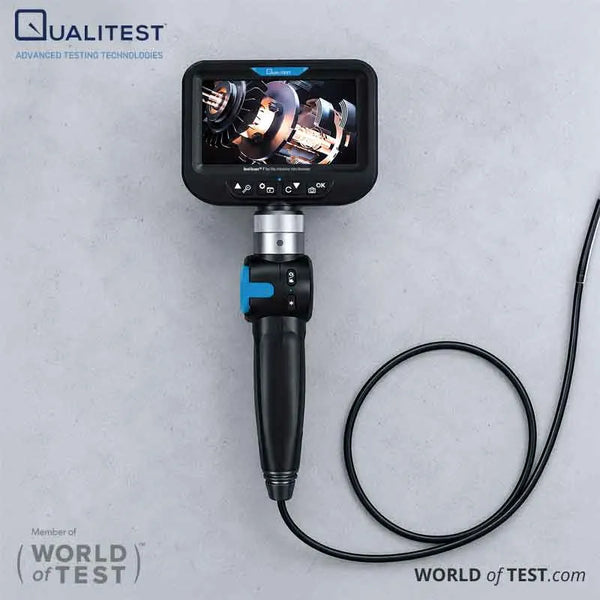
In straight lines and open cavities, you need a firm structural backbone that transfers axial pushing force and wrist rotation directly to the tip without buckling inside unsupported voids. That is why our QualiScope S Semi-Rigid Video Borescope features a specialized metal and plastic semi-rigid snake tube. It provides the firm column stiffness required to advance smoothly through straight runs and vertical entries without premature mechanical collapse.
Flexible tubes, in contrast, are built for clearing tight turns, complex elbows, and confined cavities. Flexible braided casings bend around tight radii effortlessly. However, an unsupported flexible line provides minimal column stiffness over extended horizontal distances, making it vulnerable to coiling and dragging against surface friction.
For pathways with repeated bends, our flexible systems are built for long service lives: the QualiScope IV incorporates a high-density tungsten-wire braided tube rated for 20,000 bending cycles, while our modular QualiScope I line delivers articulation endurance exceeding 30,000 cycles.
When to Use a Semi-Rigid Borescope
Identifying when to use a semi rigid borescope helps quality managers deploy the proper tool for specific plant geometries. While flexible probes are essential for threading through multi-bend engine passages and intricate castings, a semi-rigid scope is the clear frontrunner whenever forward column rigidity and direct tactile feedback are the primary requirements.
Key industrial applications where semi-rigid designs prove their value include:
- Boiler Tubes and Heat Exchangers: Advancing down straight boiler tube passes where flexible cables buckle against rough internal scale deposits.
- Process Lines, Tubing, and HVAC Ducts: Crossing horizontal gaps where flexible lines droop out of the target field of view.
- Hydraulic and Pneumatic Cylinders: Traveling straight along polished cylinder bores to spot scoring, pitting, and seal wear without wall deflection.
- Energy Generation and Utility Stations: Inspecting vertical drops and structural cavities inside cooling headers and turbine casings.
- Surface Anomaly Screening: Conducting smooth linear passes to inspect for metal peeling, surface scratching, and foreign particulate accumulation.
In general, semi-rigid borescopes trade maximum reach and tight-elbow clearance for forward column control. Our QualiScope S is offered in 1 m, 2 m, and 3 m cable lengths, making it best suited for straight tube passes and ducts accessible within that span.
For longer runs or multi-bend pathways, flexible articulating options such as the QualiScope T (up to 5 m with two-way steering), the QualiScope IV (4-direction steering), or the QualiScope I (up to 8 m with 4-way and 360-degree probes) are better suited.
Industrial Focus: US Utility Outages
Consider a scheduled turnaround outage at an American electric utility plant or a Gulf Coast petrochemical facility. Maintenance teams must examine hundreds of horizontal steam generator tubes for scale, wall thinning, and pitting without cutting open header assemblies.
In this setting, a flexible line quickly droops under gravity and drags through bottom scale deposits. Meanwhile, a completely rigid tool cannot clear surrounding structural framework outside the port. Using a shape-holding semi-rigid scope allows technicians to pre-bend an entry profile that bridges the distance, stays centered along the tube bore, and uses 210-degree tip articulation to examine upper circumferential welds.
QualiScope S Specifications
The QualiScope S brings reliable, field-ready mechanical construction to demanding plant environments:
- Steering and Optics: Dual-axis tip steering articulating up to 210 degrees, probe diameters starting from 3.9 mm (varies by configuration), an 80° to 90° field of view, and depth of field spanning 15 to 100 mm. It utilizes a 1/9" CMOS sensor (with a 1/6" CMOS sensor available on one configuration), capturing photo and video resolution up to 1920 × 1080 (JPG / MOV).
- Lighting Control: 6 high-output LEDs with manual dimming to eliminate glare washouts on reflective metal surfaces.
- Length Configurations: Available in working cable lengths of 1 m, 2 m, and 3 m.
- Interface and Storage: Integrated 4.3-inch IPS screen (480 × 272 resolution), TF card storage (supporting up to 32 GB), PC connection, and TV output.
- Environmental Build: Sealed with a whole-machine waterproof rating, rated to operate from -10°C to 50°C, and supported by an integrated high-temperature alarm.
How to Stop Borescope Probe from Sagging in Pipes
Technicians working with horizontal piping recognize the challenge of probe sag. Gravity pulls the camera head downward, causing it to drag through bottom debris, obscuring the optical window and stalling forward advancement.
Comparing a shape holding inspection camera vs flexible probe illustrates the mechanical difference immediately: a flexible line drops to the pipe floor, whereas a semi-rigid tube retains its pre-set physical profile across open spaces.
If your facility is addressing how to stop borescope probe from sagging in pipes, deploying the QualiScope S allows operators to apply an efficient four-step field procedure:
- Pre-Shape the Insertion Profile: Prior to inserting the probe into the access port, bend a gentle upward arch into the semi-rigid metal-and-plastic tube. This pre-formed curve counteracts gravitational pull, keeping the camera riding along the pipe centerline across unsupported spans.
- Advance via Base Column Stiffness: Grip the insertion tube near the entry port and advance smoothly. Let the mechanical column stiffness of the casing carry the span rather than straining the articulation joint against the pipe floor.
- Regulate Lighting to Prevent Flare: As the lens approaches reflective welds or wet pipe surfaces, adjust the manual dimming dial on the 6 LEDs to eliminate glare and maintain high image contrast on the 4.3-inch display.
- Engage Dual-Axis Steering at the Defect: Once positioned at the inspection area, use the dual-axis steering mechanism (articulating up to 210 degrees) to inspect circumferential welds, pipe joints, and wall pitting without moving the main shaft. Heed the integrated high-temperature alarm to avoid exceeding thermal limits during inspection.
Flexible and Cost-Effective Fleet Options
While semi-rigid tubes excel in straight runs, tortuous multi-bend pathways call for flexible articulation. We supply a complete lineup of inspection instruments to match specific plant geometries while keeping fleet acquisition cost-effective.
QualiScope T: Cost-Effective Everyday Inspection
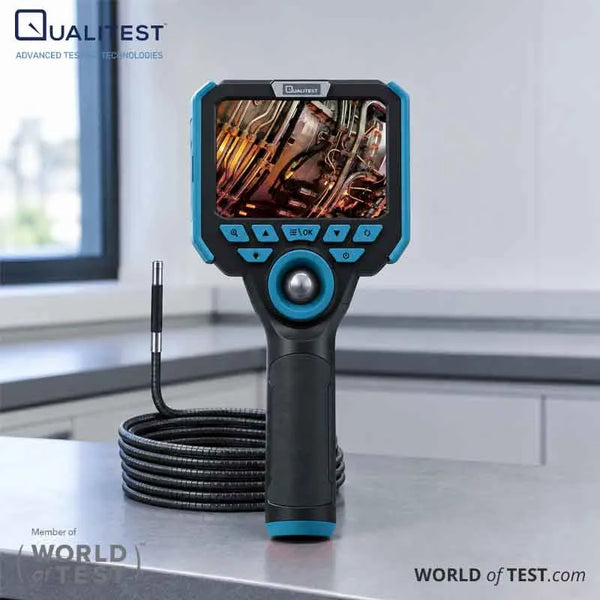
The QualiScope T provides two-way 180-degree articulation for everyday pipe, tube, and duct inspections at a lower cost than four-way or 360-degree joystick scopes.
With Ø6.2 × 16 mm (T6) and Ø8.5 × 11.5 mm (T8) probes, up to 1080p resolution on the T8, about 4 hours of working time from its 2,600 mAh battery, an IP67-rated probe tip, and CE, FCC, and RoHS certifications, it serves as an economical workhorse. It is available in Screen and Mobile versions and automatically shuts down if temperatures exceed 90°C.
QualiScope IV: Four-Way Articulating Navigation
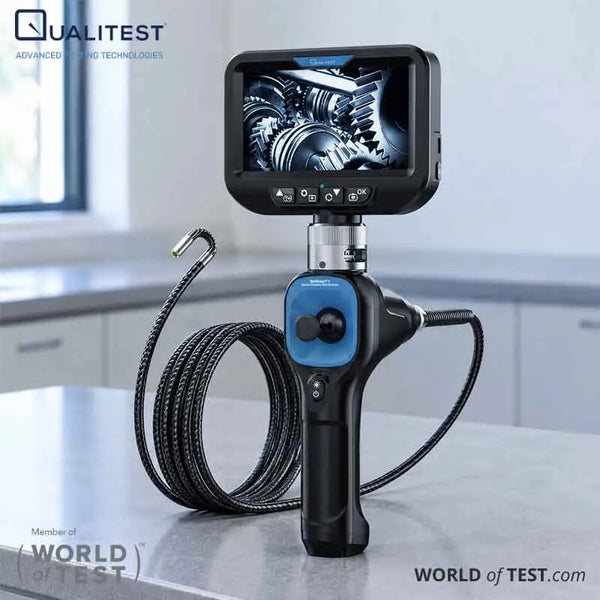
For complex winding pathways, the QualiScope IV features a flexible high-density tungsten-wire braided tube with 4-direction articulation exceeding 180 degrees. It includes a 5-inch HD IPS screen, a wide 120-degree field of view, a sapphire-glass lens, and Wi-Fi connectivity in Ø3.9 mm (IV4) and Ø6 mm (IV6) diameters with customizable lengths from 1 to 3 m.
QualiScope J: Precision Joystick Control
When complete 360-degree tip steering is needed inside turbine components or angled welds, the QualiScope J delivers 360-degree joystick articulation via four mechanical cables spaced at 90-degree intervals.
Available in Ø3.9 mm (J4 with tungsten wire braided mesh) and Ø6.2 mm (J6 with elastic metal hose) versions, it features an OmniVision CMOS sensor (1280 × 720 resolution), sapphire glass, an IP67-rated snake tube, and a high-capacity 5,200 mAh lithium battery.
QualiScope I: Extended-Reach Modularity
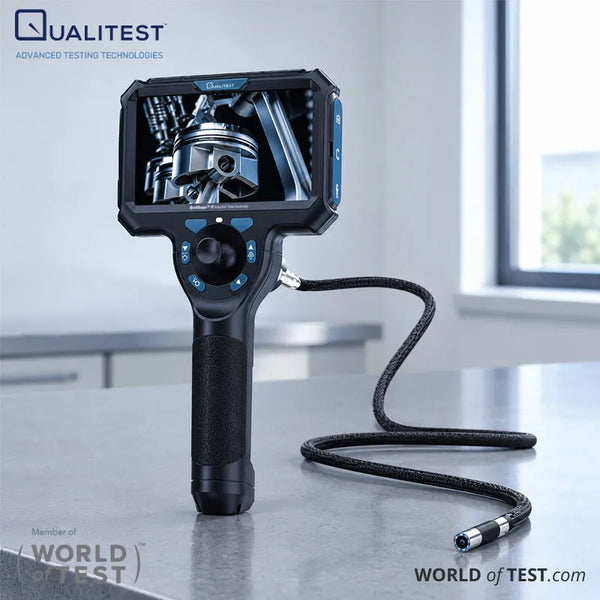
When inspection lines extend past standard lengths, the QualiScope I supports distances out to 8 m using five interchangeable probes spanning Ø2 mm and Ø3 mm (straight), Ø2.8 mm (4-way steering), and Ø3.9 mm and Ø6 mm (360° all-way steering) with articulation endurance exceeding 30,000 cycles and a 32 GB TF card.
System Comparison: Semi-Rigid vs. Flexible
Evaluate how our primary semi-rigid and flexible QualiScope systems compare side by side:
| Model | Tube Construction | Articulation & Steering | Best-Fit Inspection Scenario |
|---|---|---|---|
| QualiScope S | Metal and plastic (semi-rigid, shape-holding) | Dual-axis lens steering up to 210° | Horizontal pipes, boiler tubes, and ducts requiring anti-sag stability |
| QualiScope T | Metal and plastic snake tube | Two-way (up/down) 180° steering | Everyday plant maintenance and weld checks needing a cost-effective setup |
| QualiScope IV | High-density tungsten-wire braided | 4 directions, >180° bending angle | Complex winding pathways requiring a 120° FOV and multi-way tip control |
| QualiScope I | High-density tungsten-wire braided | Straight (I20/I30), 4-way (I28), 360° all-way (I39/I60) | Extended pipe runs out to 8 m requiring interchangeable probe diameters |
Get Cost-Effective Borescope Hardware at Qualitest
Qualitest North America supplies testing and measurement equipment directly to quality teams, maintenance departments, and industrial facilities. Whether your operations require the shape-holding column stiffness of the QualiScope S to prevent probe sag in horizontal runs or the budget-conscious everyday utility of the QualiScope T, we provide dependable, field-ready configurations.
Contact Qualitest today to discuss your pipe dimensions, request a quote, and select the ideal borescope setup for your facility.
References (Click to expand)
- Meehan, A. (1994). Remote visual inspection equipment for quality control. Proceedings of WESCON '94, 214-216.
- Meehan, A. (1995). Remote visual inspection equipment for quality control. Proceedings of WESCON'95, 505-.
- Shinozaki, K., Armstrong, M., & Urquidi, R. (1995). Flexible Borescope For Inspecting Ducts.