Operating heavy industrial equipment without thermal oversight risks sudden, expensive downtime. A dependable high temperature thermal imaging camera gives maintenance teams the non-contact radiometric data needed to catch failures early and satisfy US safety codes without paying for unneeded laboratory extras.
We believe true plant reliability comes down to matching hardware limits to your actual operating conditions. Here is our field guide to our cost-effective QualiTC lineup.
Key Takeaways
- Broad Temperature Coverage: Hardware spans from -20°C to 1200°C (-4°F to 2192°F), requiring detector limits aligned with actual asset temperatures to prevent severe image saturation.
- Furnace Diagnostic Requirements: Evaluating high-heat combustion zones depends on correct emissivity settings, background reflection removal, and optical alignment through dedicated sight glass ports.
- Mandatory US Compliance: Scheduled thermal sweeps satisfy required NFPA 70B electrical maintenance audits while keeping technicians safely positioned outside dangerous NFPA 70E arc flash boundaries.
- Practical Handheld Options: The QualiTC lineup spans multiple tiers, from straightforward 120×90 baseline units to advanced 640×480 inspection instruments featuring full-frame radiometric video and integrated laser distance measurement.
- Turnkey Analysis Software: Every QualiTC instrument includes dedicated PC analysis software in the standard package, providing complete reporting capabilities out of the box without requiring separate software purchases for routine reporting.
Industrial Thermal Camera Temperature Range and Optics
Selecting a thermal inspection setup starts with matching your target equipment to the appropriate industrial thermal camera temperature range.
Academic research demonstrates that thermal imaging systems span from -40°C to beyond 3000°C depending on detector chemistry and optical filtering. Fundamental physics governed by Planck's law dictates that peak radiant emission shifts to shorter optical wavelengths as surface temperatures climb.
High-Heat and Specialized Sensor Chemistry
For extreme high-heat environments, specialized sensor configurations target narrow spectral windows to avoid blinding the detector:
- Near-Infrared Silicon Arrays (400 to 1000 nm): Operating in the near-infrared band, silicon CMOS and CCD sensors measure from 300°C to over 1800°C, delivering tight spatial detail and fast frame rates for induction hardening and additive metal fabrication.
- Short-Wave InGaAs Detectors (900 to 1700 nm): Indium Gallium Arsenide sensors track temperatures between 300°C and 1200°C at speeds up to 100 Hz without saturation, supporting continuous thermal tracking in hot rolling mills.
- High-Dynamic and Photovoltaic Sensors: Specialized silicon arrays evaluate extreme targets from 600°C to 3000°C without mechanical filter wheels, while experimental logarithmic photovoltaic-mode sensors at 940 nm track wide scenes from room temperature (~25°C) to over 2500°C.
- Cryogenic and Flat Metalens Optics: Cooled Mercury-Cadmium-Telluride detectors drop to -150°C for cryogenic metrology. Single-pixel MEMS scanners achieve calibration uncertainties below +/-0.5°C tied to ITS-90 standards, while mid-infrared flat metalens optics check targets between 35°C and 700°C with error margins under +/-0.7%.
Uncooled Microbolometers and Thermal Drift
For day-to-day facility inspections, long-wave infrared (LWIR) uncooled microbolometers operating across 7.5 to 14 µm serve as the primary choice for mechanical sweeps, building diagnostics, and electrical enclosures, typically covering -40°C to 650°C in standard baseline trims. Compact IoT sensor arrays show predictable linear regression trends across mild 36°C to 96°C bands.
However, field research shows that uncooled portable units require warm-up stabilization stretches of 30 to 60 minutes, and up to 80 minutes in certain outdoor configurations. Additionally, ambient heat shifts inside enclosed boiler rooms and internal lens warming from targets above 225°C will distort measurement linearity if left uncorrected.
Spot Size and Measurement Field of View (General Industry Principles)
Sensor pixel count alone does not dictate how far away you can stand while taking an accurate reading. In professional thermography, spatial resolution is governed by the Instantaneous Field of View (IFOV), which defines the physical area a single detector pixel covers at a given distance:
- The Three-by-Three Pixel Rule: While a single pixel can detect that thermal energy exists, certified thermographic standards require a target to cover a minimum of three by three pixels (the measurement spot size) to obtain a calibrated, valid temperature reading.
- Distance-to-Spot Ratio (D:S): If a target is smaller than the optical measurement spot, background radiation bleeds into the detector element, diluting the temperature reading.
- Laser Distance Function: An integrated laser rangefinder measures physical distance to supply data for atmospheric transmission correction algorithms; it does not alter optical magnification or make an undersized target legible at long range.
Practical Field Optics: The QualiTC Lineup
From our engineering perspective, detector responsiveness, optical flexibility, and thermal sensitivity matter far more in regular plant maintenance than pursuing inflated theoretical upper limits. Thermal sensitivity, defined by Noise Equivalent Temperature Difference (NETD), determines how cleanly a sensor separates minor temperature gradients from background noise.
Across our QualiTC family, our commercial uncooled microbolometers cover an operating span from -20°C to 1200°C (-4°F to 2192°F) with optical configurations engineered for direct shop-floor utility:
- Interchangeable Optics for High-Heat Models: The QualiTC 38 features a standard 15 mm F/1.0 lens with optional 19 mm and 25 mm telephoto lenses, manual focus, 1x to 8x digital zoom, and an NETD of 45 mK or lower at 25°C. The flagship QualiTC 64 pairs its 640×480 array with a standard 25 mm F/1.0 lens, optional 19 mm and 35 mm optics, manual focus, and an NETD of 45 mK or lower, putting more physical pixels on distant targets.
- Smooth Live Scanning: Baseline inspection options like the QualiTC 17 feature a smooth 25Hz refresh rate to eliminate image blur during active plant walk-throughs.
- Wide Optical Alignment: The QualiTC 20 pairs a 56° × 42° thermal field of view with a wide 83° × 55° visible-light reference view for contextual framing. Combined with distance compensation reaching 5 meters (~16.4 ft), it allows technicians to audit crowded electrical enclosures without losing orientation in narrow maintenance corridors.
High-Heat Diagnostics and Furnace Inspection
Industrial furnaces, kilns, reformer tubes, and boiler walls present hostile diagnostic environments where standard visible-light cameras are ineffective because luminous hydrocarbon flames obscure internal surfaces. When selecting a commercial thermal camera for furnace inspection, technical teams must balance optical principles with practical field utility:
Furnace Thermodynamic Principles
1. Through-Flame Penetration
In specialized testing, filtered mid-wave infrared (MWIR) cameras operating with a narrow passband between 3.80 µm and 4.05 µm utilize clean spectral transmission windows where combustion gases do not emit. This allows direct thermal imaging of pipes and walls through ~1000°C flames once target temperatures exceed 50°C.
2. Emissivity and Reflection Modeling
Raw thermal radiation inside a furnace chamber combines direct surface emission, reflected radiation from refractory brickwork, and atmospheric absorption.
Academic studies confirm that without multi-variable thermo-optical adjustments and background reflection subtraction, recorded temperatures deviate substantially. Polarization filtering has also been investigated in high-heat trials to reduce parasitic thermal reflections.
3. Optical Access and Protective Enclosures
While specialized research facilities deploy water-cooled endoscopic probes, standard commercial plant inspections are conducted through peep-hole ports or infrared viewing windows to avoid disrupting internal combustion draft.
Window materials must match the camera waveband: substrates such as Germanium, Zinc Selenide, or Zinc Sulfide transmit cleanly across the 8 to 14 micrometer long-wave band used across the QualiTC lineup, whereas Sapphire transmits only up to roughly 5 micrometers, making it completely opaque to long-wave microbolometers and suitable strictly for short-wave or mid-wave instruments.
US High-Heat Field Applications
In commercial facilities across major US industrial regions, these diagnostic challenges correspond to specific operating environments:
- Gulf Coast Petrochemical Facilities (Texas and Louisiana): Process teams inspect steam methane reformers and ethylene cracking furnaces. Under continuous high-heat operations and high ambient humidity, external tube surfaces are checked routinely for internal coke accumulation and wall thinning to prevent unscheduled shutdowns.
- Midwest and Great Lakes Steelmaking (Indiana and Ohio): Integrated mills and foundries survey blast furnace shells, ladle transfer cars, and reheat furnace linings. Monitoring exterior surface temperatures allows maintenance planners to identify refractory degradation and escaping hot gas before elevated temperatures damage structural steel.
Key Defect Targets
- Refractory Degradation and Ratholing: Thermal imaging identifies localized hotspots or sub-1000°C cool areas in crown insulation, locating concealed internal voids and refractory erosion before exterior steel casings sustain damage.
- Repair Verification: Thermography monitors cooldown rates and confirms that ceramic welding repairs bond completely without causing thermal shock fractures in surrounding refractory material.
- Petrochemical Process Tubes: Advanced signal processing, such as partial least squares regression, isolates background reflection noise to identify tube overheating and internal coke choking inside chemical furnace piping.
- Combustion and Burner Balancing: Automated image analysis identifies irregular flame patterns across burner banks, helping technicians balance fuel delivery and lower emissions in coal and gas utility boilers. Dual-spectrum visual blending also overlays thermal anomalies directly onto physical equipment outlines. Laboratory control of induction melting equipment relies on similar exterior thermal surveillance.
In our assessment, relying on single static snapshot images in dynamic, high-heat environments introduces significant diagnostic risk. Because thermal drafts and burner currents fluctuate continuously, we believe recording full-frame radiometric video is critical for furnace casings and process piping, allowing technicians to evaluate temperature changes frame by frame during post-inspection analysis.
Dedicated High-Temperature Hardware
It must be noted that standard commercial LWIR microbolometers, including the QualiTC lineup, cannot penetrate active hydrocarbon flames. The QualiTC 38 and QualiTC 64 are engineered for external furnace casing surveys, exterior refractory wall audits, heat exchangers, and process piping up to 1200 degrees Celsius (2192 degrees Fahrenheit), rather than internal through-flame combustion viewing:
-
QualiTC 38 Portable Thermal Camera (Professional):
- Measurement Range: -20°C to 1200°C (-4°F to 2192°F)
- Infrared Resolution: 384×288
- Integrated Features: Full-frame radiometric video capture, an integrated 40-meter (~131 ft) laser rangefinder for distance correction, GPS coordinate logging, 4G wireless connectivity, an 8-megapixel visible camera, and a removable 5000 mAh battery providing roughly five hours of runtime.
- Target Applications: High-temperature process lines, refinery pipework, electrical utility substations, and emergency response teams.
-
QualiTC 64 Portable Thermal Camera (Advanced):
- Measurement Range: -20°C to 1200°C (-4°F to 2192°F)
- Infrared Resolution: 640×480 paired with an 8-megapixel visible camera
- Integrated Features: Full-frame radiometric video, an integrated 40-meter (~131 ft) laser rangefinder with spot measurement, wireless data transfer, GPS logging, an IP54-rated enclosure, and a removable 5000 mAh battery providing roughly five hours of continuous operation.
- Target Applications: Detailed manufacturing plant diagnostics, utility grid inspections, and electricity generation facilities under harsh operating conditions.
Handheld Lineup Selection Matrix
Not every routine maintenance schedule calls for a 1200°C ceiling. In field studies comparing portable systems, researchers observe that handheld thermal options range from compact smartphone attachments to high-resolution radiometric instruments.
While smartphone camera attachments offer compact convenience, experiments demonstrate that smaller sensor arrays can underestimate local surface temperatures by -1.3 +/- 3.4°C due to noise and optical limitations, whereas dedicated handheld platforms maintain measurement precision within -0.19 +/- 0.55°C.
Spot thermal tools weighing around 312 g blend pyrometer spot measurement with thermal imaging to accelerate surveys of electrical machinery. Beyond factory walls, portable infrared units support tracking urban heat islands, mapping geothermal surface temperatures, monitoring agricultural cold-storage facilities, and evaluating solar cavity receivers operating near 1400°C.
In specialized defense and flight applications, higher operating temperature (HOT) MCT cores reduce cooling hardware weight for mid-wave infrared imagers.
In our assessment, procurement teams frequently focus too heavily on sensor pixel counts alone. While thermal detector resolution is an important factor, we consider durable physical housings, dependable battery runtimes, and clear image alignment features equally essential for technicians working in challenging industrial settings.
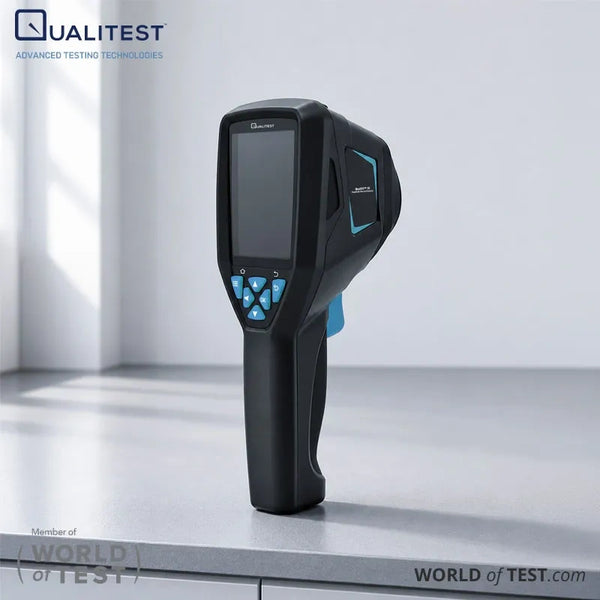
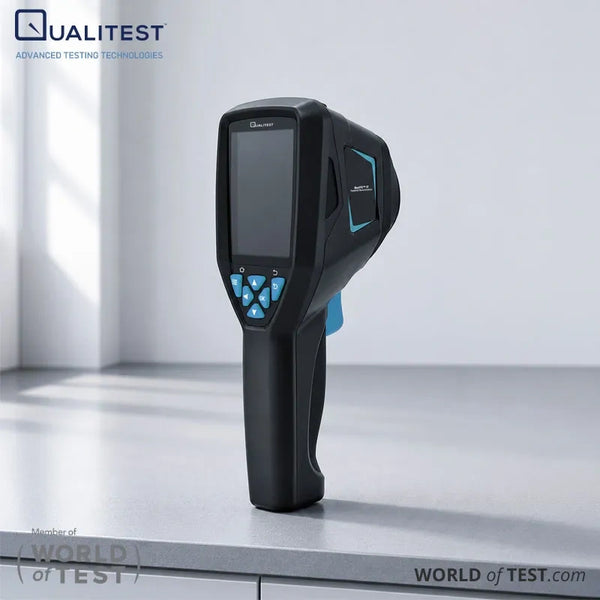
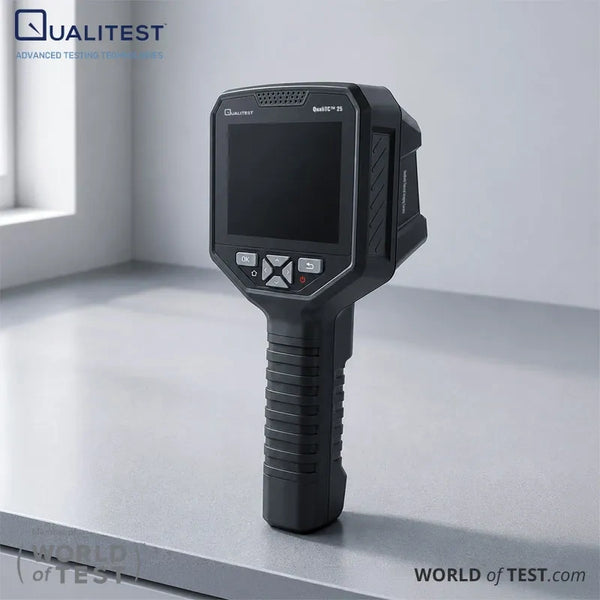
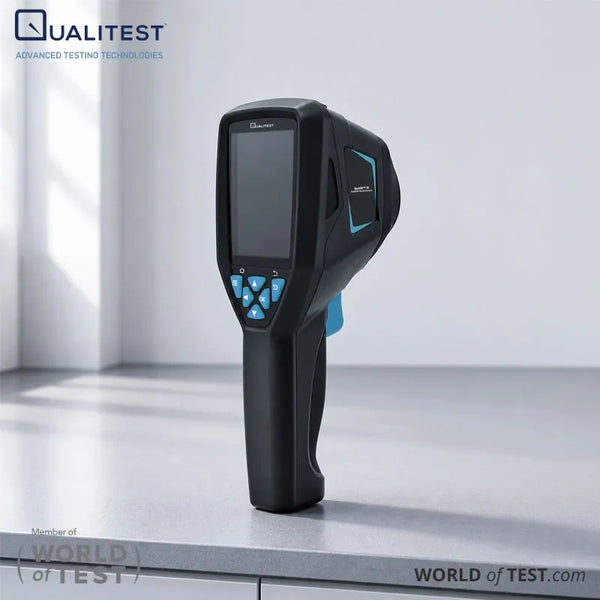
For everyday facility diagnostics, deploying a dedicated, cost-effective high temp infrared camera handheld prevents overspending on unnecessary temperature thresholds. The table below outlines our complete QualiTC commercial lineup:
| Model | Resolution | Temperature Range | Ideal Application |
|---|---|---|---|
| QualiTC 10 | 120×90 | -20°C to 550°C (-4°F to 1022°F) | Basic electrical and mechanical spot checks |
| QualiTC 15 | 120×90 | -20°C to 550°C (-4°F to 1022°F) | Quick panel scans with visual outline fusion |
| QualiTC 17 | 256×192 | -20°C to 550°C (-4°F to 1022°F) | Elevated components requiring distance correction |
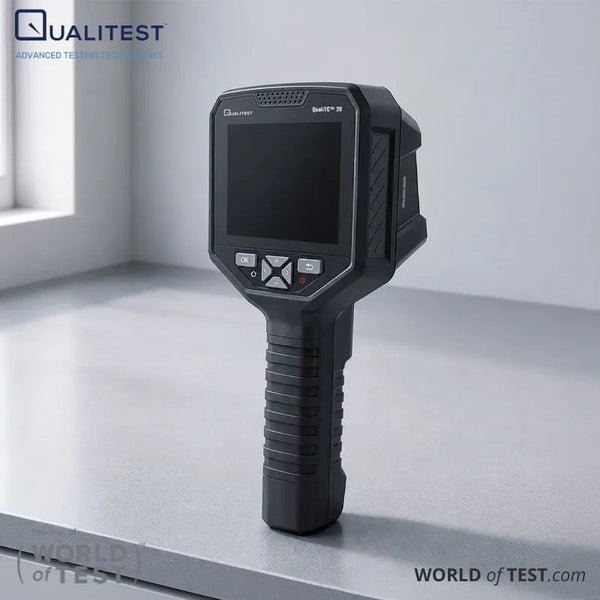
| QualiTC 20 | 256×192 | -20°C to 550°C (-4°F to 1022°F) | Crowded electrical cabinets, featuring the largest 3.5-inch display in the lineup |
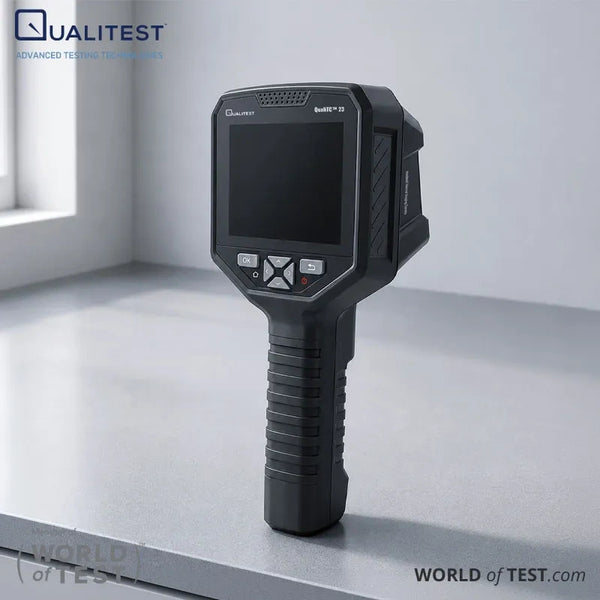
| QualiTC 23 | 220×160 | -20°C to 450°C (-4°F to 842°F) | Wireless data offloading and quick report logs |
| QualiTC 25 | 320×240 | -20°C to 450°C (-4°F to 842°F) | Grimy plant areas requiring IP54 protection |
| QualiTC 38 | 384×288 | -20°C to 1200°C (-4°F to 2192°F) | Long-range utility sweeps and hot process piping |
| QualiTC 64 | 640×480 | -20°C to 1200°C (-4°F to 2192°F) | Advanced furnace skin audits and heavy facilities |
Baseline Spot-Check Tier (-20°C to 550°C)
- QualiTC 10: A compact baseline unit with 120×90 resolution, 8GB storage, a guide laser, and full-screen hotspot tracking. It is built for quick checks on electrical breakers, HVAC ducting, and rotating mechanical bearings.
- QualiTC 15: Combines a 120×90 infrared detector with a 720P visual camera, offering outline fusion, overlay fusion, picture-in-picture, and an automatic high-temperature alert to troubleshoot plumbing and electrical connections.
- QualiTC 17: Increases resolution to 256×192 with visual blending, a 25Hz refresh rate, and distance compensation extending to 5 meters (~16.4 ft). Built in a compact 310-gram (~0.68 lb) housing, it is suited for inspecting elevated cable runs and drive motors.
- QualiTC 20: Features a 256×192 detector paired with an expansive 3.5-inch display, 5-meter distance compensation, and a 56° × 42° thermal field of view backed by an 83° × 55° visible-light camera, providing clear on-screen identification of components during routine walk-through inspections.
Connected Mid-Range Tier (-20°C to 450°C)
- QualiTC 23: Features a 220×160 sensor, wireless image offloading over WiFi, and uncompressed TIFF export for clean documentation of switchgear panels and radiant heating circuits.
- QualiTC 25: Delivers a 320×240 detector, a 640×480 visible camera, an IP54-rated housing, full-pixel temperature analysis software, and a 4800 mAh battery providing approximately four hours of continuous inspection time.
Regional Facility Applications
These baseline and mid-tier models support regular facility diagnostics across diverse US climate conditions. In the American Southwest (including Arizona, Nevada, and Texas), industrial and commercial sites face extended summer heatwaves.
Technicians use handheld thermal cameras to inspect rooftop package air conditioning units, chiller loops, and heavily loaded compressor heads under peak operational strain.
Conversely, during severe winter conditions across the Northeast and Upper Midwest, facility engineers apply thermal imagers to building envelopes, insulation boundaries, and steam lines, identifying insulation gaps, structural air leaks, and failed steam traps to control facility operating costs.
US Safety Codes and Quality Standards
Electrical Compliance and Arc Flash Safety (NFPA 70B and 70E)
In US industrial facilities, infrared thermography is central to meeting electrical safety and maintenance mandates. NFPA 70B, the national standard for electrical equipment maintenance, requires scheduled infrared thermography across electrical distribution gear.
Under NFPA 70B Table 9.2.2, baseline inspection intervals are set at 12 months for equipment rated in Condition 1 and Condition 2, but tighten to 6 months for equipment placed in Condition 3.
Furthermore, Chapter 7 mandates that inspectors record temperature differences (Delta T) between the target component and a reference phase under similar electrical loading, rather than relying on isolated absolute readings. Simultaneously, non-contact thermal imaging supports compliance with NFPA 70E safety rules by allowing technicians to inspect energized gear while remaining safely outside calculated hazard perimeters.
For example, during scheduled switchgear inspections in industrial facilities or data centers, electricians must adhere to NFPA 70E by establishing calculated approach boundaries before opening enclosures.
Utilizing instruments with verified distance compensation, such as the 5-meter optical parameter on the QualiTC 17 and 20, or the integrated 40-meter laser rangefinder available on both the QualiTC 38 and QualiTC 64, allows thermographers to position themselves at the maximum practical stand-off distance while applying mathematically valid atmospheric corrections.
While proper stand-off distance supports overall safety, non-contact thermal imaging does not eliminate the requirement for calculated boundary analysis or appropriate personal protective equipment.
NDT Standards and Calibration Integrity (ASTM and Metrology)
Our hardware supports standardized non-destructive testing procedures, including ASTM E1934 for electrical and mechanical plant surveys, along with ASTM C1060 for assessing building envelopes.
Maintaining calibration accuracy over time is critical for generating audit-ready records. In academic measurement literature, solid structural temperature stabilization and thermal drift correction reduce measurement errors from +/-5°C to +/-0.3°C.
Qualitest North America backs our commercial hardware with dedicated technical service and calibration support to ensure your instruments maintain specified tolerances throughout their operational service life.
Software Workflow and Reporting
Capturing an infrared image is only the initial step in predictive maintenance; translating raw thermal data into clear, defensible compliance reports completes the inspection cycle. While academic research investigates advanced mathematical approaches such as multispectral radiance fitting or neural-network quantum efficiency estimations to determine true surface temperatures, commercial plant operations require dependable, accessible software tools.
In our view, true commercial value requires turnkey reporting out of the box without requiring separate software purchases for standard diagnostic work. Every camera in our QualiTC family ships standard with dedicated PC analysis software, letting inspectors review radiometric thermal images offline, adjust emissivity parameters, apply distance and reflected ambient temperature corrections, and compile formal inspection reports.
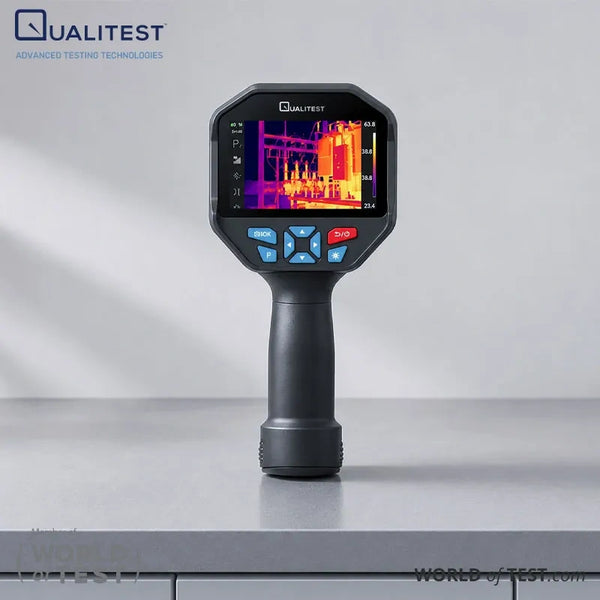
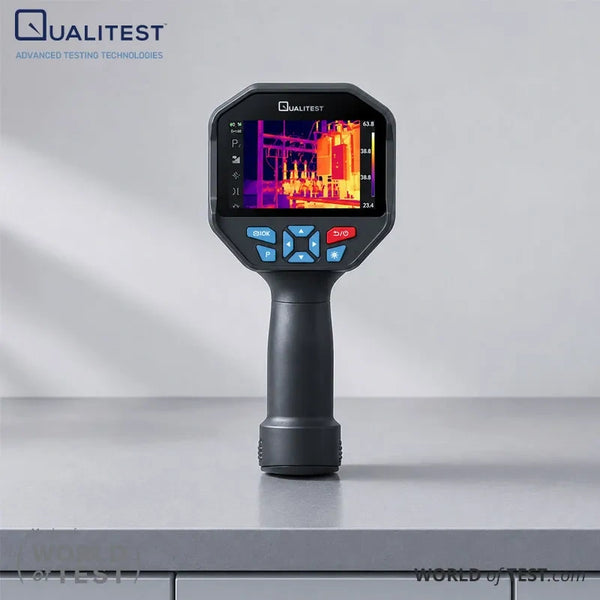
Technicians can also choose from eight selectable color palettes (Iron Red, White Hot, Black Hot, Rainbow, Red Hot, High Contrast, Green Hot, and Lava) and utilize multi-language interfaces to optimize visual contrast for their specific operating environment.
Select Your Qualitest High-Heat Thermal Camera
Selecting the right thermal inspection camera requires balancing temperature thresholds, image resolution, strict safety standards, and equipment budgets. From routine NFPA 70B electrical checks to high-heat 1200°C (2192°F) furnace monitoring, we offer cost-effective products built to perform reliably in challenging industrial facilities.
Contact the Qualitest team today to request a quote, review technical specifications, or discuss lead times and calibration support with our equipment specialists.
References (Click to expand)
- Bykov, A. A., Zolotukhina, A., Poliakov, M., Belykh, A., Asyutin, R., Korneeva, A., Batshev, V., & Khokhlov, D. (2025). Four-Wavelength Thermal Imaging for High-Energy-Density Industrial Processes. Journal of Imaging, 11.
- Sala, V., Vandone, A., Banfi, M., Mazzucato, F., Baraldo, S., & Valente, A. (2025). A Camera Calibration Method for Temperature Measurements of Incandescent Objects Based on Quantum Efficiency Estimation. Sensors (Basel, Switzerland), 25.
- Schiewe, C. (2016). Monitoring High Temperatures in Industrial Applications. 38-40.
- Usamentiaga, R., Venegas, P., Guerediaga, J., Vega, L., Molleda, J., & Bulnes, F. (2014). Infrared Thermography for Temperature Measurement and Non-Destructive Testing. Sensors (Basel, Switzerland), 14, 12305 - 12348.
- Zheng, F., Sun, G., Suo, Y.-P., H., & Feng, T. (2024). Research on Through-Flame Imaging Using Mid-Wave Infrared Camera Based on Flame Filter. Sensors (Basel, Switzerland), 24.