What if your quality team could verify resin formulation with complete certainty before a production lot leaves the plant?
At Qualitest, we believe dependable material longevity begins with precise thermal testing. The pyrolysis of polymers cleanly isolates critical carbon black and mineral fillers from the base resin. Adopting an accurate polymer pyrolysis method protects your brand, guarantees standard compliance, and slashes testing expenses.
Here is your practical guide to pyrolysis testing polymers and selecting the right equipment.
Key Takeaways
- Thermal Degradation Principle: The polymer pyrolysis method cleanly isolates carbon black and mineral fillers by vaporizing base resin chains inside an oxygen-free nitrogen atmosphere without combustion.
- Essential Material Protection: Verifying a 2.0% to 3.0% carbon black concentration prevents surface micro-cracking and premature brittle failure in outdoor polyethylene pipes, geomembranes, and utility cable jackets.
- Standard Alignment: The QualiCBCT™-200 is built in direct accordance with IEC 60811-4-1:2004 while meeting the physical furnace requirements of standard American test methods like ASTM D1603.
- In-House Economic Advantage: Transitioning from outside commercial laboratories to an internal tube furnace avoids multi-day production lag and recurring sample fees, allowing same-shift lot release.
- High-Efficiency Testing: Modern analyzers maximize laboratory throughput using 4-sample guide-rail carriers, active cooling in 20 minutes or less, automated two-way gas switching, and one-click touchscreen calculations.
Fundamentals of Polymer Pyrolysis
Strip away the textbook phrasing, and polymer pyrolysis is straightforward: you place a resin sample into a clean, oxygen-free nitrogen bath and apply high heat so thermal cracking happens without combustion.
Standard open-air burning incinerates everything into carbon dioxide and water vapor. During the pyrolysis of polymers, the total absence of oxygen stops ignition in its tracks. Instead, thermal energy causes random chain scission along the hydrocarbon backbone, turning the base resin into volatile fragments that sweep out through an exhaust path.
In peer-reviewed thermal kinetics, degradation stability generally follows the progression of polystyrene below polypropylene and polyethylene, dictated fundamentally by the bond dissociation energies required to snap the polymer chains.
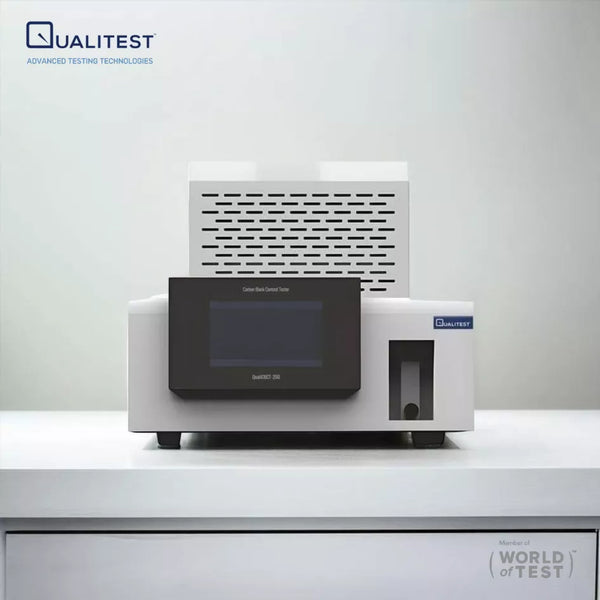
To accommodate this thermal spectrum across diverse polymer groups, testing systems like our QualiCBCT™-200 Carbon Black Content Test Apparatus provide an adjustable thermal range reaching from room temperature up to 1150°C. That high thermal ceiling gives technicians the heat needed to crack open polyolefin resins as well as cross-linked rubber compounds without missing a beat.
Once the base polymer volatilizes, only non-volatile components remain behind in the combustion boat. This residual mass consists of pure elemental carbon black, which provides vital stabilization against ultraviolet radiation and high electrical stress, along with any inorganic fillers such as calcium carbonate, silica, talc, and mineral ash.
Isolating pure soot from volatile resin remains the cleanest, most trustworthy way to verify compounding accuracy: weigh the sample upfront, cook off the resin, and burn off the remaining carbon to expose any hidden mineral fillers. Clean, direct, and audit-ready.
Core US Industrial Applications
Across American manufacturing, we believe pyrolysis testing polymers has become essential as raw material consistency fluctuates and customer quality audits tighten:
1. HDPE Municipal and Gas Piping
Consider municipal water distribution pipes, natural gas mains, and conduit lines installed across the American Southwest. In states like Arizona, Nevada, and Texas, uninstalled pipe bundles frequently sit in outdoor staging yards and along desert trench paths for months under intense solar radiation before burial.
Without a verified 2.0% to 3.0% carbon black concentration, that extreme UV exposure initiates surface micro-cracking and brittleness before the pipe even enters service. In general industry practice, there is zero room for error here: falling below two percent invites photo-oxidation, while pushing past three percent threatens weld integrity during field butt-fusion jointing.
2. Utility Cable and Telecom Jacketing
Major electrical grid hardening initiatives across the country place immense demands on cable sheathing. In wildfire-prone Western regions like California, utilities increasingly mandate underground trenching for distribution lines, while coastal installations along the Gulf Coast fight persistent humidity, brackish water intrusion, and soil contaminants.
Cable compounders rely on the polymer pyrolysis method daily to confirm that protective outer jacketing and semiconductive buffer layers meet strict utility build specifications and international standards like IEC 60811-4-1, preventing insulation tracking and line outages.
3. Geomembranes and Environmental Barriers
Massive environmental containment liners used in municipal solid waste facilities, chemical retention ponds, and mining heap leach pads across Nevada and Appalachia are expected to endure decades of outdoor exposure. While federal Resource Conservation and Recovery Act (RCRA) Subtitle D regulations mandate composite liner systems and Construction Quality Assurance (CQA) plans, the exact numerical material thresholds come from industry specifications like GRI-GM13.
This standard requires a verified carbon black content of 2.0% to 3.0% tested via ASTM D1603 or ASTM D4218, alongside dispersion verification via ASTM D5596. Thermal pyrolysis provides the certified mass loss data required to fulfill these CQA submittals and secure operating permits.
4. Automotive and Industrial Elastomers
Across automotive assembly corridors in the Midwest and Southeast, carbon black provides the structural reinforcement behind heavy-duty truck tires, engine mountings, and high-pressure hydraulic fluid seals.
Running controlled polymer pyrolysis inside a furnace capable of testing raw elastomers and finished vulcanized parts isolates the rubber hydrocarbon matrix from reinforcing fillers, giving quality technicians a clear read on batch consistency.
Key Industry Standards & Compliance
In commercial testing, specific regulatory benchmarks dictate testing parameters depending on whether your facility manufactures utility cables or infrastructure piping.
Our QualiCBCT™-200 is engineered specifically in accordance with IEC 60811-4-1 (whose carbon black and filler clauses are now maintained under the current IEC 60811-605:2012 standard), representing the international baseline for cable materials. Across broader manufacturing, laboratories also encounter domestic and international pipe standards that utilize the same underlying tube furnace pyrolysis method:
| Standard / Mandating Body | Scope and Regulatory Context |
|---|---|
| EC 60811-4-1 / IEC 60811-605 | The international cable standards governing the physical testing requirements and design parameters of the QualiCBCT™-200. |
| ASTM D1603 | The standard US industry test method for carbon black in olefin plastics using equivalent horizontal tube furnace pyrolysis under nitrogen. |
| ISO 6964 | The international pipe standard for polyolefin pipes and fittings, determining carbon black by nitrogen pyrolysis at 550°C and calcination at 900°C. |
| Plastics Pipe Institute (PPI) TR-4 | General industry policies requiring verified carbon dispersion to establish long-term hydrostatic design baselines. |
| AWWA C906 / ASTM D3350 | US water pipe specifications requiring 2.0% to 3.0% carbon black stabilization to ensure fifty-year pipeline service life. |
| AASHTO M252 / M294 | State Department of Transportation (DOT) specifications mandating certified carbon black levels in corrugated drainage pipe. |
| ASTM F699 | A rapid muffle-furnace test method, accepted under GRI-GM13 for geomembrane carbon black content alongside tube furnace methods. |
Step-by-Step Test Procedure
While independent academic research facilities sometimes modify tube furnaces with online mass spectrometers or micro-gas chromatography for fuel synthesis experiments, industrial manufacturing plants depend on standard gravimetric tube furnace pyrolysis for everyday lot clearance.
Here is how a clean test run should happen in your facility:
Step 1: Specimen Preparation and Baseline Tare
Clip a clean, representative sample of your material (typically 1.0 to 2.0 grams) and weigh it inside a porcelain or quartz combustion boat using an external analytical balance accurate to four decimal places (0.1 mg). Record this initial tare and sample mass.
Step 2: Inert Atmosphere Purging
Slide your combustion boat into the quartz tube furnace. In the QualiCBCT™-200, this heating core uses a spacious quartz tube measuring 45 mm in diameter by 300 mm in length, giving you ample room to stage samples cleanly. Before applying heat, sweep the chamber with high-purity nitrogen gas.
Rather than forcing technicians to wrestle with manual valves, modern apparatuses utilize automated two-way gas circuit switching to handle nitrogen and oxygen paths through programmed controls. We consider this purge step vital; if any atmospheric oxygen lingers inside, it will burn off your carbon black prematurely and skew your calculations downward.
Step 3: Controlled Thermal Degradation
Ramp the furnace up to a steady 500°C to 600°C (932°F to 1112°F). With the QualiCBCT™ series, a 250 mm heating zone with high-temperature alloy wire elements and 0.1°C sensor sensitivity provides tight axial temperature uniformity across the sample area.
In this thermal range, independent research demonstrates that polyolefins like polyethylene and polypropylene crack primarily into waxy aliphatic hydrocarbons and volatile vapors. These vapors sweep out through the filtration trap while carbon black particles and inorganic mineral fillers remain completely stable inside the boat. Hold the temperature for 30 to 45 minutes until the base resin has completely volatilized.
Step 4: Cooldown Under Nitrogen Flow
Allow the furnace to cool down while keeping the nitrogen sweep active. In standard setups, waiting for a furnace to cool can stall a laboratory for hours. With active forced cooling systems, instruments like the QualiCBCT™-200 drop the furnace from 900°C down to room temperature in 20 minutes or less.
We view maintaining an uninterrupted nitrogen blanket during cooling as just as vital as during heating; hot carbon black will react with ambient air instantly if the chamber is opened prematurely. Using a customized guide-rail sample holder also prevents awkward handling when sliding boats out for desiccation. Once cooled, weigh the boat on your external analytical balance to determine the mass after pyrolysis.
Step 5: Secondary Combustion for Ash Content
To separate carbon black from non-combustible mineral fillers, return the boat to the heating zone, switch the gas path from nitrogen to purified air or oxygen, and burn off the remaining carbon. The target temperature depends on your governing specification: ASTM D1603 completes this oxidation stage at roughly 550°C to 600°C, while ISO 6964 prescribes calcination at 900°C for unfilled polyolefin pipe grades.
If your material contains calcium carbonate, keep the oxidation temperature near 600°C, matching general plastic ashing guidelines like ISO 3451-1 Method A. Above approximately 800°C, calcium carbonate decomposes into solid calcium oxide and releases carbon dioxide gas, shedding roughly 44% of its mass.
This breakdown artificially deflates your measured ash weight and falsely inflates your calculated carbon black percentage. Because the QualiCBCT™-200 operates from room temperature up to 1150°C with multi-segment programming, technicians can configure the unit for either 600°C oxidation or 900°C calcination depending on the compound being verified.
Step 6: Gravimetric Calculations
Cool the sample boat in a desiccator, take your final weight on the external analytical balance, and calculate:
Carbon Black Content (%) = [(Weight after pyrolysis - Weight after combustion) / Initial sample weight] * 100
Ash Content (%) = (Weight after combustion / Initial sample weight) * 100
Rather than making technicians calculate these ratios on paper, the QualiCBCT™-200 lets operators enter the recorded external balance weights directly into its 7-inch capacitive touchscreen, executing a one-click calculation and printing out a physical verification slip on the onboard printer.
Troubleshooting Common Laboratory Errors
Even disciplined lab teams occasionally encounter unexpected results during the pyrolysis of polymers. In our view, identifying these operational variables early prevents endless recalibrations:
1. Falsely Low Carbon Black Readings (Oxygen Ingress)
If your readings come back noticeably lower than your blend formulation, trace oxygen is almost certainly leaking in.
A worn seal, loose fitting, or rushed nitrogen purge permits oxygen to burn off carbon black during the initial heating step. Relying on an automated two-way gas system eliminates technician forgetfulness during pre-run purges.
2. Incomplete Pyrolysis and Gummy Residue
If your post-pyrolysis residue appears sticky or tarry rather than dry and carbonaceous, the center of your furnace may have thermal cold spots or the nitrogen soak time was cut short. Degradation kinetics show that high-density polyethylenes require sustained thermal exposure to achieve complete mass loss.
We recommend verifying the thermal profile across your heating zone and extending the cycle slightly for high-molecular-weight resins.
3. Exhaust Restrictions from Condensing Vapors
Volatilized polyolefin fragments condense quickly once they leave the hot zone, producing heavy waxy deposits. Without an inline condensation trap, these waxy residues will plug valves and distort chamber pressures.
Equipping your setup with an integrated exhaust gas filtration device, standard on the QualiCBCT™-200, traps sticky vapors before they gum up your lines, keeping routine maintenance quick and painless.
4. Scale Instability from Thermal Drafts
Setting a warm combustion boat onto a high-precision balance creates subtle air convection currents that cause numerical drift. In our opinion, cutting corners on desiccator cooling time is one of the quickest ways to ruin an otherwise sound analytical test run.
Technology Comparison: Tube Furnace vs. TGA vs. Muffle Furnace
When selecting testing hardware, quality managers usually weigh three equipment categories alongside specialized kinetic research platforms. We often find that companies either overspend on overly complex research tools or buy basic furnaces that fail to pass customer quality audits.
| Evaluation Metric | Dedicated Tube Furnace (QualiCBCT™-200) | Thermogravimetric Analysis (TGA) | Rapid Muffle Furnace | Specialized Kinetic Platforms |
|---|---|---|---|---|
| Primary Standard | IEC 60811-4-1:2004, compatible with ASTM D1603 | ASTM E1131 | ASTM D4218 | ISO 19700 |
| Capital Investment | Accessible direct manufacturer pricing upon inquiry | High-tier capital investment exceeding six figures | Moderate initial purchase price | Prohibitive multi-component custom setups |
| Sample Throughput | High (Processes 4 samples simultaneously) | Low (Single micro-sample per run) | Moderate (One or two samples) | Low (Serial single-sample runs) |
| Sample Size | 1.0 g to 2.0 g (catches bulk batch variations) | 10 mg to 50 mg (susceptible to local variations) | 1.0 g | Variable gram-scale specimens |
| Chamber Atmosphere | Automated dual-gas (Nitrogen to Air) | Highly precise micro-purging | Ambient air or basic nitrogen flow | Nitrogen, Argon, or CO2 |
| Operational Ease | Touchscreen one-click math; ideal for plant technicians | Requires an analytical specialist | Very simple floor operation | Requires specialized research personnel |
| Best Application Fit | Routine lot verification, pipe and cable plants | Fundamental polymer kinetics | Rough screening on clean base resins | Flame research and combustion modeling |
In our view, committing six figures to an analytical research system just to verify routine production runs is an unnecessary allocation of capital. A dedicated horizontal tube furnace remains the genuine workhorse for high-volume manufacturing: it executes the polymer pyrolysis method with complete standard compliance and without requiring an analytical chemist on staff.
Economic Analysis: In-House Testing vs. Outsourcing
In general manufacturing operations, sending routine pyrolysis testing polymers work to commercial third-party labs introduces ongoing friction that impacts project margins:
- Ongoing Testing Fees: Commercial testing laboratories charge routine fees for every individual carbon black and ash determination. For an active manufacturing plant processing multiple incoming railcars of resin and running daily extrusion line checks, monthly outsourced testing invoices accumulate into a major annual operating expense.
- Costly Production Lag: Outside testing facilities typically require several business days to complete analyses and return formal inspection certificates. If an extruder masterbatch feeder drifts out of calibration on a Monday, a plant could extrude extensive footage of non-compliant pipe or conduit before the external laboratory report arrives, creating high scrap volumes or quarantined inventory.
- Operational Payback: Establishing internal testing with a dedicated tube furnace delivers swift financial returns by eliminating per-sample outsourcing invoices and avoiding production bottlenecks. While the primary pyrolysis stage completes in roughly 45 minutes, active forced cooling allows quality teams to complete full multi-sample verification on the very same operating shift rather than waiting days for outside lab certificates.
Equipment Selection Criteria for Quality Labs
If your company is evaluating hardware for pyrolysis testing polymers, we recommend looking beyond general sales sheets and focusing on these operational areas:
Throughput and Active Cooling Performance
Single-boat furnaces create an unnecessary bottleneck on active production lines. Look for an internal quartz tube diameter, such as the 45 mm bore on the QualiCBCT™-200, that accommodates a customized guide-rail carrier holding 4 samples simultaneously.
Furthermore, conventional high-temperature tube furnaces can take up to three hours to cool down between test runs. An integrated forced-cooling system that drops the tube from 900°C to handling temperature in 20 minutes flat multiplies your daily testing capacity.
Atmosphere Automation and Thermal Precision
Relying on manual shut-off valves to swap nitrogen for oxygen creates room for technician error. Select an apparatus equipped with automated two-way gas circuit switching that handles line changeovers through programmed cycle setpoints.
Thermal accuracy is equally critical: confirm that the heating core provides tight temperature uniformity across the central heating zone, backed by 0.1°C sensor sensitivity, so every specimen receives identical exposure.
Digital Processing and Electrical Setup
Your technicians should not have to run manual math calculations on scratch paper. Built-in software with one-click calculation and direct report printing through a 7-inch capacitive touchscreen prevents basic clerical errors and speeds up release logs.
In terms of facility integration, check your laboratory electrical setup: the QualiCBCT™-200 operates standard with an AC 220V (50Hz/60Hz) electrical line, and a 110V configuration is also available for North American facilities.
Cost-Effective Pyrolysis Testing with Qualitest
At Qualitest, we supply cost-effective testing instruments that help North American manufacturers meet international and industrial standards without overspending.
Our flagship QualiCBCT™-200 Carbon Black Content Tester is purpose-built for efficient tube furnace pyrolysis testing polymers:
- Broad Thermal Range: Operates from room temperature up to 1150°C with multi-segment temperature programming.
- Automated Gas Routing: Two-way automated program switching between nitrogen and oxygen.
- High Lab Output: Processes 4 samples simultaneously with active cooling from 900°C to room temperature in 20 minutes or less.
- Clean and Compliant: Features an integrated exhaust filtration device, one-click touchscreen calculations, and full alignment with IEC 60811-4-1:2004 while satisfying the physical requirements of ASTM D1603.
Whether you are bringing quality control in-house to eliminate recurring lab fees or replacing an aging unit, our engineering team is ready to assist.
Explore our cost-effective thermal testing solutions: Learn more about the Carbon Black Content Tester (QualiCBCT™-200) or contact our team today for a tailored quote.
References (Click to expand)
- De Lannoye, K., Belt, A., Reinecke, E.-A., & Arnold, L. (2024). The Tube Furnace with Online Mass Loss Measurement as a New Bench Scale Test for Pyrolysis. Fire Technology, 60, 3689-3707.
- Meng, X., Yu, H., Lu, Z., & Jin, T. (2024). Catalytic Pyrolysis of Polypropylene for Cable Semiconductive Buffer Layers. Polymers, 16(10), 1435.
- Natesakhawat, S., Weidman, J., Garcia, S., Means, N., & Wang, P. (2024). Pyrolysis of high-density polyethylene: Degradation behaviors, kinetics, and product characteristics. Journal of the Energy Institute, 114, 101738.
- Park, K.-B., & Kim, J.-S. (2023). Pyrolysis products from various types of plastics using TG-FTIR at different reaction temperatures. Journal of Analytical and Applied Pyrolysis, 170, 105983.
- Park, S. S., Seo, D., Lee, S. H., Yu, T., & Hwang, J. (2012). Study on pyrolysis characteristics of refuse plastic fuel using lab-scale tube furnace and thermogravimetric analysis reactor. Journal of Analytical and Applied Pyrolysis, 97, 29-38.