We’re going to call it: nailing your test speeds is the absolute best way to prove your materials are world-class.
While many focus only on the stretch, we believe the real win comes from getting the strain rate exactly right. It’s that high-stakes tempo that turns a standard lab setup into something that is sheer perfection.
Key Takeaways
- Speed Changes Everything: The pace of deformation dictates how a material behaves. Testing at the correct tempo is just as critical as measuring the stretch itself.
- Materials Are Sensitive: Fast impacts can make materials stiffer but more brittle. Getting your test speeds right prevents unexpected product failures in the field.
- Control is Crucial: Upgrading from basic position control to advanced strain control is the absolute gold standard for getting a spot-on strain rate calculation.
- Rules Matter: Sticking to precise ASTM standards keeps your certifications solid as a rock and guarantees your numbers hold up against the competition.
Defining Strain Rate
In the simplest terms possible, strain rate is just the change in how much something has warped compared to how many seconds have ticked by. In technical circles, this refers to the pace at which a material is deformed, typically measured as the change in strain per unit of time in inverse seconds (s⁻¹).
Think about a glob of dough: if you pull it apart like you've got all day, it stretches into a long string. But if you give it a sudden, violent snap, it breaks into pieces faster than you can blink.
We see this exact same vibe with industrial-grade metals and fancy composites, where the rate significantly influences the final tensile properties.
Strain Rate Sensitivity in Industrial Materials
Why does the tempo of the pull matter so much? It all boils down to a quirky trait called strain rate sensitivity.
Loads of materials, especially those bendy polymers and certain types of shiny metals, act like completely different animals depending on how fast you hit them. When things happen at a higher pace, we usually see that materials get way stiffer and harder to break, but they also get much more brittle.
Think about a polycarbonate safety helmet. If something slowly presses on it, the plastic bends and squishes. But if a heavy piece of steel drops on it from a high beam, that sudden, high-speed impact causes the material to behave differently: it stiffens up to deflect the blow, but if it hits its limit, it shatters instead of just bending.
We’ve noticed that if you run your test too slow, you might trick yourself into thinking a part is way more flexible than it actually is when it hits a bump in the road. Grasping this sensitivity ensures your gear won't fail when people are actually using it.
The Strain Rate Formula
To put a hard number on this behavior, the pros in the lab look at one specific bit of math. The standard strain rate formula is written as the change in warping divided by the change in time:
Strain Rate (έ) = dε / dt
To break it down:
- έ (Epsilon dot): This is the strain rate (s⁻¹).
- dε: The total amount of warping that happened (change in strain).
- dt: How much time skipped past (change in time).
If you’re just looking at how fast the top part of your machine is moving (v) and the starting length of your sample (L₀), you can also use this version of the strain rate formula: έ = v / L₀.
It’s a straightforward way to calculate the rate by dividing the change in strain by the corresponding time interval during the test.
How to Calculate Strain Rate in Tensile Test Scenarios
For the folks running the floor, the math is just the beginning. You’re probably wondering how to calculate strain rate in tensile test setups when you’re actually standing in front of the machine.
Doing a manual strain rate calculation means you need to know exactly how fast your equipment is yanking things apart and then divide that by the starting length of the part you're testing.
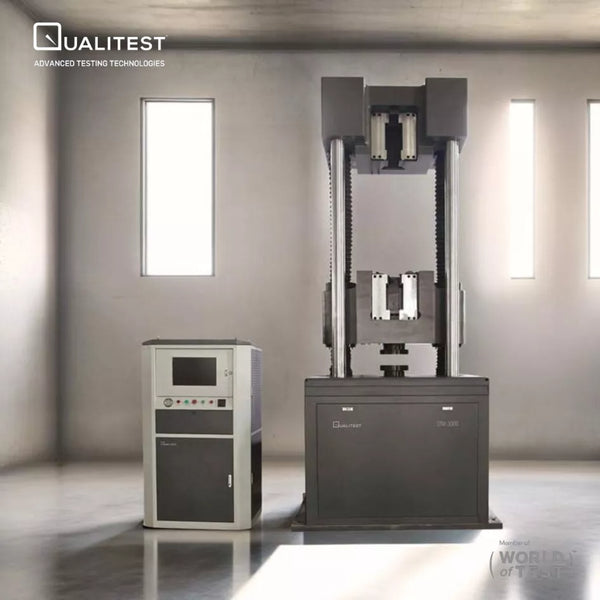
Let’s look at two totally different lab scenarios. Say a facility is testing a chunk of stiff automotive steel. They might run a massive unit like our 3000 kN Universal Testing Machine - QTM-3000 at a crawl, like 1 mm per minute on a 50 mm sample, giving a basic speed of 0.02 per minute.
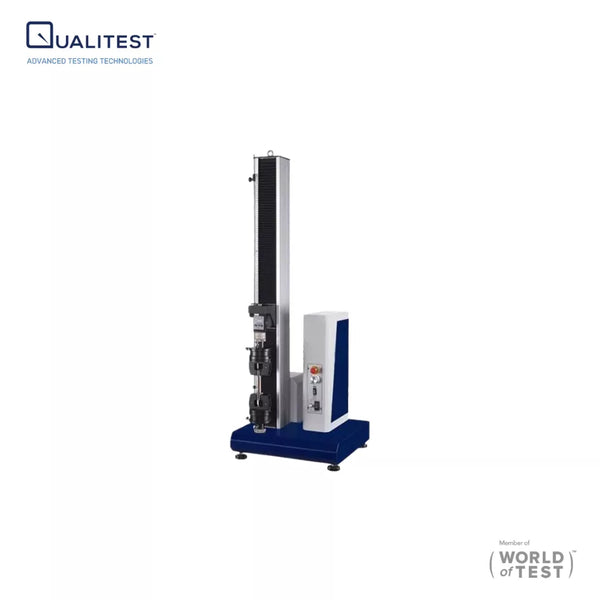
On the flip side, testing a highly elastic silicone rubber bumper might require a highly responsive setup like our Single Column Universal Testing Machine Series - QM-5 to sprint at 500 mm per minute on that same 50 mm sample. The math is exactly the same, but the physical reality on the floor is night and day.
Related article: Comparing Single Column vs Dual Column UTM
Strain Control vs. Position Control Methodologies
In a serious, high-speed lab, you shouldn't be doing this math on a napkin. Plus, we’re firm believers that the way your machine handles that speed is the most important choice you'll make:
- Position Control: This is when the machine moves its arm at a steady, fixed speed. It’s easy to set up, but in our eyes, it doesn't account for the tiny bit of "give" or flex in the machine itself.
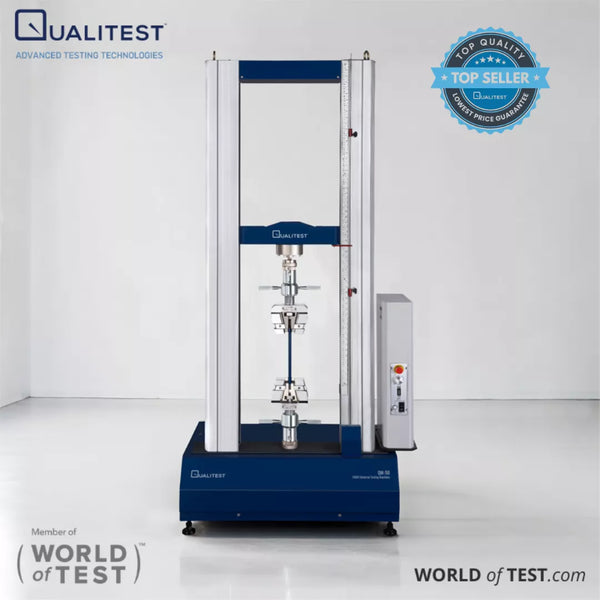
- Strain Control: This is the high-performance path for testing. You clip a tiny sensor called an extensometer right onto the sample. Your software, like the systems driving our 50kN Universal Testing Machine - QM-50 Series, then does the strain rate calculation every millisecond. Recent research even points to advanced methods like optical strain rate control with digital image correlation (DIC) to really nail that precision. We think this is the absolute gold standard because the machine reacts instantly to keep the strain rate perfectly steady right on the material itself.
ASTM Tensile Test Strain Rate Compliance
Since materials can be so moody depending on the speed, following the rules is a huge deal. You can't compare your results to the competition if you were playing by different rules.
That’s why we’re loud and clear about this: following the official astm tensile test strain rate isn't just a suggestion; it's a requirement for anyone who wants to be taken seriously.
Take ASTM E8/E8M-16a for example: it’s the standard for testing metals and recommends specific rates for static tests, often around 10⁻³ to 10⁻¹ s⁻¹ for steels. Catching the exact yield point using this standard usually demands a strict, slow crawl so the sensors don't miss the subtle shift in the metal.
It’s not just for steel, either. You’ve got ASTM D638 for plastics and ASTM D412 for rubbery stuff. Contrast that slow metal test with ASTM D638, which actually allows for much faster pulling speeds because flexible plastics stretch incredibly far before they finally snap.
Staying on top of the correct astm tensile test strain rate keeps you out of trouble and makes sure your certifications are solid as a rock.
High Strain Rate Tensile Testing and Impact Analysis
Standard testing is great for slow and steady stuff, but what happens when a car slams into a wall? That’s where high strain rate tensile testing comes into play.
This isn't your everyday pull-test. high strain rate tensile testing looks at things moving at crazy speeds, sometimes thousands of times faster than normal. Take the aerospace industry: engineers have to know how titanium alloys in jet engine fan blades will react if they suck in an object at 500 miles per hour.
Standard testing simply won't cut it. They rely on intense setups, like the split Hopkinson tension bar, to explore rates from 10 to over 1000 s⁻¹.
Studies show that materials like aluminum alloys and steels exhibit much higher strength and different elongation behavior at these breakneck speeds. We’ve even seen novel high-speed techniques using magnetic pulse driving for incredibly rapid testing of aluminum.
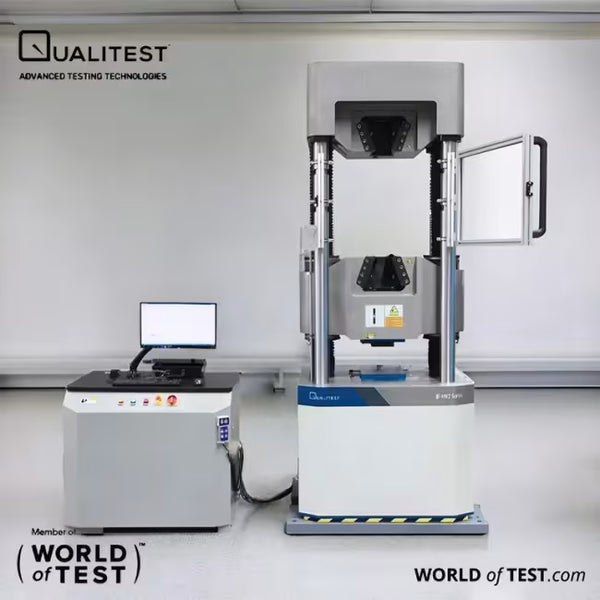
We think these setups are the ultimate way to see if your testing protocol is actually working, using heavy-duty gear like our Servo Hydraulic Universal Testing Machine - QT-HW2 to capture that kinetic shockwave.
Related article: Electromechanical vs Hydraulic UTM: Choosing Your System
Trust Qualitest for Reliable, Cost-Effective UTM Systems
At the end of the day, getting data you can actually trust is what keeps your projects moving. Here at Qualitest, we believe that hitting those precision targets shouldn't be a headache.
We offer a full range of cost-effective gear built for the heavy industrial grind. Whether you're doing quick checks or deep research, our setups help you lock down the correct astm tensile test strain rate without blowing your budget.
We’re going to call it: top-tier gear shouldn't cost as much as a private island. Take a look at our cost-effective Universal Testing Machines today. Let’s get your testing looking like sheer perfection.
References ⏷
- Baciu, F., Rusu-Casandra, A., & Pastrama, S. (2020). Low strain rate testing of tensile properties of steel. Materials Today: Proceedings.
- Chen, L., Shi, H., Li, W., et al. (2024). Design of a novel high-speed tensile method for testing the high strain rate tensile behavior of aluminum alloys. The Review of Scientific Instruments, 95(12).
- Gao, X., Zhou, L., Ren, X., & Li, J. (2020). Rate effect on the stress–strain behavior of concrete under uniaxial tensile stress. Structural Concrete, 22, E815 - E830.
- Jie, T., Manchao, H., Qiao, Y., Xia, M., & Zhigang, T. (2021). Tensile behavior of a novel high-strength and high-toughness steel at strain rates from 0.1 s−1 to 1000 s−1. Construction and Building Materials, 304, 124606.
- Li, W., & Chen, H. (2023). Tensile performance of normal and high-strength structural steels at high strain rates. Thin-Walled Structures.
- Naumann, D. (2024). Influence of an optical strain rate controlled tensile testing method on mechanical properties of sheet metals. Materials Research Proceedings.
- Nicholas, T. (1981). Tensile testing of materials at high rates of strain. Experimental Mechanics, 21, 177-185.
- Smerd, R., Winkler, S., Salisbury, C., et al. (2005). High strain rate tensile testing of automotive aluminum alloy sheet. International Journal of Impact Engineering, 32, 541-560.