RCA abrasion testing and steel wool abrasion testing answer two very different questions about surface durability, and picking the wrong one can derail months of qualification work.
The quick-reference table below gives you the side-by-side breakdown upfront. The rest of the article explains how each method works, where they apply, and what to watch out for when building your test program.
RCA Paper Tape vs. Steel Wool: A Direct Comparison
Choosing between the two methods comes down to what material you are testing and what kind of failure you are trying to simulate. These methods measure fundamentally different things, and we think this is where product teams most often underinvest.
Running a single test and calling it done is tempting when schedules are tight, but each method answers a completely different question.
| Parameter | RCA Paper Tape | Steel Wool Abrasion |
|---|---|---|
| Primary abrasive | Non-waxed paper tape (fresh media per cycle) | Super-fine steel wool pad (No. 0000) |
| Primary application | Inks, coatings on membrane switches and electronics | Hard coats on transparent plastics and optics |
| Standard | ASTM F2357 | No single ASTM standard (ASTM-referenced procedures vary) |
| Load range | 55 g, 175 g (typical) | 165 kPa and above |
| Failure metric | Cycles to substrate exposure, ink removal | Haze gain (%), scratch density, visual rating |
| Media consistency | High (fresh tape each cycle) | Moderate (pad degrades over cycles) |
| Humidity sensitivity | High (paper tape absorbs moisture) | Lower |
| Surface geometry | Flat or gently curved | Flat preferred |
RCA recreates the repetitive, low-force contact that comes from a finger or a cloth. Steel wool recreates the harder, sharper contact that happens when something catches the surface. Because the two methods excite different wear mechanisms, results do not correlate.
Published research on wear-resistant overlays confirms this: materials that perform well under low-stress abrasion can still show poor results under rolling contact conditions, so material rankings shift depending on which abrasion test method is applied.
To make this concrete: consider a printed silicone keypad with a clear protective topcoat. Under RCA paper tape at a 175 g load, that keypad might survive several thousand cycles before the printed legends start to fade.
Run the same part under steel wool at 165 kPa, and you could see visible haze on the topcoat in a fraction of those cycles. Neither result is wrong, they are just measuring different failure modes. Both numbers matter, and neither tells the full story on its own.
If you want the deeper explanation behind each method, how they relate to other abrasion tests, and how to choose the right one for your application, read on.
What Is RCA Abrasion Testing?
RCA abrasion testing measures how well printed inks, coatings, and surface finishes hold up against wear on membrane switches, keypads, and consumer electronics enclosures. The test follows ASTM F2357, which lays out the exact procedure and equipment required.
In an RCA abrasion wear test, a fresh strip of uncoated, non-waxed paper tape moves continuously over the test specimen under a controlled load. The paper tape feeds off a supply reel, contacts the specimen at the test point, and winds onto a take-up reel, so every increment of the test presents a clean, untouched section of tape to the surface.
That fresh-media design eliminates the build-up error that trips up fixed-medium tests, where coating debris accumulates and cushions later cycles. We consider this one of the more thoughtful design decisions in surface abrasion testing.
The RCA abrasion wear test is built for flat or gently curved surfaces. Typical applications include:
- Printed silicone keypads and rubber membrane switches
- Inked legends on treadmill and appliance control panels
- Coated foil overlays and decorative printed panels
- Plated or painted enclosures for consumer electronics
- TV remote controls, game controllers, and medical device panels
ASTM F2357 calls for load values of 175 g or 55 g, depending on how aggressive a simulation the application needs.
After the programmed number of cycles, the operator inspects the specimen visually or measures gloss and haze change. The number of cycles it takes to reach a defined failure point (visible substrate exposure, ink removal, coating delamination) is the number you report.
What Is a Steel Wool Abrasion Test?
The steel wool abrasion test evaluates scratch resistance and abrasion wear on transparent plastics, optical coatings, and hard-surface finishes. Instead of paper tape, it uses a pad of super-fine steel wool (grade No. 0000, roughly equivalent to 300 to 600 grit sandpaper).
The test apparatus rotates or oscillates that pad across the specimen under a specified normal pressure, commonly 165.4 kPa (24 psi) or higher, at around 60 rpm. After a set number of cycles, the operator measures haze gain using a haze meter or rates scratching intensity by visual or optical inspection. Common applications include:
- Scratch-resistant coatings on polycarbonate (PC) and acrylic (PMMA) sheet
- Anti-reflective (AR) and UV-curable hard coats on optical lenses and displays
- Automotive clear coats and automotive glazing panels
- Hard surface floor coatings and protective laminates
Research has shown that specialized abrasion tests are often needed for coatings under roughly 30 µm in thickness, since standard bulk methods may not accurately capture their wear behavior. This makes steel wool testing especially relevant for UV-curable hard coats and AR coatings, where film thickness is tightly controlled and failure happens at the surface rather than in the bulk.
The steel wool test is also one of the few abrasion methods where loads can push past 345 kPa, making it well suited to simulating aggressive scratching. Instruments like the QualiSHA Surface Hardness Abrasion Tester can run steel wool alongside other media like cotton, sandpaper, and erasers, giving labs flexibility to run several surface durability tests on the same platform.
Where RCA and Steel Wool Fit in the Broader Testing and Standards Picture
RCA and steel wool sit within a broader family of surface wear evaluation methods, and knowing where each one fits is what separates a well-built test strategy from one that produces data without a clear application basis. Published abrasion research consistently shows that material rankings can change with test type and severity, which is why matching the test method to the actual service condition matters as much as running the test itself.
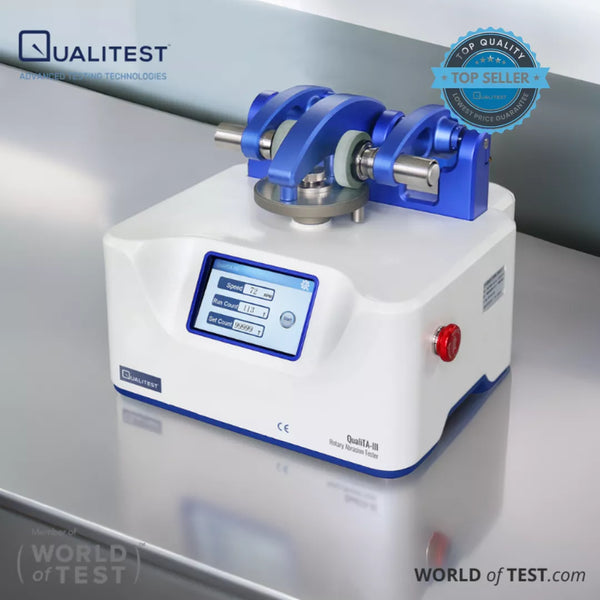
Taber abrasion testing (governed by ASTM D4060, ISO 5470, and ASTM G195-21) uses two weighted abrasive wheels that rotate against a flat specimen in a circular path, producing a cross-hatched wear pattern reported as mass loss in milligrams or as a Wear Index. Instruments like the QualiTA-III Taber-type Rotary Abrader handle coatings, plastics, textiles, and flooring materials well, but apply a much larger contact area than the RCA tester and cannot recreate the focused fingertip contact of an RCA test.
We find that Taber testing tends to get defaulted to simply because the equipment is already on the lab floor, even when a different method would produce far more relevant data. That is a habit worth breaking.
Related article: DIN vs Taber Test: Which Abrasion Method Wins for You?
Martindale abrasion testing (governed by ISO 12947) uses a figure-eight motion to abrade fabric specimens against a standard wool or abrasive cloth. It is the go-to method for upholstery, apparel, and technical textiles, reporting cycles to pilling or fabric breakdown.
Wyzenbeek abrasion testing is a textile-specific method that uses a back-and-forth motion across a woven wire mesh or cotton duck abradant. Like Martindale, it applies strictly to fabrics and soft furnishing materials.
Key Industry Standards
For engineers working inside regulated or specification-driven environments, these are the standards that matter most:
- ASTM F2357-04 / ASTM F2357-10: Standard test methods for determining abrasion resistance of inks and coatings on membrane switches using the RCA abrader.
- ASTM F3152-16: Updates to the RCA abrader test method, specifying the abrader model and operating parameters.
- ASTM D1044: Standard test method for resistance of transparent plastics to surface abrasion, often used alongside steel wool testing as a reference point.
- ASTM G195-21: Guide for conducting wear tests using a rotary platform abraser (Taber-type).
- ISO 9352: Plastics abrasion resistance testing using Taber-type abrasion wheels, a related but separate method.
Always confirm which version of the standard your customer or specification requires before you build your test protocol. Version mismatches are a surprisingly common source of compliance complications during audits.
Which Test Should You Use?
The application determines the method. Use RCA when the product carries printed graphics, inked legends, or soft coatings that users contact with fingers or soft cloths.
Use steel wool when the product has a clear hard coat on a transparent plastic substrate and the failure mode is scratching from harder, sharper objects. For products that sit at the intersection of both (coated display panels, decorated electronic enclosures), running both tests is the most thorough approach.
A few quick application examples to map this to your own situation:
- A medical device manufacturer qualifying a printed control panel for an FDA submission typically runs RCA testing, since the failure mode that matters is repeated finger contact and routine cleaning wiping the legends away.
- An automotive supplier qualifying a clear instrument cluster cover for scratch resistance typically runs steel wool testing on an instrument like the QualiSHA, because the failure mode that matters is harder, sharper contact from rings, fingernails, or cleaning tools.
- A consumer electronics OEM developing a touchscreen overlay with printed bezels typically runs both, because the print on the bezel needs to survive fingertip wear while the clear touchscreen area needs to survive scratching.
- An appliance manufacturer qualifying a printed silicone keypad on a treadmill or oven control panel almost always runs RCA, since the lifetime failure mode is the legend wearing through.
Factors That Affect Abrasion Test Accuracy
Several variables can quietly undermine the reliability of either test. Getting a handle on these is what keeps inter-lab variability from consuming your data.
RCA Abrasion Testing
- Paper tape condition. Use non-waxed, un-oiled paper tape from a qualified source. Tape age and humidity absorption change the surface energy and effective grit. Always pull tape from the same verified source and store it under controlled humidity.
- Load calibration. Verify the normal load before every test series. A weight arm even slightly out of calibration will systematically skew cycle counts.
- Specimen fixturing. The specimen must stay completely flat and still throughout the test. Any rocking or shifting artificially shortens the cycle count.
- Environmental conditions. Temperature and relative humidity affect both the tape and the coating. Always report ambient conditions with results.
Steel Wool Abrasion Testing
- Pad conditioning. A fresh, uncompressed pad behaves differently from one that has been pre-loaded. Inconsistent pad preparation is one of the fastest ways to introduce run-to-run variation.
- Pad degradation. Unlike the fresh-media design of the RCA tester, a steel wool pad picks up coating debris as the test runs. On longer tests with softer coatings, the pad loses aggressiveness and the coating ends up looking better than it actually is.
- Angular velocity and contact area. Rotary steel wool testers apply both tangential and radial velocity components to the pad, producing non-uniform wear patterns. Measurement zones should be clearly defined and reported the same way every time. Instruments with adjustable speed, stroke, and load settings, like the QualiSHA, are valuable here for tightening consistency.
- Haze measurement protocol. Haze gain readings depend on the haze meter geometry, the measurement area, and whether the specimen was cleaned beforehand. Standardize this just as carefully as the abrasion cycle itself.
Get the Right Abrasion Tester With Qualitest
At Qualitest, we supply abrasion testing equipment for production labs and R&D environments across North America.
If your team needs RCA abrasion testing, steel wool abrasion testing, or coverage across multiple test methods, explore our full range of Abrasion Testers here.
Our team is ready to help you find the right instrument for your application and budget. Reach out to us today.
References (Click to expand)
- ASTM International. (2021). Guide for Conducting Wear Tests Using a Rotary Platform Abraser (ASTM G195-21).
- Hutchings, I. (1998). Abrasive and erosive wear tests for thin coatings: a unified approach. Tribology International, 31, 5-15.
- Islam, M., Jiang, J., & Xie, Y. (2021). Assessment of low-stress and rolling contact abrasion of WC-based overlays for the restoration of undercarriage components. Wear.
- Marín-Pareja, N., Rodríguez, C., Llano, E., & Restrepo, G. (2025). Mechatronic redesign of mechanical brushing apparatus to evaluate abrasive wear of road construction materials. MethodsX, 15.
- Petersen, D., Link, R., Rutherford, K., & Hutchings, I. (1997). Theory and application of a micro-scale abrasive wear test. Journal of Testing and Evaluation, 25, 250-260.
- Rutherford, K., & Hutchings, I. (1996). A micro-abrasive wear test, with particular application to coated systems. Surface & Coatings Technology, 79, 231-239.