Nothing beats the feeling of seeing a stack of clean, error-free test reports on your desk. Achieving that level of sheer perfection comes down to one vital piece of the puzzle: a rock-solid hold on your specimen.
When your clamping pressure is satisfyingly spot on, slippage vanishes and your results become exceptionally dependable. This guide gives you the full lowdown on these essential fixtures to keep your lab running as smoothly as possible.
Key Takeaways
- Understand the core function: Grasping the true definition of grips for tensile testing is the first step to securing accurate measurement reports. These fixtures serve as the vital physical bridge between your material sample and the force sensor.
- Match the clamp to the material: Figuring out how to choose grips for tensile test operations requires pairing the holding style and jaw face texture with your specific physical material. Heavy metals require aggressive wedge clamps, while delicate films need gentle air-operated holds.
- Small daily habits prevent slippage: Continuously improving grip on tensile testing relies on practical facility maintenance. Keeping your jaw faces perfectly clean, aligning your equipment straight, and fine-tuning your clamping pressure will completely eliminate annoying specimen sliding.
- Follow the international rulebook: Utilizing the correct mechanical attachments guarantees your testing facility strictly follows major global testing standards like ASTM and ISO.
The Definition of Grips for Tensile Testing
When you are setting up a facility to check how physical materials hold up under stress, being mathematically precise and totally error-free is the only way to operate a business. But what are we actually talking about when these specific tools come up in general conversation?
The definition of grips for tensile testing is actually quite straightforward. They are those mechanical, compressed-air-operated, or pressurized-fluid-driven fixtures that grab your physical sample and refuse to let go while the pulling equipment stretches it apart.
Their main job is to hold your test piece with a firm, unwavering squeeze so it doesn’t shift during the stretching process, avoiding slip, crushing, peeling, or stress concentrations at the clamping point.
They must be gentle enough that they do not leave deep physical marks or cause the material to snap right at the metal jaw face. Poor gripping often causes failure at the ends or a significant underestimation of the true material strength, especially for soft, composite, or non-ferrous specimens.
Think about trying to pull apart a massive construction steel beam versus a flimsy, see-through strip of grocery-store bread wrapping. The thick steel needs a heavy metal Wedge Grip that bites down aggressively to stop it from flying out.
Conversely, the thin bread wrapping needs a flat, rubber-coated Pneumatic Grip that will not tear the flimsy plastic before the pulling machine even starts running. We see these fixtures as the essential physical bridge that connects your material sample to the part of the machine that measures the applied force.
If that physical bridge is shaky, your whole evaluation is going to be a total, unusable mess.
Compliance with Global Testing Standards
In professional material evaluation, being "close enough" simply is not an option for any serious business. We believe that picking the right holding clamp isn’t just about securing a piece of plastic or metal; it is about following the established rulebook to the absolute letter.
From our perspective, using the correct holding attachments, along with proper testing Adapters, is the only way to make sure you follow those big-name industry standards that everyone looks for, such as:
- ASTM E8 / ASTM E8M: The standard way to pull on metallic materials.
- ASTM D638 & ISO 527: The go-to rules for seeing how plastics behave under physical pressure.
- ASTM D412: How to test rubber without it snapping in the wrong physical spot.
- ASTM D882: The specific way to handle very thin plastic sheets.
How to Choose Grips for Tensile Test Protocols
With so many different holding styles sitting on the storage shelf, trying to pick the proper one can feel like a bit of a serious head-scratcher. We have found that getting the hang of how to choose grips for tensile test setups is the most important foundational step in making sure your collected numbers are actually correct.
We often tell people that picking the holding unit is just as big of a deal as picking the large stretching machine itself.
To help you find the perfect match for your facility, we have put together this quick cheat sheet of what works best for different physical materials:
| Grip Style | Ideal Specimen Type | Capacity | Common Standards |
|---|---|---|---|
| Wedge Grip | Hard plastics and high-strength metals | 10kN to over 1000kN | ASTM E8; for materials that need a tighter hold the harder you pull. |
| Pneumatic Grip | Rubbery bits, thin films, soft tissues | 1kN to 10kN | ASTM D882; for those delicate samples that need a steady squeeze. |
| Hydraulic Grip | Very large metals and thick plates | 50kN up to 3000kN | Heavy-duty industrial work like steel rebar or plates. |
| Screw Grip | Paper and general-purpose polymers | Up to 10kN | Great for everyday lab work where things are not too extreme. |
| Eccentric Roller | Rubber and sticky tapes | 1kN to 5kN | ASTM D412; for stuff that gets much thinner as you stretch it. |
Let’s look at a practical, everyday situation. A manufacturing plant creating structural car parts needs to pull on heavily reinforced metals.
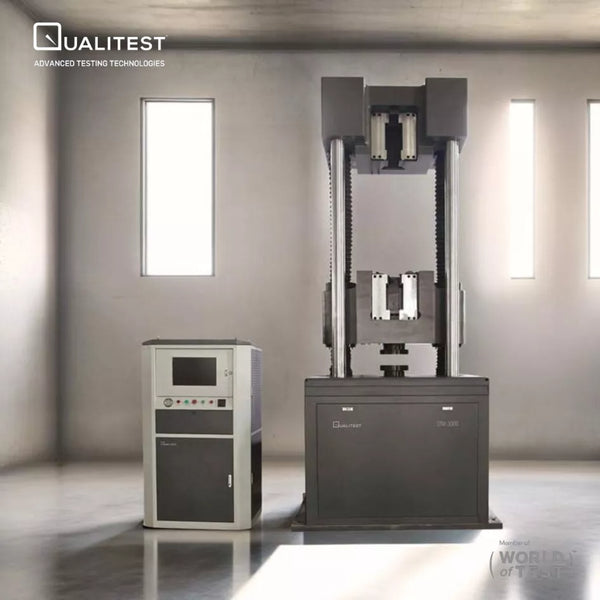
They would mount a heavy-duty Wedge Grip onto a Servo Hydraulic Universal Testing Machine instead of standard Screw Grips because the wedge design squeezes tighter and tighter as the machine pulls harder, preventing the heavy metal piece from flying out during a high-force stretching process.
Related article: Electromechanical vs Hydraulic UTM: Choosing Your System
Alternatively, if they were evaluating perfectly machined metallic rods with threaded ends, they would swap over to a specific Thread Head Grip for a flawless fit.
Our Honest Advice: Do not just look at the holding style; check the physical texture and hardness of those jaw faces too. Jaw faces that are too hard or too rough can actually peel coatings or damage the test piece, causing premature failure.
We think it is a much smarter move to get a clamp that can handle a bit more pulling force than you think you need, rather than pushing a smaller unit until it completely fails.
Improving Grip on Tensile Testing: Operational Strategies
Even if you have the perfect mechanical gear, things can still go sideways if you are not paying close attention to the small details.
If your test pieces are constantly sliding out or snapping right at the edge of the clamp (those annoying "jaw breaks"), then focusing on improving grip on tensile testing is your next big, logical move.
We really believe that keeping your gear in top-notch physical condition is the most overlooked part of running a testing facility. Here is how to keep things running perfectly:
Optimizing Grip Alignment
If your clamps are even a tiny bit crooked, they will twist your sample and completely ruin your numbers. We suggest double-checking that everything is lined up perfectly straight for a true, balanced pull.
In fact, research indicates that different grip systems and misalignments actually change the shape of the stress-strain curve and apparent strength entirely.
Equipment Maintenance and Cleaning
Residue from old samples, especially sticky items like packaging tape or soft melting plastics, can quickly build up on those metal jaw faces.
We believe that a quick cleaning session and swapping out worn-down teeth on your Shear Grip or Pincer Grip is the easiest way to get your holding friction back where it needs to be.
For dynamic tests with high strain rates, optimizing grip components with clean, laser-sintered flats significantly improves precision and reproducibility.
Calibrating Clamping Pressure
If you are using an air-operated Pneumatic Grip or a fluid-driven Hydraulic Grip, getting the applied pressure right is absolutely everything. Finding that sweet, middle ground where it is tight enough to hold but not so tight it completely smashes the sample is the secret to a perfect, error-free test.
Furthermore, adding simple cardboard liners or emery cloth tabs between the jaws and the specimen reduces stress concentrations and limits slipping without damaging soft tissues or papers. You can also utilize extra secondary grips around rubber specimens to significantly increase your test success rates.
Utilizing Specialized Jaw Faces and Adaptors
Sometimes, you do not need a whole new holding unit. Switching to a different texture, or using abrasive paper inserts, improves holding without damage for tricky materials like tab-less CFRP laminates.
Additionally, using specialized engineering plastic sleeves or customized adaptors reduces the hardness mismatch and prevents coating peel, allowing composite bars to reach their true physical capacity.
Strategic Testing Solutions with Qualitest
At Qualitest, we know that having data you can actually trust is the absolute backbone of your company’s professional reputation. We see a well-stocked testing facility as a brilliant, strategic move for your business, not just another monthly bill to pay.
- Whether you are fixing up an old, tired setup or building a brand-new testing facility from scratch, we have the practical solutions you are looking for. We would love for you to take a look at our Universal Testing Machines to find the perfect capacity fit for your daily operations.
- To get your facility fully ready for any physical challenge, we strongly suggest looking through our large selection of Grip & Fixtures. We have the exact, budget-friendly accessories specifically built for your highly unique testing situation.
Give our friendly technical team a shout today! We are ready to help you find the perfect setup to get your physical products moving and keep your quality levels consistently high.
References (Click to expand)
- Akinribide, O., Ogunkoya, A., Momoh, I., Ogundare, O., Attahdaniel, B., & Olusunle, S. (2013). Design and Development of Grip for Circular Test Piece Inuniversal Tensile Testing Machine. Journal of Minerals and Materials Characterization and Engineering, 1, 331-335.
- Arboleda, D., Carozzi, F., Nanni, A., & Poggi, C. (2016). Testing Procedures for the Uniaxial Tensile Characterization of Fabric-Reinforced Cementitious Matrix Composites. Journal of Composites for Construction, 20, 04015063.
- Başaran, B., Yaka, H., & Kalkan, I. (2020). Engineering plastic gripping mechanism for tension testing of FRP bars. Journal of Composite Materials, 54, 4427 - 4440.
- Başaran, B., Yaka, H., & Kalkan, I. (2021). PVC and POM gripping mechanisms for tension testing of FRP bars. Structural Engineering and Mechanics, 77, 75-87.
- Focacci, F., D’Antino, T., & Carloni, C. (2022). Tensile Testing of FRCM Coupons for Material Characterization: Discussion of Critical Aspects. Journal of Composites for Construction.
- Matsuo, T., Hojo, M., & Kageyama, K. (2019). Influence of gripping method on tensile properties of unidirectional thermoplastic CFRP – Round-robin activity for international standardization in Japan. Journal of Composite Materials, 53, 4161 - 4171.
- Ng, B., Chou, S., & Krishna, V. (2005). The Influence of Gripping Techniques on the Tensile Properties of Tendons. Proceedings of the Institution of Mechanical Engineers, Part H: Journal of Engineering in Medicine, 219, 349 - 354.
- Portnov, G., Kulakov, V., & Arnautov, A. (2013). Grips for the transmission of tensile loads to a FRP strip. Mechanics of Composite Materials, 49, 457-474.
- Rameshchandra, D. (2016). DESIGN OF GRIPPER IN UNIVERSAL TESTING MACHINE. International Journal of Advance Research and Innovative Ideas in Education, 2, 1161-1170.
- Setyawan, D., Sulisetyono, A., & Aryawan, W. (2022). EFFECT OF ADDITIONAL GRIP ON TENSILE STRENGTH OF NON-FERROUS MATERIALS FOR SHIP. Journal of Applied Engineering Science.
- Taylor, G. (1973). Simple, light-weight grips for tensile testing. Journal of Physics E: Scientific Instruments, 6, 513-513.
- Truong, V., Lee, D., & Kim, D. (2021). Effects of different grips and surface treatments of textile on measured direct tensile response of textile reinforced cementitious composites. Composite Structures.
- Unger, R., Schegner, P., Nocke, A., & Cherif, C. (2019). Technological Development of a Yarn Grip System for High-Speed Tensile Testing of High-Performance Fibers. Autex Research Journal, 19, 347 - 354.
- Yoshihara, H., & Yoshinobu, M. (2015). Simple Evaluation of the Tensile Properties of Copy Paper Using Manual Grips and End-Tabs. Journal of The Society of Materials Science, Japan, 64, 350-355.