Consistent flow is the secret behind every great product. Whether you are mixing paint or processing food, nailing the viscosity is what drives quality and separates market leaders from the rest.
At Qualitest, we believe mastering high viscosity vs low viscosity is the easiest way to guarantee success. When you control the flow, your production runs smoothly and your customers get exactly what they expect.
Here is how to measure it right and the cost-effective tools to help you do it.
What Exactly is Viscosity?
Before we compare the extremes, we have to get the basics down.
Scientifically, viscosity is a measure of a fluid's resistance to flow or deformation, caused by internal friction between adjacent layers of the fluid in relative motion (Definitions, 2020; Yadav, 2019; Funk & Dinger, 1994). It quantifies how "thick" or "sluggish" a fluid is, with higher viscosity indicating greater resistance to flow.
When we discuss fluid dynamics in a factory, we are usually looking at how easily a liquid can be poured, pumped through a tube, or spread over a surface. While many manufacturers understand this concept intuitively, they often struggle to put a real number on it without the proper gear.
High Viscosity Means...
Technically, high viscosity means that a fluid has a serious amount of internal friction. Mathematically, viscosity is defined as the ratio of shear stress to shear rate in a fluid (Westerhof et al., 2018; Bragg, 1973).
In high viscosity fluids like honey or heavy oils, the molecules create massive resistance against one another. These fluids move slowly and need a significant shove to get going.
Low Viscosity Meaning...
On the flip side, the low viscosity meaning relates to fluids that flow fast because there is minimal friction inside.
Low viscosity fluids flow easily and quickly, like juice or water (OpenStax, 2016; Funk & Dinger, 1994). These liquids are thin, runny, and slide past one another easily, resulting in rapid movement.
Low Viscosity vs High Viscosity: The Practical Differences
When comparing low viscosity vs high viscosity, the main thing to watch is how the material handles a push. But if you ask us, the real difference lies in how you handle them on the production floor.
Flow Rate: The Visual Test
High viscosity fluids creep along slowly. Picture sticky honey refusing to leave a spoon. Conversely, low viscosity fluids move immediately like water pouring from a glass.
It is important to note that fluids with constant viscosity at all shear rates are called Newtonian fluids, while those with variable viscosity are non-Newtonian (Westerhof et al., 2018; Bragg, 1973). This distinction is critical when choosing a testing method.
Related article: Fluid Testing Guide: The 3 Viscosity Behaviors
Pumping Requirements and Equipment Stress
Moving high viscosity fluids calls for heavy-duty pumps, such as gear pumps, that can physically force the material through the line. Low viscosity fluids can usually be moved with standard centrifugal pumps.
The difference in viscosity affects practical applications such as oil recovery, where heavy oils with high viscosity pose challenges in flow and processing compared to low viscosity conventional oils (Temizel et al., 2018).
We say this constantly: misjudging these requirements is a primary reason equipment fails in processing plants.
High Viscosity vs Low Viscosity Examples in Industry
To really picture these concepts, it helps to look at specific high viscosity vs low viscosity examples across different sectors.
High Viscosity Examples
These materials are often what we would call sludge, paste, or heavy liquid.
- Adhesives and Epoxies: These must stay exactly where you apply them, requiring huge resistance to flow.
- Asphalt and Tar: Used in construction, these are practically solid until you heat them up.
- Peanut Butter and Molasses: In the food industry, texture is everything. Seriously, nobody wants runny peanut butter. That is a quality control failure.
- Molten Polymers: In the plastics business, melted plastic needs to be thick enough to hold a shape but thin enough to fill a mold. We view this as the ultimate balancing act, often requiring advanced tools like our ViscoQT 1700/S or 1800/S Series to analyze the flow curve properly.
- Creams and Lotions: A premium cosmetic cream relies on high viscosity to feel "expensive." If it pours out like tap water, consumers perceive it as inferior.
Low Viscosity Examples
These materials flow without hesitation and are often used as solvents or bases.
- Water and Alcohol: The gold standards for the low viscosity meaning.
- Milk: Even though it has solids, it flows almost as easily as water.
- Gasoline: Essential for engines where the fuel needs to move through lines immediately.
- Industrial Inks: For printing, fluids must be thin to pass through tiny nozzles. But we always remind clients that if the ink is too thin, it splashes and ruins the definition.
- Hydraulic Fluids: These must flow quickly to transmit power efficiently. Any thickening here usually signals that your machinery is degrading.
The Scale: Quantifying High Viscosity vs Low Viscosity
To pick the right testing gear, you have to put a number on it. We always tell our customers that "thick" is just an opinion, but numbers don't lie.
- 1 cP (Water): Extremely low viscosity. This is easily handled by our ViscoQT 1000 Series (Basic) models.
- 1,000 cP (Castor Oil): Needs standard Rotational Viscometers.
- 50,000 cP (Ketchup): A mid-range fluid that might need specific spindles to get a real reading.
- 250,000+ cP (Peanut Butter/Pastes): Majorly thick materials like these need high-torque instruments, such as the ViscoQT 2000 or the RotoViscoQT, to cut through the resistance and give you data that is accurate.
Why Temperature Control Changes the High Viscosity Meaning
High viscosity means nothing if you don't account for the heat.
Temperature and fluid composition also influence viscosity, with viscosity generally decreasing as temperature increases for liquids (Andrade, 1930; Bhattad, 2023). A heavy oil can act like a low-viscosity fluid if you heat it, while cooling a liquid can cause it to thicken instantly.
In our professional opinion, testing viscosity without checking the temperature is essentially just guessing. You can read more here: Temp and Viscosity: Key to Consistent Production
For consistent results, especially with petrochemicals and food, using a viscometer with a built-in temperature probe like the ViscoQT TS-DV Series is the only way to make sure your "pass/fail" data is actually valid. If you are comparing low viscosity vs high viscosity behavior without controlling heat, your data is likely useless.
Matching the Instrument to Low Viscosity vs High Viscosity Needs
At Qualitest, we know every lab is different. We see many labs overspending on complex features they don't need or buying equipment that can't handle the resistance. We want to fix that balance.
For Paints and Coatings
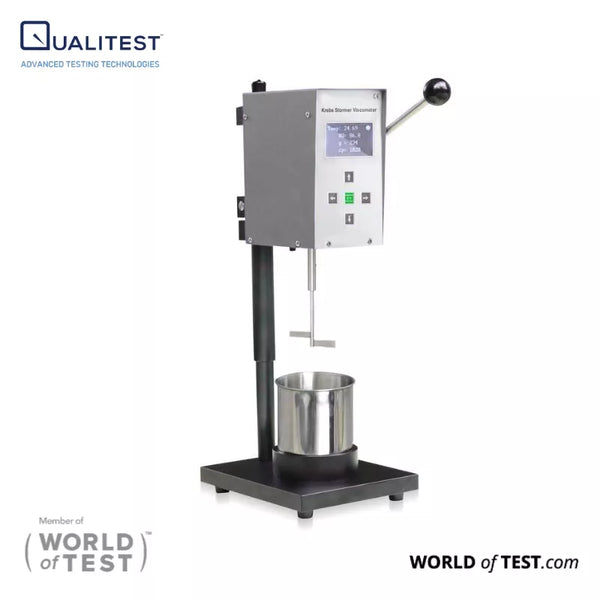
If you are testing standard materials, the ViscoQT KS Series (KS-100, KS-200, or KS-300) is the absolute standard. It prevents your paint from being a watery mess (too low viscosity) or too thick to spray (too high viscosity), giving you the direct Krebs units (KU) you need.
For Adhesives and Pastes
Testing thick materials often requires spinning at different speeds. Our ViscoQT 2000 Intelligent Laboratory Viscometer lets you see how thick glue acts when you apply force, giving you clear insight into shear thinning behavior.
For Complex R&D Analysis
Sometimes, you need to record changes over time or analyze high-polymer structures. We recommend the ViscoQT 1700/S and 1800/S Series Programmable Rheometers. We find that removing the need for a PC connection by using the onboard screen saves technicians significant headaches during testing.
For General Quality Control
If you just need to verify a batch falls within a high viscosity vs low viscosity range and you are watching the budget, the Dial Reading Viscometer ViscoQT DR-100 is the perfect balance of accuracy and price. It gets the job done without overcomplicating the interface.
Related article: Dial Reading vs Digital Viscometers: Which is Best?
Qualitest: Cost-Effective Solutions for Your Lab
We are convinced that high-quality testing shouldn't destroy your budget. Don't let viscosity variables disrupt your production line. Whether you are pumping thin solvents or mixing thick resins, Qualitest has the cost-effective solution you need.
Check out our full collection of Viscometers here!
References
- (2020). Viscosity. Definitions.
- Yadav, D. (2019). A Review on Effect of Viscosity on Liquids, Gases and Solid.
- Westerhof, N., Stergiopulos, N., Noble, M., & Westerhof, B. (2018). Viscosity. Snapshots of Hemodynamics.
- Bragg, B. (1973). Viscosity-Measurement by. Nature.
- Bhattad, A. (2023). Review on viscosity measurement: devices, methods and models. Journal of Thermal Analysis and Calorimetry, 1-17.
- Funk, J., & Dinger, D. (1994). Viscosity and Rheology. Predictive Process Control of Crowded Particulate Suspensions, 235-252.
- Temizel, C., Canbaz, C., Tran, M., Abdelfatah, E., Jia, B., Putra, D., Irani, M., & Alkouh, A. (2018). A Comprehensive Review Heavy Oil Reservoirs, Latest Techniques, Discoveries, Technologies and Applications in the Oil and Gas Industry. Day 1 Mon, December 10, 2018. - Andrade, E. (1930). The Viscosity of Liquids.. Nature, 125, 309-310. https://doi.org/10.1038/125309b0
- OpenStax, O. (2016). 12.4 Viscosity and Laminar Flow; Poiseuille’s Law.