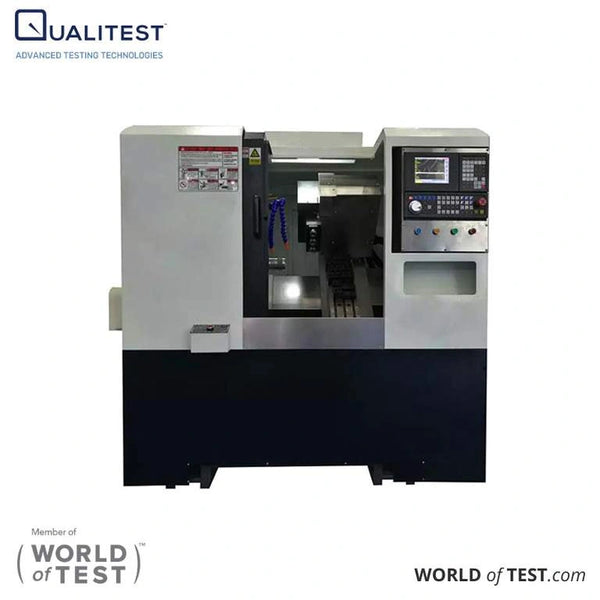
Choosing the wrong machining setup for your testing laboratory risks non-compliant samples and wasted capital. While laser cutters are technically computer-directed machines, real-world operations pit physical mechanical tools against thermal light ablation in a CNC vs laser cutter showdown.
Selecting the right CNC machine vs laser cutter setup protects your ASTM sample integrity, avoids heat distortion, and keeps daily operating overhead low. Here is your concise operational breakdown to select the best equipment setup for your facility.
Key Takeaways
- Cutting Mechanism: Mechanical CNC machines carve 3D parts physically, whereas lasers rely on thermal energy for flat 2D profiling.
- Specimen Quality: Mechanical milling produces zero heat distortion, preserving true material strength for ASTM E8 and D638 testing.
- Stock Thickness: Solid CNC tools handle thick metal blocks, rods, and polymers without tapered edges or surface burning.
- Predictable Costs: CNC operating expenses stay modular with standard end mills, avoiding high gas fees and costly laser source replacements.
- Easier Compliance: Enclosed CNC mini-mills fit standard labs with basic mist collection, avoiding strict Class 4 laser safety rules.
Operating Principles: Solid Tooling vs Thermal Light Energy
Before allocating capital toward new machinery, let’s look at how each technology removes stock.
Mechanical Milling and Lathes (Physical Subtractive Cutting)
General mechanical CNC machinery automates tool motion using computer toolpaths across tasks such as cutting, drilling, turning, boring, and tapping.
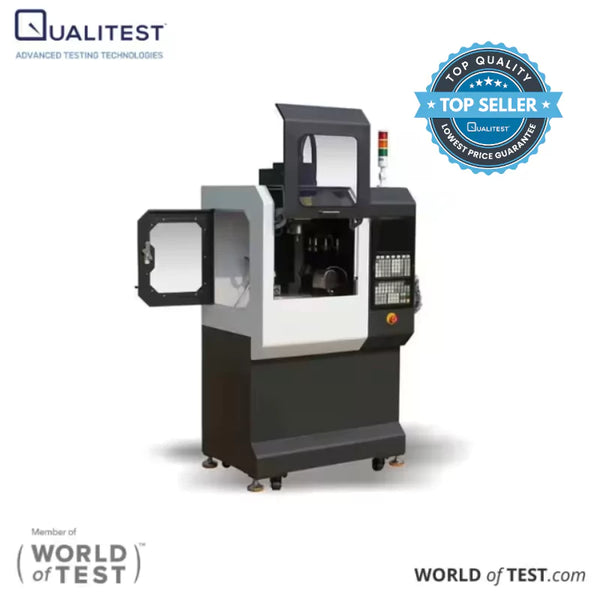
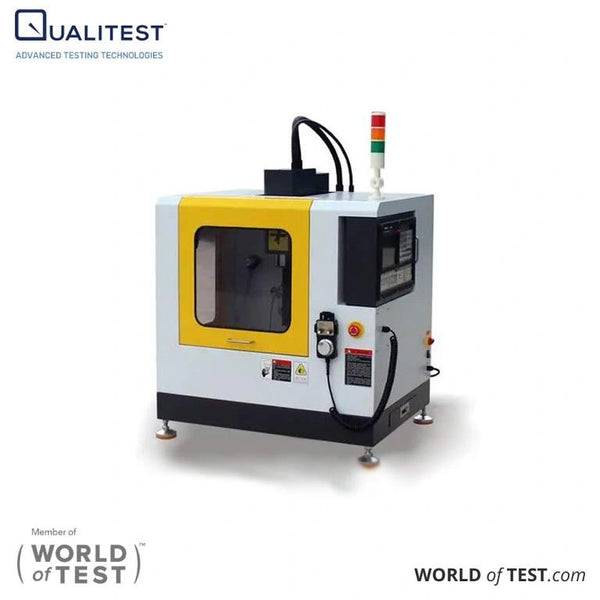
Spinning carbide cutters, indexable inserts, and sturdy tool bits execute physical stock removal. High-precision milling systems like our Mini CNC Milling Machine QualiMill™ 220 utilize high-speed spindles reaching 24,000 rpm with a 2.2 kW motor capacity to shave off fine layers across multiple axes.
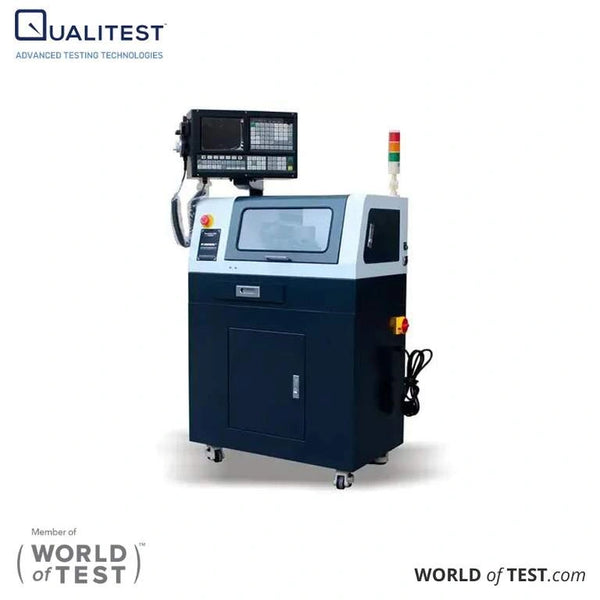
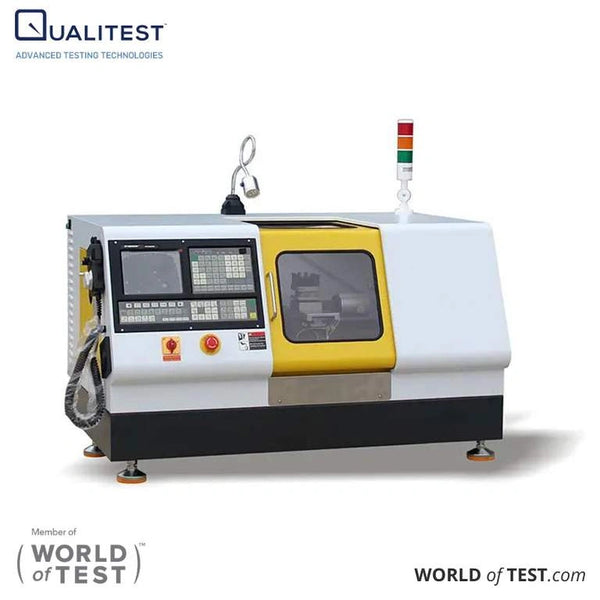
Similarly, specialized lathes like our QualiLathe™ 140 rotate the workpiece against a stationary cutter to turn round stock into precise pins and shafts. The primary advantage is zero thermal damage, relying on mechanical shearing force and liquid coolant to shape metal and polymer stock without altering internal material grain structures.
Read more: CNC Milling vs Lathe: Choosing the Right Facility Tool
Laser Systems (Thermal Ablation)
CNC laser systems project a focused light beam through optical mirrors or fiber lines directly onto your workpiece, following CAD/G-code paths to vaporize material. The intense thermal energy melts, burns, or vaporizes stock along a 2D path while high-pressure gas clears the molten slag.
In any laser cutter vs CNC evaluation, the core debate centers on mechanical cutting force versus thermal energy. Lasers offer fast, non-contact profile cutting through thin sheet stock, but they leave a heat footprint along the cut edge.
Key Differences That Impact Daily Operations
If you are weighing whether your facility needs a CNC or laser cutter, these operational metrics dictate the right choice:
Multi-Axis 3D Geometry vs. High-Speed 2D Profiling
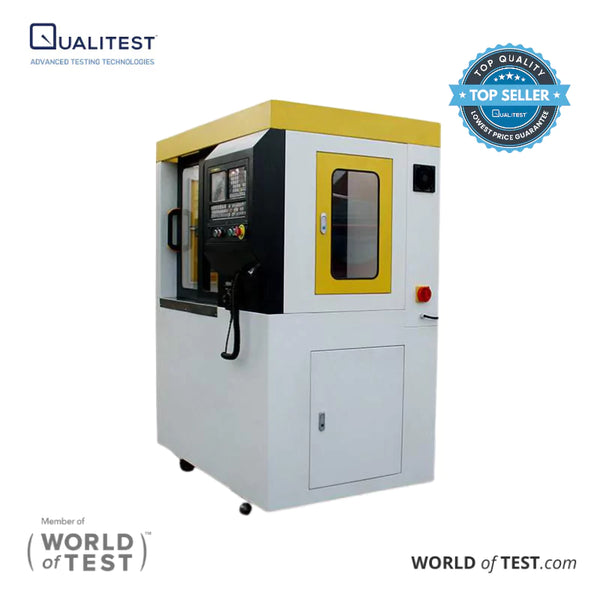
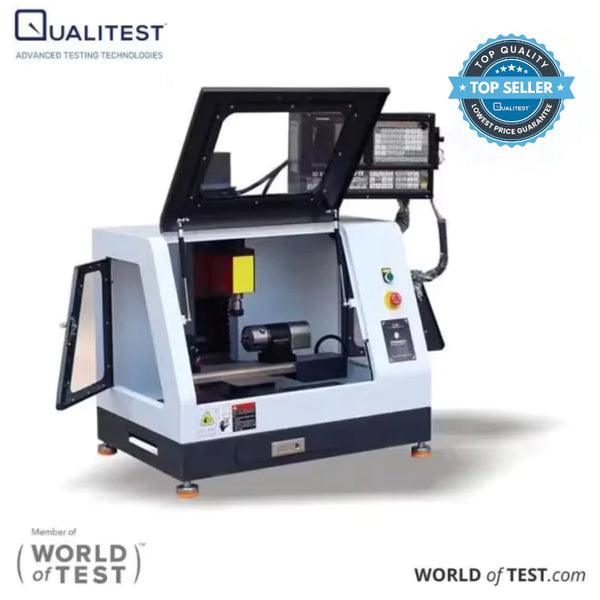
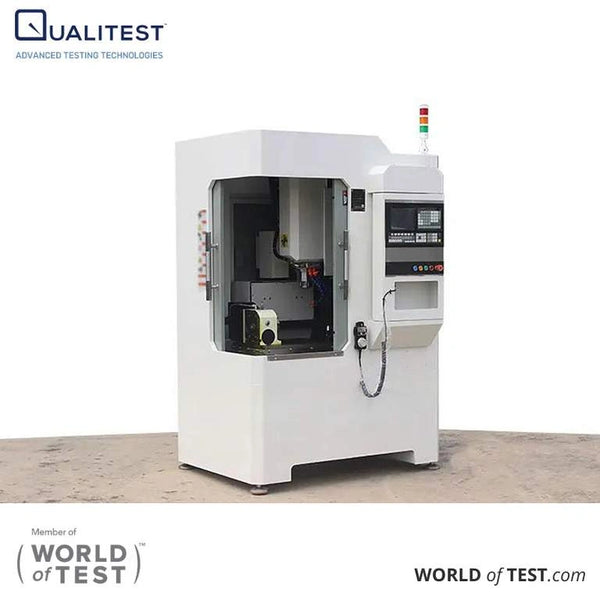
Both technologies serve distinct geometric roles on the shop floor. General mechanical CNC platforms operate natively across 3D space, removing material at varying depths to produce complex contours, tapped threads, turned shafts, and multi-level pockets. Multi-axis systems like our 4 Axis CNC Milling Machine – QualiMill™ 300A and QualiCNC™ 300 allow operators to machine intricate 3D components from solid blocks.
Related article: 5-Axis vs 3-Axis vs 4-Axis CNC Machining Differences
Meanwhile, laser cutters deliver unmatched speed and efficiency when processing flat 2D sheet profiles and fine surface vector engraving. One trade-off worth noting: because CNC cutting is limited by the physical radius of the rotating bit, laser cutters can achieve sharper interior corners and finer 2D detail (kerf widths as tight as 0.1mm) than any mechanical tool.
For labs producing standard ASTM dog-bone or bar specimens this rarely matters since the geometry requires smooth transition radii, but it is a factor if your lab also needs intricate flat components like custom gaskets or fixtures.
Material Compatibility and Thickness Limits
Mechanical units equipped with solid carbide bits process thick slabs of structural aluminum, stainless steel, dense engineering plastics, and composites without running out of torque or depth capability.
On the other hand, laser systems perform exceptionally well on thin sheet metals and acrylic profiles. However, attempting to cut thick structural plates with a laser often leads to tapered edges, surface burning, and heavy slag buildup.
Heat Affected Zone (HAZ) and Specimen Integrity
Thermal ablation from laser cutting leaves a Heat Affected Zone (HAZ). Academic research shows that laser processing introduces temperature-related chemical changes to material surfaces. That baked edge alters physical properties, which can distort mechanical strength test numbers.
In North American manufacturing sectors (such as aerospace OEMs in the Pacific Northwest, automotive supply chains in the Midwest, or medical device facilities in California and Minnesota), strict adherence to US standards like ASTM E8/E8M (metallic tensile testing) and ASTM D638 (plastic tensile testing) requires mechanical sample preparation.
Purpose-built turning units like our QualiLathe™ 210, equipped with an 1,100 W MT4 spindle and an 8,000 mm/min rapid traverse, shape round dog-bone tensile specimens cleanly. Research indicates that mechanical routing preserves grain consistency better across varied cutting angles, making mechanical carving the recognized choice for producing standardized test specimens without risking audit discrepancies.
Total Cost of Ownership and Facility Setup
Evaluating financial feasibility requires looking past the initial machine sticker price to analyze daily operating overhead, facility infrastructure, and environmental compliance in a laser cutter vs CNC comparison.
Mechanical Operating Overhead and Facility Integration
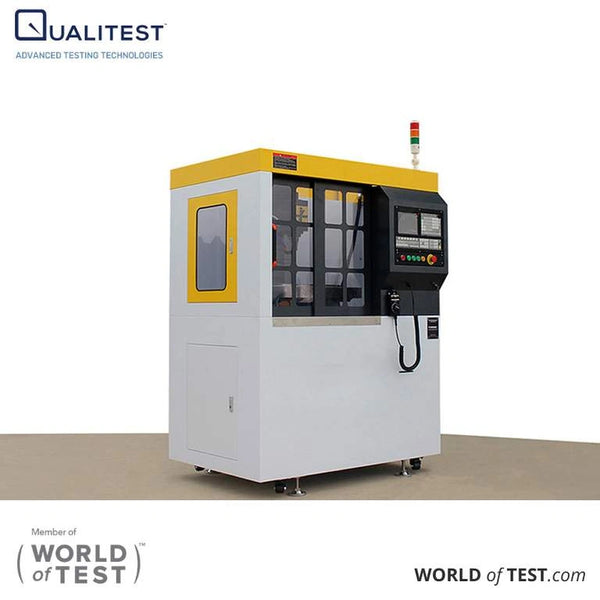
Mechanical machining expenses consist of predictable consumables like end mills, turning inserts, drill bits, and liquid coolant, which facility managers can budget easily through local North American tool distributors. While large-scale production platforms can carry higher initial costs, compact desktop mini-mills like our Desktop CNC Machine – QualiCNC™ 200 (featuring 230 x 130 x 220 mm X/Y/Z travel) provide accessible entry costs for testing labs.
From an environmental perspective, mechanical units utilize fully enclosed glass cabinets to contain metal shavings and coolant spray. Coolant mist collectors maintain compliance with US OSHA indoor air quality standards, allowing compact benchtop mini-mills like our QualiMill™ M4 to integrate into existing laboratory spaces without requiring special ventilation ductwork or concrete floor reinforcements.
Laser Utility Overhead and Safety Compliance
Laser cutting requires ongoing expenses for high-purity nitrogen or oxygen assist gas cylinders, focal lenses, and protective nozzles. Across US industrial regions, gas cylinder rentals, tank refills, and delivery logistics add recurring monthly operational overhead. Furthermore, laser sources (such as glass tubes or fiber modules) have finite operational lifespans, making source replacement a major capital outlay.
Vaporizing polymers and treated sheet metals generates toxic gases and fine particulates. Under US EPA guidelines and OSHA workplace rules, industrial HEPA and activated carbon filtration systems are mandatory. Additionally, US ANSI Z136.1 standards for the Safe Use of Lasers mandate that Class 4 laser installations feature light-tight protective housings, safety interlocks, and dedicated safety eyewear protocols.
Programming, Workflow, and Operator Skill Sets
Evaluating operational complexity helps align machinery with your team's current technical capabilities. Laser cutters accept 2D vector drawings (such as DXF files) and begin cutting with minimal parameter adjustments.
Because laser cutting is a non-contact process, part clamping is straightforward. In contrast, mechanical mills require 3D CAD models and CAM software to establish toolpaths, spindle speeds, feed rates, and step-over values, along with rigid vises, toe clamps, or vacuum fixtures to withstand cutting forces.
Related article: CNC Machine vs 3D Printer: Side-by-Side Guide
In US community college workforce programs, ABET-accredited engineering departments, and federally funded manufacturing reshoring initiatives, practical instruction in mechanical G-code programming remains a priority.
Operating machinery equipped with multilingual controllers (like the KY980Tc on our QualiLathe™ series), manual pulse generator (MPG) handwheels, or integrated Educational CIM & FMS Industry 4.0 systems gives trainees direct experience with tooling physics and physical cutting mechanics.
Practical Decision Guide: Aligning Equipment with Your Workload
Selecting a mechanical mill or lathe is the proper operational choice when your primary workload involves manufacturing unburned, audit-compliant test specimens under strict ASTM (E8/D638) and ISO standards. Mechanical machinery is also essential for carving 3D components, thick plates, custom tooling, or turned shafts using heavy-duty milling centers like our QualiMill™ 400 (featuring an 8-tool Automatic Tool Changer and ±0.01 mm repeatability) or turn-mill platforms like our QualiMill™ TM500.
Additionally, mechanical setups provide the required foundation for machining structural metals, brass, and dense engineering polymers while training technicians in smart factory concepts.
Conversely, a laser cutter is the ideal investment when your primary output consists of slicing through thin sheet metal enclosures, flat gaskets, or acrylic profiles at high speed. Lasers also perform well at marking part numbers, logos, or fine vector text onto flat surfaces and cutting thin, flexible sheet materials without applying physical clamping pressure.
Reviewing a CNC or laser cutter choice through this practical operational focus clarifies which technology delivers the best return on investment.
Head-to-Head Comparison: CNC Machine vs Laser Cutter
| Operational Feature | General CNC Machine (Milling & Turning) | CNC Laser Cutter |
|---|---|---|
| Material Removal Mechanism | Rotary mechanical tool motion | Focused laser beam ablation |
| Typical Strengths | Broad machining versatility and 3D depth | Fine cutting, engraving, and marking |
| Automation Level | Computer-controlled motion | Computer motion plus laser source control |
| Heat Affected Zone (HAZ) | Zero thermal distortion (coolant maintains temperature) | Present (baked edges and chemical surface alterations) |
| Test Sample Integrity | Primary choice for ASTM (E8/D638) & ISO physical test specimens | Restricted (heat-altered edges alter strength test data) |
| US Regulatory Compliance | OSHA coolant mist containment in enclosed cabinets | OSHA fume extraction & ANSI Z136.1 Class 4 laser safety rules |
| Small-Shop Positioning | Cost-effective benchtop setups available | Low-cost entry prototypes for schools and small firms |
Practical Buyer’s Checklist: Evaluating Your Facility Needs
If your team is finalizing a CNC machine vs laser cutter purchase decision, evaluate these four operational questions:
-
Are you producing physical specimens for tensile, compression, or impact testing under ASTM or ISO standards?
Our Assessment: Select CNC. Dedicated equipment like the QualiLathe™ 210 or QualiMill™ 220 avoids thermal distortion, ensuring your material testing data remains accurate and audit-compliant.
-
Does your workload involve solid 3D blocks, turned cylinders, or thick structural plates?
Our Assessment: Select CNC. Lasers cannot carve deep 3D geometry or thick structural stock efficiently.
-
Is your primary output thin sheet metal enclosures or acrylic profiles under 3mm?
Our Assessment: Select Laser Cutter. Lasers process thin flat profiles quickly without physical clamping setup time.
-
Are you training future engineers on physical G-code programming and toolpath logic for US manufacturing roles?
Our Assessment: Select CNC. Equipment featuring industrial controllers delivers essential practical experience in tooling physics and mechanical manufacturing.
Equip Your Academic & Research Labs with Qualitest
When your operations require uncompromised sample integrity, long-term reliability, and sensible budget management, mechanical machining remains the clear operational standard.
At Qualitest, we provide high-value, cost-effective CNC Milling & Lathe Machines engineered specifically for testing laboratories, R&D centers, and technical training environments across North America:
- Compact Desktop Mills (QualiMill™ M4 & QualiMill™ 220): High-repeatability mini milling systems built for clean, heat-free polymer and metal specimen preparation.
- Specimen-Prep Lathes (QualiLathe™ Series): Specialized turning systems engineered specifically to produce round dog-bone tensile specimens meeting strict ASTM standards.
- Multi-Axis & Educational Systems (QualiMill™ 300A/400): Feature-packed 4-axis/5-axis centers and CIM/FMS platforms for advanced research and smart factory training.
We are committed to helping you select machinery that solves your technical challenges while maintaining operational cost efficiency.
Ready to upgrade your sample preparation or laboratory machining setup? Explore our complete CNC Milling & Lathe Machine line or contact our technical specialists today to request a custom proposal!
References (Click to expand)
- Abedrabbo, F., Guerrero, J., Quito Carrión, A., Gavilanez, E., & Zumba, J. (2025). A Budget-Friendly CNC Laser-Cutting Machine. Proceedings of the 23rd LACCEI International Multi-Conference for Engineering, Education and Technology (LACCEI).
- Ahmed, R. U., Yasmin, M., Das, A., & Ahmmad, S. M. (2023). Design and Fabrication of a Low-Cost Customizable Modern CNC Laser Cutter. 472-485.
- Ambrizal, N. H. B., Farooqi, A., Alsultan, O. I., & Yusoff, N. (2017). Design and Development of CNC Robotic Machine Integrate-able with Nd-Yag Laser Device. Procedia Engineering, 184, 145-155.
- Carrillo, N., & Pérez Chicaiza, J. J. (2017). Dimensionamiento e implementación de una máquina CNC de corte por láser para optimizar la calidad de trabajos en acrílico de hasta 5 mm de espesor.
- Chen, Y.-X. (2016). Modal Analysis of Three Dimensional Numerical Control Laser Cutting Machine Based on Finite Element Method.
- Gopalan, S. R., Jegan, B., & Govindarajan, T. S. (2024). Wireless control system for laser cutters and engraving machines. The International Journal of Advanced Manufacturing Technology, 134, 2269–2289.
- Gurău, L., Coșereanu, C., Timar, M., Lungu, A., & Condoroţeanu, C.-D. (2022). Comparative Surface Quality of Maple (Acer pseudoplatanus) Cut through by CNC Routing and by CO2 Laser at Different Angles as Related to the Wood Grain. Coatings.
- Habsi, R. A., & Rameshkumar, G. (2016). Design and Fabrication of 3-Axis Computer Numerical Control (CNC) Laser Cutter.
- Khan, N. M., Maheshwari, A., & Verma, H. (2022). Study and Design of Arduino Based CNC Laser Cutting Machine. IOP Conference Series: Materials Science and Engineering, 1224.
- Mesin, A. T., Manufaktur, D., Hadi, S., M., Cahyo, T., & W. (2021). Rancang bangun mesin CNC laser cutting CO2 2 axis bebasis microcontroler dengan software Mach3.
- Nechval, K., Reiskarts, V., & Chatys, W. (2025). Research and development of CNC machine prototype for laser cutting and engraving. Science, Technology and Innovation.
- Philipp, T., Kehrer, A., & Rens, S. (2023). Lasercutting.
- Thorat, A., Gunjal, M., Londhe, G., Kumbhar, S., Urkude, A., & Sharma, R. (2024). Crafting Artistry with CNC Laser Engraving. 2024 Ninth International Conference on Science Technology Engineering and Mathematics (ICONSTEM), 1-6.
- Yousif, I. F., Alsudani, M., Waheed, S. R., Khudhair, Z. N., Adnan, M. M., & Al-Khaykan, A. (2023). Automatic Laser Engraving Machine for Different Materials based on Microcontroller. Malaysian Journal of Fundamental and Applied Sciences.
- Yusuf, R., Daniyan, I., Ayodeji, S., Lawal, A., Olasanoye, O., & Adeodu, A. (2024). Performance evaluation and Optimisation of a Small-Scale Laser Cutting and Engraving Machine. 2024 IEEE 5th International Conference on Electro-Computing Technologies for Humanity (NIGERCON), 1-5.