Ever watch hard-earned profits melt away because of a single fake gold bar or a ruined heirloom? If you are managing a jewelry business or a metal recycling shop, verifying purity without destroying your physical inventory is a constant, high-stakes puzzle.
This guide lays out exactly how to protect your financial margins, verify chemical composition, and choose the appropriate testing equipment without leaving a single scratch on your valuable products. Read on to discover why non destructive testing for jewelry is the preferred standard for avoiding fraud and staying strictly compliant with industry regulations.
Key Takeaways
- Checking metals without damaging them completely protects the resale value of your delicate jewelry and high-ticket inventory.
- Upgrading to modern testing equipment delivers rapid financial returns by completely eliminating costly third-party laboratory fees.
- Figuring out the appropriate density tester relies heavily on your daily sample volume, precision requirements, and automated features.
- Combining simple hydrostatic weighing with advanced X-ray scans creates the ultimate defense against sophisticated counterfeits.
Why Non Destructive Testing for Jewelry is Critical
When you are holding a piece of high-value finished jewelry, an irreplaceable family heirloom, or delicate structural components, every single speck of metal counts. Honestly, the main reason why non destructive testing for jewelry is such a massive deal is that it keeps the piece looking absolutely gorgeous and structurally solid.
According to recent research, these methods retain the original physical shape of the item without destroying it, ensuring the jewelry is still preserved and can be styled without visible flaws. As an appraiser, supplier, or manufacturer, you need a way to check if the goods are real without leaving a scratch on them.
In our opinion, using invasive testing on a beautiful, finished piece of jewelry is a compromise that you should try to avoid at all costs. On top of that, running a commercial business means you have to play by the rules.
Using modern, non-invasive gear makes it incredibly easy to stick to strict ASTM and ISO quality control guidelines, alongside the US Federal Trade Commission (FTC) requirements for accurate metal stamping and purity declarations. Old-school methods like scraping or chemical etching simply fail to meet modern standards, especially when a single scuff can completely tank the resale value.
The Advantage of Non Destructive Testing Technique for Jewelry
When you look at the advantage of non destructive testing technique for jewelry, the perks go way beyond just keeping the shiny stuff looking pretty. For anyone running a commercial operation, bringing in non-destructive methods completely changes how daily operations run, and it makes your finance team incredibly happy too:
- Money Back in Your Pocket (The ROI): We like to think of this gear as a hard-working guard for your cash. By stopping fake gold in its tracks and saving you from paying shockingly high fees, or suffering through frustrating shipping delays when mailing samples to third-party assay laboratories in major North American hubs like the New York Diamond District or Los Angeles, this equipment practically pays for itself in no time.
- Not a Single Speck of Metal is Lost: Unlike old-fashioned destructive fire tests, these methods make sure you do not lose a microscopic trace of precious metal. Your inventory stays exactly as heavy, and valuable, as when it arrived.
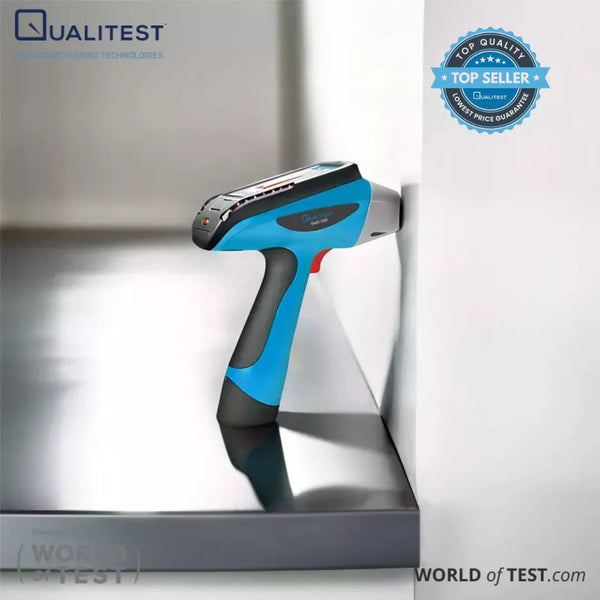
- Impressive Speed: Our modern gear spits out results in just a few seconds. We believe this snappy speed is a lifesaver for busy shops that cannot afford to have work pile up. For example, our Handheld Portable XRF Analyzer QualiX™ 2000 Series displays element readings from Magnesium (Mg) to Uranium (U) in as little as 2 seconds. Plus, it features an IP64 dustproof and weatherproof rating, and packs a 9000mAh battery for up to 12 hours of continuous use right in the field.
- No More Breathing in Nasty Stuff: Ditching chemical acid tests means your team does not have to breathe in toxic fumes or worry about chemical spills. It keeps the workspace much safer, lowers your insurance worries, and makes satisfying strict workplace safety rules from agencies like OSHA much simpler for facilities operating across the United States.
How to Choose Gold Density Tester: 5 Essential Criteria
Since measuring specific gravity using Archimedes' principle is one of the easiest and most reliable ways to test metal without hurting it, it is usually where most folks start out. If you are looking at your options and trying to figure out how to choose gold density tester that actually fits your daily workflow, we think you should look at these key things:
1. Sample Volume and Capacity
Analyzing the volume and physical dimensions of your test items is key.
If you are dealing with large, heavy bars, solid ingots, or heaps of scrap from the busy North American 'cash for gold' and metal recycling markets, you will need a machine that can handle some serious weight. Trying to squeeze oversized ingots into a tiny testing chamber will only slow down your entire team, while using an oversized tank for a single thin chain might reduce the accuracy of your reading.
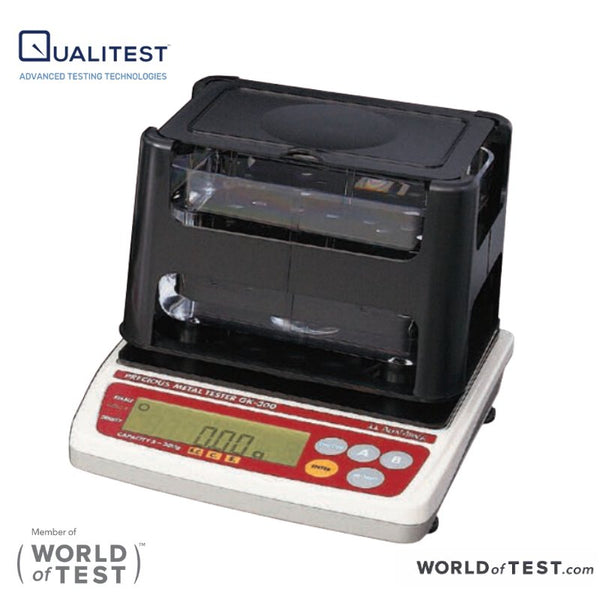
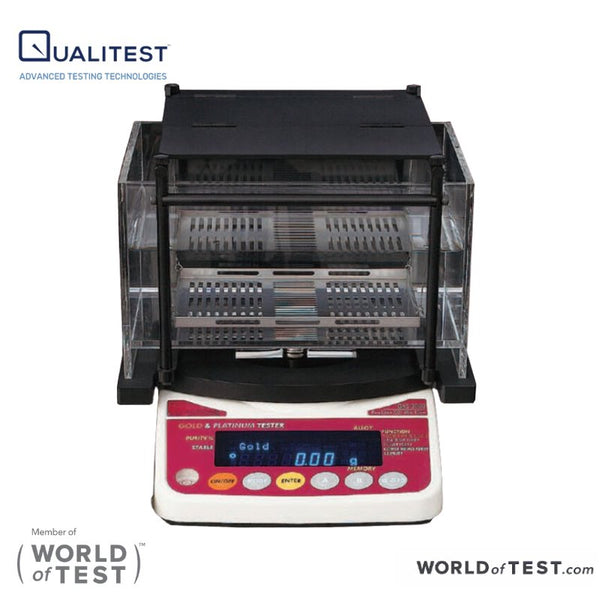
For heavy lifting, our GKS-3000 is engineered perfectly for this, offering a measuring range of 0.01g up to a massive 3,000g. On the flip side, if you are just checking delicate rings and thin chains, a baseline setup like the GK-300, which features a practical measuring capacity of 0.001g to 300g, works beautifully. Also, ensuring the system easily reads regional standards like troy ounces and pennyweights is a huge plus.
2. Measurement Precision and Resolution
Precision is a critical factor for high-value transactions. Typical commercial densimeters have a readability of 0.1 g/ml, which unfortunately leaves too much uncertainty to clearly separate real gold from tungsten fakes. Catching highly sophisticated counterfeits requires a machine that registers the absolute smallest fractions of a gram.
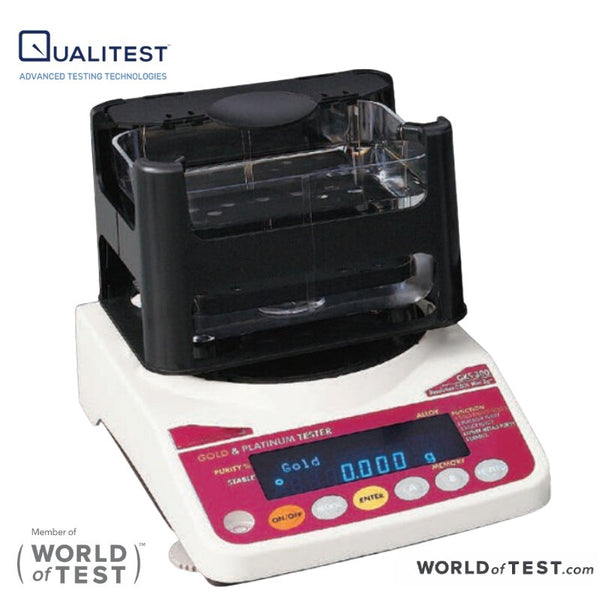
If you are a high-end lab or dealing with super-expensive pieces, you need tighter margins. For instance, our GKS-300 provides an ultra-fine density resolution of 0.001g/cm³. It requires a minimum sample weight of just 2g to flawlessly evaluate gold from K9 to K24 (up to 99.9% purity), giving you the laboratory-grade accuracy you need.
3. Environmental and Liquid Control
Liquid handling and room conditions dramatically affect density measurement accuracy. Even a slight draft from an overhead air conditioning vent or a tiny shift in room heat can throw off a sensitive hydrostatic reading.
We believe you must use pure distilled water, match it to the room temperature, and manage airflow to avoid trapped bubbles and liquid temperature changes.
4. Automation and Ease of Use
We honestly think that doing manual math calculations is an absolute recipe for costly human errors! Selecting an electronic tester that automates the calculation and displays the karat count instantly keeps your staff efficient and reduces the need for manual record-keeping.
Picking an automated electronic tester that does all the heavy lifting and displays the karat count instantly is a total lifesaver for a busy team. Plus, an automated machine means you can train new staff members in just a few minutes, rather than teaching them complex formulas.
Related article: How to Test Gold Purity: Non-Destructive Systems Guide
5. ROI and Long-Term Value
B2B buyers need high-grade laboratory accuracy without overextending operational budgets. Focus on finding a dependable unit constructed from durable materials that will survive years of heavy daily use without demanding constant repairs.
We believe finding a machine that balances undeniable reliability with a sensible price tag is the best way to keep your business running smoothly.
Technology Comparison: Density, XRF, and Micro-CT
Getting a good grasp on the technology is just as important as knowing you need to buy it. While density testers are amazing everyday workhorses, your business might eventually need something with a bit more analytical muscle.
In fact, historical studies point out that simple hydrostatic weighing can sometimes be the least suitable method for highly precise karat verification on its own.
So, what are your options for deeper analysis?
X-Ray Fluorescence (XRF)
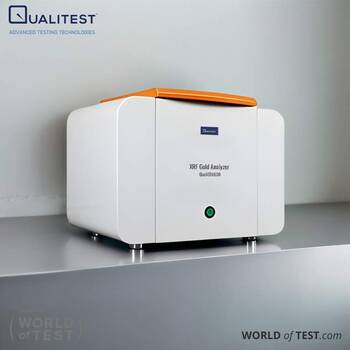
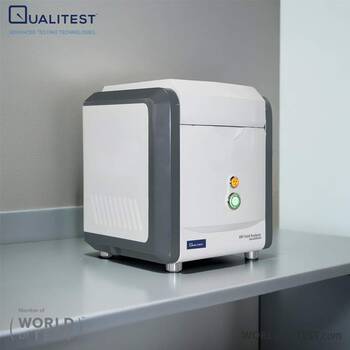
If your facility needs to measure compositional percentages from a minor 0.01% up to 99.99% (like our benchtop QualiEDX™ 600), or if you need an advanced system that secures an operating stability variance of just 0.1% for pure gold exceeding 95% while also evaluating plating thickness (like the QualiEDX™ 800), XRF is the logical next step. It provides incredibly fast, chemical-composition information without any surface damage.
Dual-Energy Micro-CT
However, XRF typically only reads surface layers up to about 2mm deep. What happens if a fake tungsten core is hidden deep inside a thick gold bar? That is where dual-energy micro-computed tomography (micro-CT) steps in.
This technology acts like a medical scan for your metals, peering completely through the item to detect internal fake parts and identify different materials hidden far underneath the surface. While it provides an incredibly thorough internal view, this complex machinery is still primarily a research-stage tool and simply is not practical or affordable for daily commercial shop use just yet.
Since choosing between accessible methods like density testing and XRF can completely reshape your workflow, we have put together a dedicated, in-depth guide comparing these two main commercial technologies side-by-side. Check out our detailed comparison article to find out which setup makes the most sense for your business!
Read more: Density vs. XRF: Choosing Your Gold Testing Equipment
Qualitest: Advanced Non-Destructive Testing Tools
At Qualitest, we specialize in providing cost-effective, highly accurate precious metal testing systems that protect your financial margins.
We do not simply ship equipment and walk away. Instead, we support your operations over the long term with solid warranties, dependable technical support, and ongoing calibration guidance to ensure your measurements remain precise year after year. Whether you need a practical hydrostatic system for daily density analysis or a highly detailed chemical composition analyzer, we have a reliable solution for your facility.
We are here to support your quality control and help you secure customer trust. Explore our cost-effective ranges of Gold Purity Testers and XRF Spectrometers and Metal Analyzers today, or contact our sales team to request a quote.
References (Click to expand)
- Abdullah, J., Samsudin, A., Omar, N., & Manan, H. A. (2015). Non-Destructive Assaying Gold Jewellery Using Dual-Energy Micro-Computed Tomography. Jurnal Teknologi, 73.
- Goldman, M., Davis, D., & Clifford, R. (2009). Preventing the Sale of Fraudulent Gemstones using Non-Destructive X-Ray Fluorescence Spectroscopy. Microscopy Today, 17, 52-55.
- Hazan, R., Paulus, W., & Sapiee, N. (2020). GOLD JEWELRY ANALYSIS: XRF APPLICATIONS. 65-69.
- Li, H., Wang, X., Zhu, Y., & Wang, Y. (2015). Rapid synthesis determination of gold in gold jewelry alloys. Atlantis Press.
- Li, H., Shi, S., Wang, X., Zhu, Y., Yu, N., & Wang, Y. (2015). Determination of Gold in Gold Jewelry Alloys by a Synthesis Method. Advanced Materials Research, 1120-1121, 1350-1355.
- Mercer, M. E. (1992). Methods for Determining the Gold Content of Jewelry Metals. Gems & Gemology, 28, 222-233.
- Nor, F. M., Tamuri, A. R., Ismail, A., & Mazuki, A. (2020). Verification of the hydrostatic weighing system with existing gold purity instruments. IOP Conference Series: Materials Science and Engineering, 824.
- Rashid, W. N. A., Mohamad, E. J., Rahim, R. A., Abdullah, J., Ameran, H., Kok, S. L., Sapiee, M. R., Saat, S., & Subki, A. (2016). Design of non-destructive test on gold metal using parallel plate capacitance sensor: A conceptual framework. 2016 IEEE Student Conference on Research and Development (SCOReD), 1-6.
- Singh, D., Singh, V. N., Jalan, I., Singh, N., & Singh, S. P. (2025). Modern Competent Methods for Purity Determination of Gold: Some Practical Aspects. Journal of Materials Engineering and Performance, 34, 12269-12286.