Want to instantly safeguard your business profits and build unmatched trust with your clients?
For companies handling precious metals daily, knowing exactly how to test gold purity without causing any inventory damage is the ultimate way to close deals with confidence. Let’s look at why utilizing a modern specific gravity balance is a total win for your business, and see exactly how a gold density tester works to keep your cash flow completely secure.
Key Takeaways
Before looking at the technical details, here is a quick summary of the core facts:
- Preserve your stock value: Specific gravity testing is entirely non-destructive, meaning you protect the exact retail form and full value of your gold.
- Smart scientific foundation: These systems use simple water displacement to calculate density and estimate karat purity with high reliability.
- Eliminate operational delays: You get accurate readings in just a couple of seconds, keeping your transactional workflow moving.
- Clear operational boundaries: While highly reliable for solid items, density testers cannot test hollow jewelry or pieces set with gemstones, and they cannot detect tungsten-filled fakes on their own.
Comparing Gold Verification Methods
Back in the day, operators testing metal had to make do with some highly destructive and inaccurate options to figure out how to test gold purity.
Limitations of Acid Testing
This traditional approach involves scraping your gold item across a touchstone and applying highly corrosive nitric acid over the mark. Sure, the starter kits are cheap, but this method leaves an ugly, permanent scar on your inventory, relies far too much on an employee's subjective color guessing, and forces you to keep dangerous chemicals on your retail counter.
In our view, using harsh acids in front of a modern client looks incredibly outdated and compromises your professional image.
Constraints of Fire Assaying
This is the classic approach to getting an absolute reading by melting the entire gold piece. But let's face facts: melting down your own inventory destroys its retail form, takes hours, and belongs strictly in a giant refinery, not on a retail counter or a quick trade desk.
Today, your business needs a method that is simple, cheap, and does not damage the gold. We believe that turning to modern specific gravity equipment is the smartest move a growing enterprise can make.
How a Gold Density Tester Works
To get your metal verification process to a level of total certainty without damaging a single piece of stock, you need to rely on electronic density balances. We believe specific gravity is easily the most straightforward, hassle-free way to verify your inventory.
The way how a gold density tester works relies on a clever bit of physics from way back: Archimedes’ buoyancy principle, an old standard for checking if gold has been adulterated with lighter materials.
Pure 24-karat gold has an incredibly heavy, unmistakable density of around 19.30 grams per cubic centimeter. Counterfeiters usually mix in cheaper metals like copper, zinc, or lead to make their knock-offs heavy, but none of those can replicate the heavy footprint of real gold.
Here is the straightforward breakdown of how a gold density tester works in practice:
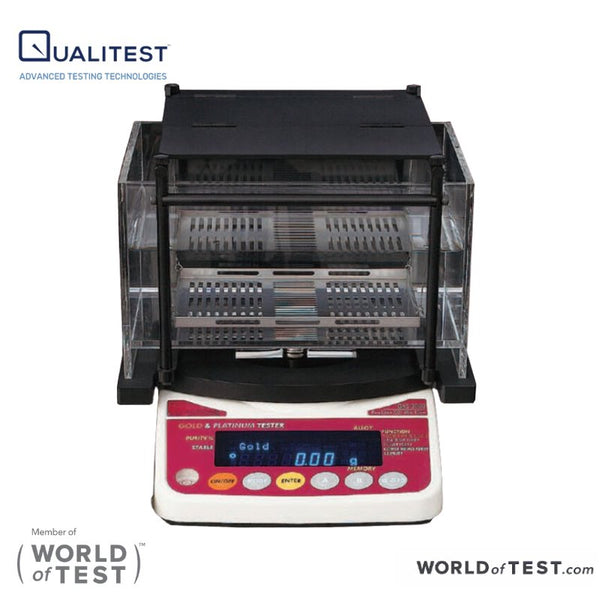
- Weight in the air: You place the gold piece onto the top scale of the device to record its precise weight in the open air.
- Weight in the water: Next, you lower the item into a clear container of liquid (usually pure distilled water) sitting directly below. To reduce measurement errors, you must match the water temperature to your room temperature. The device measures how much the item weighs when it is fully submerged.
- Instant calculation: The built-in microprocessor looks at the dry weight and the submerged weight to find the buoyant force, instantly calculating the exact volume of water pushed aside.
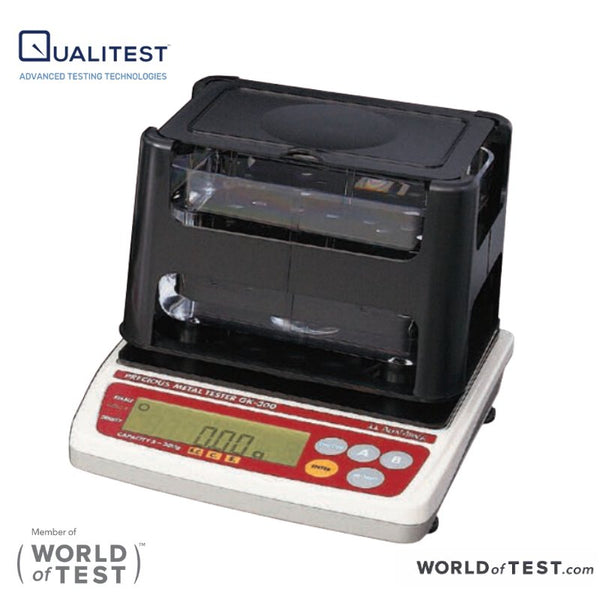
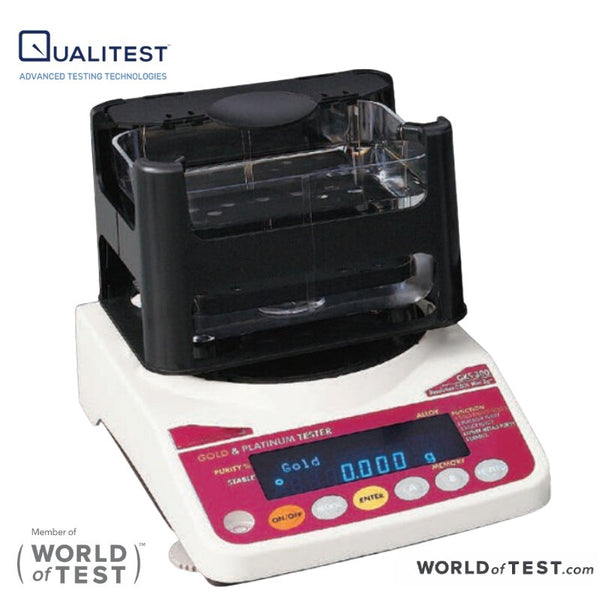
By dividing the dry weight by the volume of water displaced, the machine calculates the precise density of your item. For instance, a unit like the Qualitest GKS-300 provides high-precision resolution specifically for the exacting analysis of small, high-value items.
Within seconds, the digital screen displays the exact karat value (14K, 18K, 22K) and the exact purity percentage from its built-in reference tables. No guesswork, no drama.
Density Testers vs. XRF Scanners
While traditional acid bottles are a poor choice, modern overviews list both density balances and X-ray Fluorescence (XRF) analyzers as key non-destructive options. Both technologies serve essential roles in material verification.
XRF analyzers offer incredibly high-speed, elemental analysis of surface alloys, whereas density testers focus on verifying the overall bulk density of the entire item.
Which technology matches your specific operational volume, workflow, and budget? We compare the distinct strengths of both systems to help you choose: Density vs. XRF: Choosing Your Gold Testing Equipment
Limitations of Density Testing
Honesty is everything in B2B transactions, and knowing your equipment inside and out is essential. We strongly believe that being fully transparent about what a machine cannot do is a million times better than using sales talk.
Let's be real: no single device is a magic solution for everything. While density testing is incredibly reliable, typical shop densimeters have an uncertainty around 0.1 to 0.2 g/mL, which means you have a few specific limits to keep in mind:
- Hollow or porous items: Because it relies on submerging items in water to measure volume, anything that is completely hollow or has a porous surface will trap air bubbles and yield an incorrect reading by changing the apparent density. For instance, a heavy, solid Miami Cuban link, a massive staple across US retail counters, will test perfectly every time, but a hollow gold rope chain will trap air and require a different approach.
- Tungsten-filled fakes: Gold (19.30 g/mL) and tungsten (19.25 g/mL) have almost identical densities, meaning standard density testers simply cannot distinguish a tungsten-filled fake from real gold on their own.
- Gemstone interference: If you have jewelry loaded with heavy gemstones, the scale will get confused because those stones have totally different weight properties than the gold itself.
To get the most accurate readings possible, you need to replace your distilled water regularly, ensure it is traceable to standards, and carefully control the temperature, airflow, and instrument levelling. For solid, stone-free chains and standard bands, we think a straightforward, proven unit like the GK-300 Basic Model is absolutely unbeatable for reliable, daily use on your retail counter.
Operational Advantages of Density Testing
Once you see exactly how a gold density tester works, the financial return for your business is incredibly clear. Placing one of these scales on your counter gives you some massive, immediate advantages:
Non-Destructive Material Analysis
Unlike acid kits, this method is 100% non-destructive. Your inventory stays absolutely pristine, avoiding damaging cuts or drills, and keeps every penny of its retail value.
Related article: How to Choose Non Destructive Gold Density Tester
Efficient Turnaround Times
You get your answers in a couple of seconds. In our view, any testing process that makes you or your client wait around for more than a minute is a severe operational bottleneck that slows your business down to a crawl, and busy shops cannot afford that.
Multi-Metal Compatibility
These scales are not single-purpose tools. They work beautifully for verifying the standard 10K and 14K alloys that dominate the American market, and they evaluate silver and platinum with equal precision.
If you are dealing with massive regional bullion like American Gold Eagles, Canadian Maple Leafs, or heavy scrap metal, a high-capacity solution like the GKS-3000 is engineered perfectly for verifying large, heavy pieces and ingots. It is like having multiple testing tools in one package.
Transparent Client Verification
Handing your client or vendor a digital, objective readout builds instant, rock-solid trust. We believe today's buyers expect hard, objective data on a screen, not just a salesperson nodding their head and saying it looks fine.
Trust Your Gold Verification Process to Qualitest
At Qualitest, we do not think acquiring highly precise testing equipment should mean emptying your bank account. When your daily cash flow depends on knowing exactly how to test gold purity with absolute, sleep-easy certainty, we have your back with reliable, cost-effective setups that give you high-end laboratory precision without the heavy price tag.
We have a fantastic lineup of highly accurate gold density testers built specifically for the needs of North American jewelry shops, busy trade desks, and commercial assay labs. Our setups are engineered to protect your profits and streamline your workflow from day one.
Stop guessing and start protecting your profits today. We invite you to explore our cost-effective setups and find the perfect fit for your counter by taking a look at our collection of Gold Purity Testers.
References (Click to expand)
- Nor, F. M., Tamuri, A. R., Ismail, A., & Mazuki, A. (2020). Verification of the hydrostatic weighing system with existing gold purity instruments. IOP Conference Series: Materials Science and Engineering, 824.
- Singh, D., Singh, V. N., Jalan, I., Singh, N., & Singh, S. P. (2025). Modern Competent Methods for Purity Determination of Gold: Some Practical Aspects. Journal of Materials Engineering and Performance, 34, 12269-12286.
- Sinkankas, J. (1986). Contributions to A History of Gemology: Specific Gravity — Origins and Development of the Hydrostatic Method. Gems & Gemology, 22, 156-165.
- Thompson, F. (2008). Archimedes and the golden crown. Physics Education, 43, 396-399.