Let’s talk about that moment when a customer unboxes your product. That flawless, consistent shine isn't just luck. It is engineering. Whether you are crafting luxury automobiles, sleek electronics, or high-end furniture, getting the visual finish exactly right is what separates premium brands from the budget options.
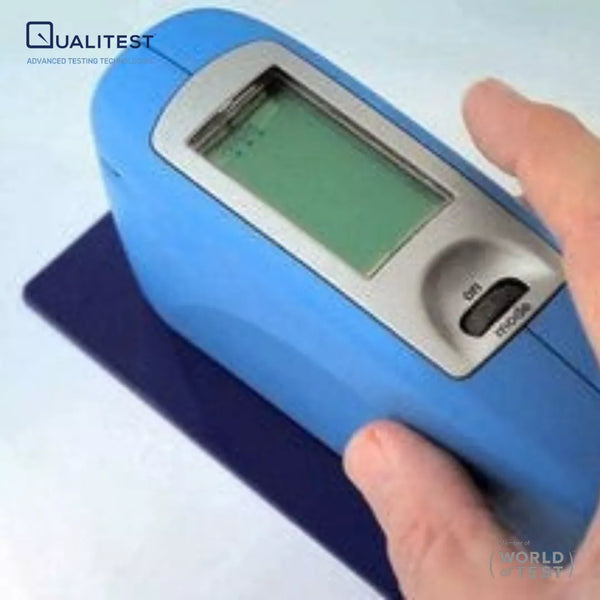
To hit that mark of perfection every single time, you need more than just good lighting. You need precise data. That is why we place such high value on the versatility of the Gloss Meter Micro-TRI-Gloss. It is the specific tool that turns "looks good to me" into "guaranteed quality."
Key Takeaways
- Visual quality is a direct indicator of manufacturing consistency and brand value.
- Accurate measurement requires specific angles, with 20 degrees for high gloss and 85 degrees for matte finishes.
- Relying on a standard 60 degree angle for every surface often results in unreliable data.
- A tri-angle gloss meter consolidates all three geometries into one efficient tool for diverse production lines.
- Qualitest provides cost-effective, digital solutions like the Micro-TRI-Gloss that ensure compliance without overspending.
Getting the Angles Right (Because Looks Deceive)
You cannot simply aim a sensor at a plastic part and hope for accuracy. You have to capture the reflection at the specific angle that mimics how human eyes actually perceive that surface.
Gloss meters commonly measure specular gloss at three standard angles: 20°, 60°, and 85°, each suited for different surface types and gloss levels (Yong et al., 2020; Zarobila et al., 2024; Budde, 1980).
From our time working with countless labs, we see far too many technicians relying on a single angle for everything. We consider this a significant oversight. To get it right, you really need the full trio:
20° (The High Gloss)
This acute angle is used for high-gloss surfaces (Budde, 1980). Think about that deep, wet-look black finish on a grand piano or a luxury sedan.
If you measure that with a standard 60° angle, it might read as 'shiny,' but it won't catch that subtle milky haze that kills the premium vibe. Only the 20° angle catches that defect.
Related article: The Difference Between Gloss and Haze
60° (The Universal Standard)
The 60° angle is considered the universal or reference angle for general gloss measurement (Zarobila et al., 2024). Almost everyone uses this as the standard starting line. But we feel strongly that it should not always be the finish line.
85° (The Matte Finish)
For surfaces intended to be non-reflective, like leather interiors or dull plastics, the 85° angle is preferred. It provides a more sensitive reading for low-gloss or matte surfaces (Yong et al., 2020).
Consider a leather dashboard. It needs to look rich but flat so it doesn't blind the driver with glare. If you use a 60° angle here, the numbers will bounce around without making sense. The 85° angle is the only way to confirm that the texture is consistent and safe.
Why You Need a Tri-Angle Instrument
Here is the issue most production floors face. You are rarely manufacturing just one type of finish. You might have a high-gloss cover here and a matte button there. Purchasing a different instrument for every surface texture is, in our view, an inefficient use of your budget.
This is why we constantly recommend a gloss meter 20 60 85, such as our Micro-TRI-Gloss series. The tri-angle gloss meter combines these three angles in one instrument, allowing comprehensive gloss characterization across a wide range of surface finishes, from matte to high gloss (Weber et al., 2023; Schreckendgust & Gowing, 1958).
Read more: Single Angle vs Tri Angle Gloss Meter: Expert Guide
Using a versatile unit like this keeps your operations smooth because:
- You capture complexity: This approach helps capture the complex interaction of light with surface roughness and texture, as different angles highlight different surface features and gloss behaviors (Yong et al., 2020; Safi et al., 2023).
- It is efficient: Technicians can switch measuring modes instantly. For those handling coatings, dual-function models like the Micro-TRI-Gloss µ even measure paint thickness simultaneously.
- It stops the estimation: If a 60° reading is too high (>70 GU), the device directs you to the 20° angle. If it drops significantly (<10 GU), you switch to 85°. It is that straightforward.
Let’s Look at a Real Scenario
Imagine you are running QC for an automotive supplier. You have high-gloss exterior trim coming down Line A that needs to gleam perfectly, which requires a 20° check. Five minutes later, you are inspecting the soft-touch matte buttons for the console on Line B, which requires an 85° check.
If you are using a basic single-angle device, you are stuck. You either miss the haze on the trim or you get useless data on the buttons. With a gloss meter 20 60 85, you simply press a button to switch modes. You catch the hazy trim, you approve the matte buttons, and you keep the line moving without missing a beat.
Who is Actually Using This?
Tri-angle gloss meters are especially useful in quality control and research where precise and reproducible gloss data are needed (Cook & Thomas, 1990; Budde, 1980).
We have observed that the most effective quality teams are the ones that adapt to their specific materials. Our Tri-Gloss units are staples in sectors where visual perfection is the only option:
- Automotive: It is not just about paint. We see clients using the 20° setting to perfect that "mirror-like" chrome on the grill. For strictly matte interiors, many prefer the Micro-TRI-Gloss S variant for its enhanced precision on low-gloss surfaces.
- Consumer Electronics: Smartphones and laptops. Users expect that sleek, liquid-glass look. A 20° check ensures the finish feels premium in the hand.
- Aerospace: Cabin interiors. Business class seats need to look pristine but not glare under reading lights (perfect for the 85° angle).
- Plastics & Packaging: Precise gloss data is critical for moulded plastics (Cook & Thomas, 1990). Think about a high-end perfume box where the varnish needs to pop on the shelf. Our unit checks that consistency in seconds.
- Coil Coatings: Monitoring those massive metal finishing lines to prevent haze.
Quality Control That Won't Drain Your Budget
At Qualitest, we hold a strong opinion on equipment costs. High precision shouldn't demand an exorbitant budget. We know QC managers are under pressure to improve consistency while spending less.
If you strictly run a single application, a simple MiniGloss 60° might get the job done. But for facilities that need flexibility, we firmly believe you should not have to pay a premium just for a famous logo.
Our Gloss Meter Micro-TRI-Gloss 20°, 60°, 85° compares favorably with the expensive brands on accuracy, but for a cost that makes sense for your bottom line.
Data That Actually Means Something
Also, manually recording figures on a clipboard? We believe that method is outdated. Modern QC requires concrete digital receipts.
When you use the Micro-TRI-Gloss, you aren't just seeing a digital readout. These units calculate the statistics for you—Averages, Max/Min, Deviations—directly on the display. Plus, with substantial onboard memory and simple USB/Bluetooth connections, keeping your records organized for audits is effortless.
Stop Estimating and Start Measuring
Uniformity is how you maintain customer loyalty. Seriously, trusting your own eyes or an obsolete single-angle device is a risk you do not need to take. Integrate a versatile gloss meter 20/60/85 into your workflow and ensure that every single product leaving your dock looks absolutely flawless.
We are here to help you secure the right equipment without the inflated price tag.
Ready to stop making excuses for your surface quality? Review our cost-effective options of Gloss Meter Collection here
References
- Budde, W (1980). A Reference Instrument for 20°, 60° and 85° Gloss Measurements. Metrologia, 16, 1 - 5.
- Cook, M., & Thomas, K. (1990). Evaluation of gloss meters for measurement of moulded plastics. Polymer Testing, 9, 233-244.
- Safi, M., Ameri, F., & Ansari, K. (2023). Specular gloss estimation by measuring the colorimetric data produced by a reflection measurement at 8° of incidence. Physica Scripta, 99.
- Schreckendgust, J., & Gowing, D. (1958). High-speed, direct-reading glossmeter. Journal of the Optical Society of America, 48, 241-245.
- Weber, C., Sauer, H., & Dörsam, E. (2023). Modeling and investigating the dynamic gloss of flexo printed UV-inks containing aluminum pigments.
- Yong, Q., Chang, J., Liu, Q., Jiang, F., Wei, D., & Li, H. (2020). Matt Polyurethane Coating: Correlation of Surface Roughness on Measurement Length and Gloss. Polymers, 12.
- Zarobila, C., Nadal, M., & Miller, C. (2024). Measuring gloss using spectral reflectance. Measurement Science and Technology, 35.