Great design deserves a flawless finish. Whether you are manufacturing sleek automotive components or high-clarity films, the visual appeal of your product is often the deciding factor for your customers.
At Qualitest, we see precise optical testing not just as a requirement, but as a major competitive advantage. Mastering the optics of your material ensures your brand stands out for all the right reasons.
You will often encounter two critical terms in this process: gloss and haze. While both relate to light, they measure completely different visual properties. Understanding the technical difference between gloss and haze is essential for selecting the right equipment.
What Exactly is Gloss?
Gloss is simply a metric for specular reflection. In practical terms, it quantifies how well a surface reflects light in a mirror-like direction (Hunter, 1937).
When light strikes a smooth surface, it reflects off at the exact same angle it arrived. A surface with high gloss appears wet, bright, and reflective. Think of the deep, piano-black trim inside a luxury vehicle or a freshly polished granite countertop. That sharp, crisp look where you can clearly see the reflection of your own face? That is high gloss.
Related article: Gloss Meter 20/60/85: Measure Matte to High Gloss Now
If the surface is rough or textured, the light scatters in multiple directions (diffuse reflection), making the surface appear matte or flat. Industries like automotive, furniture, and paint manufacturing rely heavily on gloss meters to ensure batch-to-batch consistency (Beuckels et al., 2022).
In our experience, gloss is usually the first metric QA teams review. However, as established by Ged et al. (2010), recognizing real materials often requires understanding more than just their glossy appearance.
Related article: Single Angle vs Tri Angle Gloss Meter: Expert Guide
Grasping Haze
Haze is a measure of light scattering. It describes that distracting "cloudiness" or "milky" appearance that can ruin a material (Billmeyer & Chen, 1985).
To fully distinguish the gloss vs haze dynamic, you must separate haze into the two types that frustrate manufacturers:
- Reflection Haze: This occurs on high-gloss surfaces. Picture a polished car hood that looks shiny from ten feet away, but when you get close, there is a milky halo surrounding the reflection of the overhead streetlamp. That is reflection haze; the surface is shiny, but the reflection is not clear (Vangorp et al., 2017).
- Transmission Haze: This affects transparent materials like plastic films, glass, or screens. Consider a clear plastic sandwich bag. If you hold it up and the sandwich inside looks blurry or soft-focus, you are dealing with high transmission haze (Luna-Navarro et al., 2024).
We find that transmission haze is the most overlooked parameter in packaging. Many producers focus on transparency but forget that a material can be transparent yet still "hazy," affecting how the consumer views the product inside.
The Difference Between Haze and Gloss: A Breakdown
To help you visualize the difference between haze and gloss without the confusion, we’ve outlined the primary distinctions below. This table synthesizes data on definitions and visual effects (Beuckels et al., 2023; Simonsen et al., 2009).
| Feature | Gloss | Haze |
|---|---|---|
| What we are tracking | Directional reflection (Intensity/Shine) | Scattered light (Cloudiness/Clarity) |
| Visual Effect | Sharp, mirror-like reflection | Milky, blurry, or halo-like effect |
| The Primary Question | "How shiny is the surface?" | "How clear is the material?" |
| Key Industries | Automotive, Paints, Polished Metals | Packaging, Plastics, Glass, Screens |
It is entirely possible for a product to possess high gloss but also high haze. For example, a clear plastic sheet might be very shiny (high gloss) but still look cloudy when you look through it (high haze).
This relationship is well documented (Simonsen et al., 2009; Andreassen et al., 2002), which is why we always recommend measuring both sides of the gloss vs haze equation for a complete picture of optical quality.
Root Causes Affecting Gloss vs Haze
Before you can resolve a defect, you must identify the source. From troubleshooting hundreds of client applications, we find that the root cause is rarely a mystery. It usually comes down to specific process variables defined in material science.
When testing for the difference between gloss and haze, you are essentially looking for these common culprits:
- Surface Texture: Increased microscale roughness raises haze and reduces gloss (Simonsen et al., 2009; Bafna et al., 2001). We see this often in injection molding, where a slightly rough mold surface leaves the final plastic part looking dull instead of glass-like.
- Dispersion Issues and Inhomogeneities: In our opinion, this is the leading culprit in plastics. Bulk or surface defects scatter light, increasing haze (Andreassen et al., 2002). This looks like a clear water bottle that has a slight, foggy yellow tint because the internal additives didn't mix fully.
- Coating Defects: Application issues can drastically alter gloss readings. Dirt, polishing marks, or poor coatings can increase haze and decrease gloss (Beuckels et al., 2023). A classic example is "orange peel" on powder-coated metal, where the finish looks bumpy like citrus skin rather than smooth paint.
- Particle Structure: In films and coatings, the arrangement and size of particles affect both gloss and haze (Semmler et al., 2018).
Selecting Equipment for the Difference Between Gloss and Haze
Once you identify the issue, you need precise quantification. Knowing the technical difference between gloss and haze helps you select the solution that works without draining your budget.
We advocate for "smart spending" in the lab. You need equipment that meets the standards, but you shouldn't have to overpay for features you will never utilize.
1. Measuring Surface Shine (Gloss)
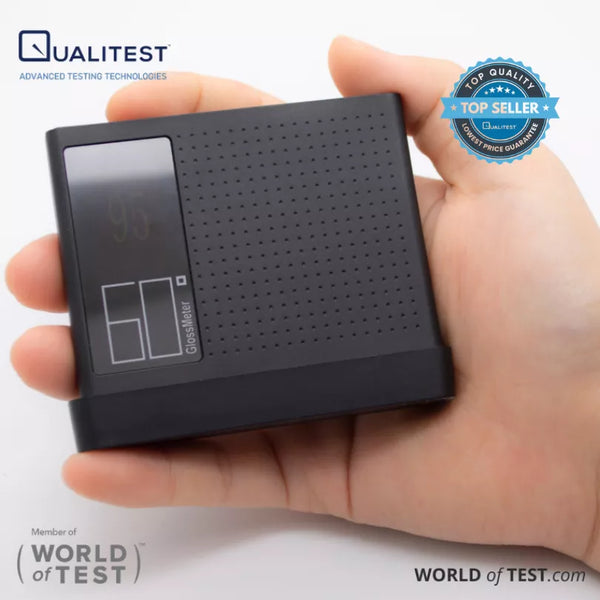
If your goal is to control the visual "pop" or shine of an opaque surface, such as paint, coated metal, or polished stone, you need a Gloss Meter.
We offer a wide range of portable and benchtop gloss meters built for various angles (20°, 60°, 85°) to suit different materials. Crucially, our instruments adhere to major international standards such as ASTM D523 and ISO 2813.
From our MiniGloss QG60 Series for quick checks to our advanced Micro-TRI-Gloss for comprehensive analysis, we have instruments that fit both your technical specifications and your budget.
Explore our Gloss Meters here: Gloss Meters Collection
2. Measuring Transparency and Clarity (Haze)
If you are manufacturing transparent products like packaging films, touchscreens, or eyewear, measuring specular gloss isn't sufficient. You need to quantify how light passes through the material.
Our Portable Haze Meter (QualiHaze QH-Series) is engineered specifically for this task. It measures transmission haze and transmittance with high accuracy. It is fully compliant with industry standards ASTM D1003 (the standard test method for haze and luminous transmittance of transparent plastics) and ISO 14782.
Discover our Haze Meter solutions: Portable Haze Meter
Why Choose Qualitest?
At Qualitest, we understand that reliable data shouldn't require a budget-breaking investment.
As a leading North American supplier, we challenge the notion that high precision requires a high price tag. We specialize in providing cost-effective, high-precision testing instruments that perform on par with the most expensive brands on the market.
Whether you are resolving a "milky" finish on a glossy product or need to ensure the clarity of a new plastic film for ASTM D1003 compliance, our team is here to help you manage the specific requirements regarding the difference between haze and gloss.
Ready to improve your product quality without overspending? Contact us today to discuss your application, and let us help you find the perfect, budget-friendly testing solution for your needs.
References:
- Andreassen, E., Larsen, Å., Nord-Varhaug, K., Skar, M., & Oysaed, H. (2002). Haze of polyethylene films—effects of material parameters and clarifying agents. Polymer Engineering and Science, 42, 1082-1097.
- Bafna, A., Beaucage, G., Mirabella, F., Skillas, G., & Sukumaran, S. (2001). Optical properties and orientation in polyethylene blown films. Journal of Polymer Science Part B, 39, 2923-2936.
- Beuckels, S., Audenaert, J., Hanselaer, P., & Leloup, F. (2022). Development of an image-based measurement instrument for gloss characterization. Journal of Coatings Technology and Research, 19, 1567-1582.
- Beuckels, S., Audenaert, J., & Leloup, F. (2023). Optical characterization of the psychophysical surface gloss space in the presence of surface haze. Optics Continuum.
- Billmeyer, F., & Chen, Y. (1985). On the measurement of haze. Color Research and Application, 10, 219-224.
- Ged, G., Obein, G., Silvestri, Z., Rohellec, J., & Viénot, F. (2010). Recognizing real materials from their glossy appearance. Journal of vision, 10 9.
- Hunter, R. (1937). Methods of determining gloss. Journal of research of the National Bureau of Standards, 18, 19.
- Luna-Navarro, A., Brembilla, E., De La Barra, P., Moreau, L., & Overend, M. (2024). Luminance-based methodology for assessment of low level haze in glazing. Glass Structures & Engineering.
- Semmler, J., Bley, K., Taylor, R., Stingl, M., & Vogel, N. (2018). Particulate Coatings with Optimized Haze Properties. Advanced Functional Materials, 29.
- Simonsen, I., Larsen, Å., Andreassen, E., Ommundsen, E., & Nord-Varhaug, K. (2009). Haze of surface random systems: An approximate analytic approach. Physical Review A, 79, 063813.
- Vangorp, P., Barla, P., & Fleming, R. (2017). The perception of hazy gloss. Journal of vision, 17 5, 19.