Leaning on a single melt flow number is a massive gamble that just isn't cutting it anymore. In the high-stakes business of factory-floor production, playing a hunch on how your molten material acts is a straight shot to a bad day.
To get the full, high-definition picture, you’ve got to get cozy with the flow rate ratio. As a North American crew that lives for testing gear, we’re here to show you why this specific number is the key to staying ahead of the pack.
Key Takeaways
- Relying on a basic melt flow test leaves too much to chance; calculating the flow rate ratio gives you the complete blueprint of how your material will actually behave under pressure.
- We consider this metric the ultimate magnifying glass for your polymer's internal structure, helping your team accurately predict shear thinning and optimize high-speed production.
- Nailing a reliable measurement demands highly accurate, automated testing hardware to completely wipe out human error and protect your factory floor from costly material waste.
The Fundamentals of Flow Rate Ratio
In plain English, the flow rate ratio is that one specific number that shows you how your plastic’s thickness shifts when the pressure really starts cooking.
You find it by grabbing the flow speed of your material at two different heavy-duty weights while keeping the heat exactly the same. Then, you just do a quick bit of math to find the gap between the high-pressure value and the low-pressure one.
Here is the exact math breakdown you need:
FRR = MFR (High Load) ÷ MFR (Low Load)
Let’s throw some real numbers at it. Say your heavy-load test spits out 50g/10min, and your light-load test gives you 5g/10min. You simply divide 50 by 5, which leaves you with a flow rate ratio of 10. It’s basic math, but it tells a massive story about your material's internal structure.
For example, when people are checking polyethylene, a widely used flow rate ratio is I21/I2. This is the ratio of the melt index at a 21.6 kg load compared to the index at 2.16 kg, both at the same temperature. This resulting number acts like a magnifying glass.
Related article: MFR vs MVR: Why Both Metrics Matter for Your Production
It reveals how the tiny internal bits of your material are actually put together. While a single flow test tells you the average weight of the molecules, we look at the flow rate ratio as a practical tool to identify the polymer type and architecture, such as whether it is bimodal or long-chain branched.
Why Flow Rate Ratio is Critical for Your Production Quality
From where we’re sitting, keeping an eye on your flow rate ratio is a total necessity for several big reasons:
1. Predicting Shear Thinning and Material Flow
Plastics are weird; they get way thinner and slipperier when you push them faster. A big-time flow rate ratio usually means your plastic is super sensitive to pressure.
We’ve noticed that these materials generally slide through an extruder like a dream, which is the main reason your electricity bills stay low and your expensive gear doesn't wear out early.
2. Extracting Rheological Data at a Lower Cost
Using several loads on the same tester effectively generates a series of flow rates versus load.
We find this approach incredibly useful because these ratios can be transformed into shear stress versus shear rate data. This provides approximate viscosity curves comparable to full capillary rheometry but at a far lower cost.
3. Enhancing Data Integrity in Your QC Protocols
Trusting just one melt flow number is a gamble. We’re convinced that two piles of resin can look identical on a basic test but act like total opposites on the factory floor because they differ in molecular weight distribution (MWD) or branching.
By making the flow rate ratio a part of your daily routine, we’re certain you can catch those sneaky batch-to-batch changes before they turn into a mountain of wasted scrap.
Best Practices for Accurate Flow Rate Ratio Measurement
Getting a flow rate ratio you can actually trust requires gear that’s dead-on and won't flake out on you. You’ve got to stick to Procedure D of the ASTM D1238 standard, which is the specific way to run these multi-weight checks.
Since you’re relying on two different measurements, any tiny wiggle in the heat or the weight is going to make your final ratio look like nonsense.
In our view, trying to do this with old-school manual math or clunky, outdated machinery is just asking for a massive headache. You need a serious piece of hardware that handles the heavy lifting, tracks the piston movement perfectly, and crunches the flow rate ratio numbers automatically.
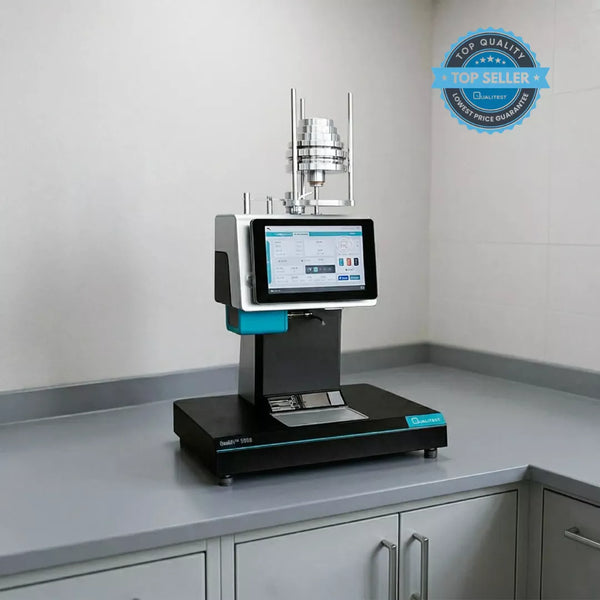
This is exactly where our Fully Automatic MFI QualiFi™ 6000G-Auto absolutely shines. If you want a machine that does the hard work for you, or if you prefer the incredibly sleek, automated setup of our MFI QualiFi™ 5000 Galaxy Series, you are setting yourself up for success.
It’s honestly the only way to make sure human error doesn't ruin your day.
Analyzing the Data: What the Ratios Indicate
Every material is a bit different, but we’ve found that having a general ballpark helps your team make lightning-fast choices. Here is a quick-reference cheat sheet showing exactly how this plays out:
| Polymer Category | Typical I21/I2 Range | Use Case | Ideal Manufacturing Method |
|---|---|---|---|
| Metallocene LLDPE | ~18 | Narrow MWD Resins | High-Precision Injection Molding |
| ZN-LLDPE | ~25 | Standard Distinctions | General Purpose Film |
| Broad MWD (HDPE) | 50 - 100+ | High-Speed Processing | Blow Molding & Pipe Extrusion |
Low Flow Rate Ratio (around 18-30)
These are widely considered "rock-solid" polymers. They don’t change much under pressure.
Metallocene LLDPE and certain standard grades of Nylon usually sit in this category, making them the top choice for injection molding where you need that material to fill every tiny corner of a mold perfectly without warping.
High Flow Rate Ratio (50 to 100+)
These are the high-speed workhorses. Across the manufacturing sector, these materials are treated as the kings of fast-moving production. High-Density Polyethylene (HDPE) is a prime example here.
They’re tough as nails when melted, which is exactly why they’re the universal go-to for manufacturing heavy underground pipes and massive liquid storage containers.
Common Testing Pitfalls and Preventive Measures
Even the best crews can run into snags that make the flow rate ratio look wonky. Based on what we’ve seen in the industry, keep your eyes peeled for these:
- Gunked-Up Parts: If your die isn't clean as a whistle, it’s going to choke the flow and give you a garbage flow rate ratio calculation.
- Cooking the Plastic Too Long: Timing is everything. If you leave the sample sitting in the hot barrel for too long, the plastic starts to break down or get weirdly chunky, which fakes out your results.
- Wet Resin Disasters: You’ve got to dry your stuff! If there’s even a hint of moisture in things like Nylon or PET, that water literally chops the long polymer chains into shorter pieces under high heat (a nasty process called hydrolysis). This molecular breakdown makes the flow speed skyrocket and turns your flow rate ratio into total fiction.
Get Your Lab Up to Speed with Qualitest
At Qualitest, we’re a North American team focused on helping you get your lab running like a well-oiled machine without making your budget people lose their minds.
We’ve got a whole spread of dead-accurate, wallet-friendly Melt Flow Testers that can take whatever your factory floor throws at them. Whether you just need the rock-solid basics for standard checks, like our dependable Melt Flow Indexer QualiFi-2000 Series (including the highly popular QualiFi-2000A and the dual-method QualiFi-2000AB), or you’re looking for a machine that handles the flow rate ratio math for you with pinpoint accuracy, we’ve got your back.
Want to see what your material is actually made of? Check out our budget-friendly and seriously impressive lineup of Melt Flow Testers and Indexers (MFI) to find the perfect fit for your shop.
References:
- Mertz, A., Mix, A., Baek, H., & Giacomin, A. (2013). Understanding Melt Index and ASTM D1238. Journal of Testing and Evaluation, 41, 50-62.
- Oubellaouch, K. (2024). A melt flow index-based approach for the viscosity curves determination. Materials Research Proceedings.
- Oubellaouch, K., Pelaccia, R., Orazi, L., Pozzi, P., Carmignato, S., Bonato, N., Donati, L., Raimondi, L., & Reggiani, B. (2025). A novel experimental–numerical procedure for the rheological characterization of thermoplastic polymers applied to injection molding. The International Journal of Advanced Manufacturing Technology, 140, 5419 - 5433.
- Rides, M. (1999). Review of melt mass flow rate and melt volume flow rate measurements for polymer melts.
- Rides, M., Allen, C., Dawson, A., & Maxwell, A. (2025). Multi-rate and extensional flow measurements using the melt flow rate instrument.
- Rides, M., Allen, C., & Dawson, A. (2001). Improved testing using the melt flow rate instrument - multi-rate and extensional flow measurements.
- Wilczyński, K., Buziak, K., Lewandowski, A., & Wilczyński, K. (2025). Rheology for Wood Plastic Composite Extrusion—Part 1: Laboratory vs. On-Line Rheometry. Polymers, 17.
- Xu, K., Wen, Y., & Xu, X. (2022). Melt flow ratio: a way to identify the type of polyethylene. Advanced Industrial and Engineering Polymer Research.