What happens to your bottom line when a bad shipment of mixed metal stock reaches your customer?
Deciding between XRF vs OES determines whether you catch alloy errors at the receiving dock or discover critical carbon discrepancies in finished parts. While research shows XRF and Spark OES are complementary tools rather than competing methods, choosing the right instrument depends on your light element requirements and surface damage limits.
Let us break down OES vs XRF so you invest your equipment budget with total confidence.
Key Takeaways
- Complementary Methods: XRF and Spark OES serve distinct testing goals across your supply chain rather than replacing one another.
- Carbon & Light Elements: Spark OES accurately measures Carbon, Nitrogen, and Sulfur, whereas XRF technology cannot detect Carbon.
- Sample Integrity: Handheld XRF provides 100% non-destructive surface testing, while Spark OES leaves a small, charred spark mark.
- Speed vs Depth: Handheld XRF gives point-and-shoot field screening in seconds, whereas Spark OES delivers full-spectrum laboratory chemistry.
- Long-Term Costs: XRF operates on rechargeable batteries with minimal upkeep, while Spark OES requires continuous supplies of high-purity argon gas.
What is X-Ray Fluorescence (XRF)?
Think of X-Ray Fluorescence as a completely damage-free, point-and-shoot analytical tool that reads what elements are inside solid slabs, messy powders, or jars of liquid without leaving a single scratch behind.
How This X-Ray Unit Works
An XRF analyzer irradiates the target sample with primary X-rays, causing inner-shell electron transitions that emit characteristic fluorescent X-rays. Because X-ray phenomena vary systematically with atomic number across each period of the periodic table, measuring these photon energy glimmers identifies and quantifies the elements present.
Crucially, this process operates on any sample form regardless of whether the material conducts electricity. Handheld energy-dispersive XRF (EDXRF) devices typically analyze a tight measurement spot size of roughly 4 mm.
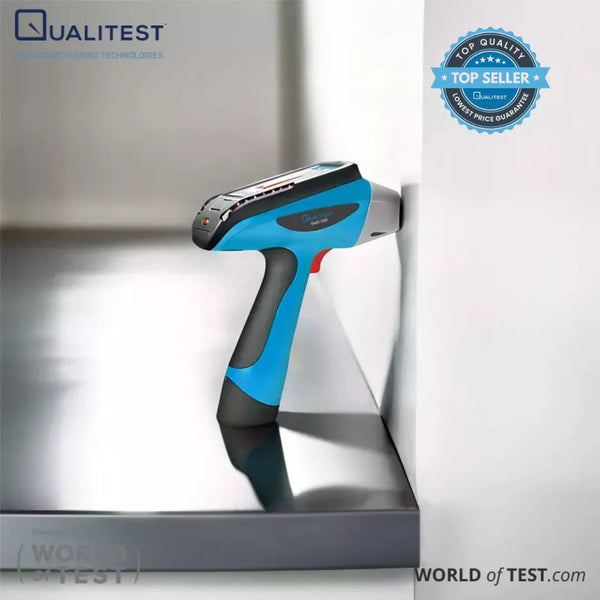
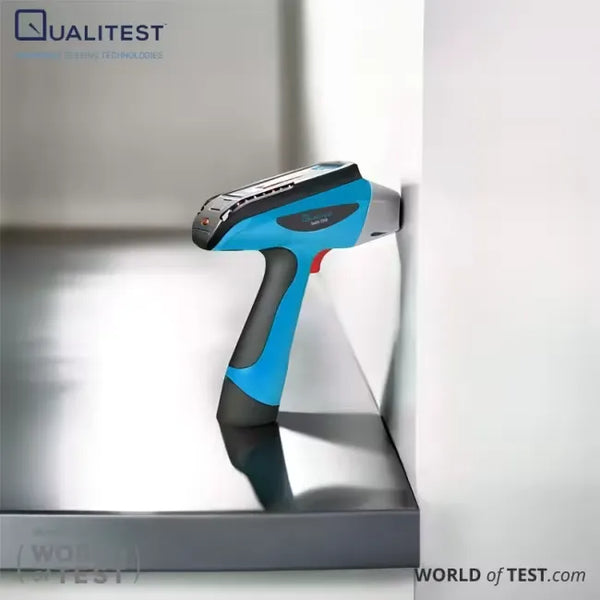
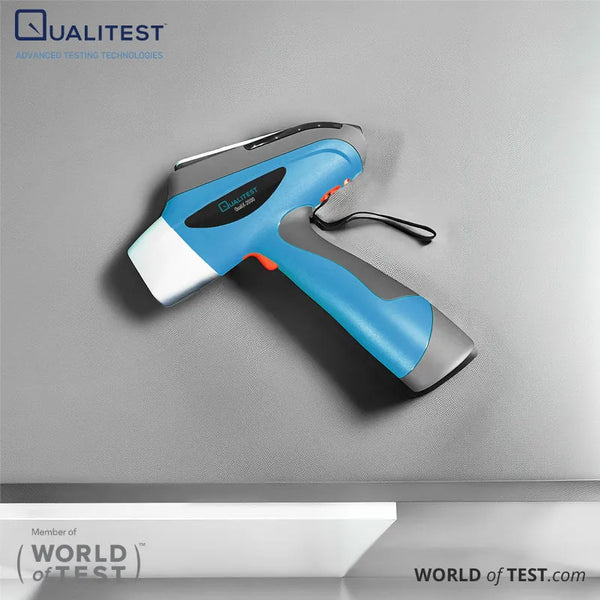
Modern Handheld XRF Capabilities: The QualiX™ 2000 Series
Modern instruments, such as our QualiX™ 2000 Series Handheld Portable XRF Analyzer, package high-end laboratory optics into a lightweight frame weighing under 2 kg (1.7 kg).
Built around a 50 kV / 200 µA miniature end-window X-ray tube and a High-Resolution Silicon Drift Detector (Fast-SDD) with Peltier cooling, these units achieve an energy resolution as tight as 125 eV on the alloy-focused 2000A model (128 eV on the 2000M and 2000R variants at the Mn K-alpha line) to detect elements from Magnesium (Mg, atomic number 12) through Uranium (U, atomic number 92).
Different applications call for specific hardware setups, which is why model variants are built for target industries:
- QualiX™ 2000A (Alloy): Features a Rhodium (Rh) target tube with 2.0 mm and 4.0 mm collimators. Built specifically for PMI inspection, metal QA, manufacturing verification, and scrap sorting following API RP 578 and ASTM E1476.
- QualiX™ 2000M (Ore & Mineral): Configured for geological exploration, grade mapping, and EPA Method 6200 environmental soil screening.
- QualiX™ 2000R (RoHS): Equipped with a Silver (Ag) target tube and expanded collimator options (2.0 mm, 4.0 mm, 6.0 mm) for screening restricted substances (Pb, Cd, Hg, Cr, Br) under IEC 62321-3-1.
Why Quality Teams Pick XRF
- 100% Zero-Damage Testing: It leaves absolutely zero burn marks, scratches, or gouges on finished aerospace parts, expensive valves, or installed pipes.
- Easy to Carry Anywhere: Lightweight units powered by a 9000 mAh rechargeable battery deliver 8 to 12 hours of continuous operation. Point and shoot anywhere, from outdoor scrap yards to high-up refinery pipes!
- Super Fast Reads: Delivers initial alloy grade identification in as little as 1 second, with full test cycles completing within 1 to 60 seconds depending on precision settings.
- Broad Material Flexibility: Analyzes non-conductive items, liquids, slags, and powders where spark discharge testing cannot function.
Where XRF Hits a Wall
- Struggles with Light Elements: Standard XRF units struggle with ultra-light elements like Carbon, Beryllium, or Lithium, and detect Magnesium at limited sensitivity, often falling below detection limits in aluminum alloys.
- Only Reads the Surface Skin: The X-ray beam only penetrates a tiny fraction of a millimeter deep into the sample, making surface cleanliness critical.
Our Perspective: Some sales representatives claim handheld XRF guns replace full lab equipment, but we think that is plain wrong! Its real strength is super-fast field screening without damaging finished components, not full-spectrum light-element chemical analysis.
What is Optical Emission Spectroscopy (OES)?
Spark Optical Emission Spectroscopy (Spark OES) is the heavy-duty option for chemical verification in steel mills, casting foundries, and serious metal-processing facilities.
How This Spark Unit Works
Spark OES excites atoms by passing a high-voltage electrical spark discharge directly through an electrically conductive sample under a protective argon gas shield, volatilizing elemental constituents and exciting their outermost electrons. As these excited electrons drop back to ground state, they emit characteristic optical light.
Optical emission phenomena recur across periodic groups sharing similar electron configurations, permitting precise detection across broad element suites. Spark OES typically evaluates a larger measurement spot size of approximately 20 mm.
Laboratory Spark OES Precision: The QualiSparkCCD™ 7000
To capture full-spectrum chemistry down to parts-per-million levels, systems like our QualiSparkCCD™ 7000 Full-Spectrum Spark OES Optical Emission Spectrometer rely on a Paschen-Runge optical mounting with a 500 mm focal length. Enclosed in a cast optical chamber temperature-controlled to ±0.1°C and equipped with a 2700 grooves/mm holographic grating, it covers a wide wavelength range from 130 nm to 800 nm.
This expanded optical range lets quality labs analyze light elements that XRF cannot reach (including Carbon, Nitrogen, Lithium, Sodium, Potassium, Phosphorus, Sulfur, Silicon, and Boron) across metal matrices like Fe, Al, Cu, Ni, Ti, Co, Mg, Zn, Pb, and Sn. High-resolution linear CCD detectors (featuring 3648 pixels per chip with an 8 µm pixel size) deliver an optical resolution of 0.005926 nm to separate overlapping spectral lines.
Why Quality Teams Pick OES
- Nails Carbon and Ultra-Light Elements: Spark OES offers superior spectral sensitivity for light elements including Carbon, Sulfur, Phosphorus, Nitrogen, Silicon, and Boron. This makes it mandatory for distinguishing 304 stainless from low-carbon 304L, or running automatic Carbon Equivalent (CE) calculations before welding.
- High Throughput in Production: Powered by a digital solid-state spark source with adjustable excitation frequencies up to 1000 Hz, it delivers rapid chemical qualification directly on shop floors and foundry melt platforms. Its heavy-duty copper spark stand base handles sample weights up to 50 kg.
- Benchmarking Accuracy: For element concentrations above 0.1 wt%, Spark OES deviations from certified values stay below 10%, making it a reliable benchmark against which other methods are validated.
Where OES Hits a Wall
- Leaves a Mark: The electric spark ablates the surface, leaving a small, charred burn mark.
- Requires Conductive, Flat Samples: The process strictly requires an electrically conductive sample ground clean and flat to seal the spark chamber.
- Needs Gas Cylinders: Requires a continuous supply of high-purity argon gas (≥99.999%).
Our Perspective: When carbon numbers are on the line, Spark OES is the undisputed benchmark. We believe any facility casting low-carbon steel without one is taking an unnecessary risk with their quality control!
Direct Comparison: XRF vs OES
When comparing OES vs XRF, we tell plant managers the exact same thing every day: neither tool is universally "better"; it simply comes down to whether your customer contract requires carbon measurements and non-destructive testing!
Across commercial alloys spanning copper, aluminum, and steel, studies show that EDXRF, WDXRF, and LIBS align well with Spark OES benchmark values, showing absolute deviations below 1 wt% for main component elements.
However, specific element-matrix combinations show discrepancies: Silicon in aluminum alloys and steels exhibits higher deviations in XRF methods compared to Spark OES, while Manganese in high-alloyed steel is often overestimated across methods by up to 65%. Interestingly, for certain major and minor elements, XRF precision can actually improve by roughly 2x over spark OES.
| Attribute / Feature | Spark Optical Emission Spectroscopy (OES) | Handheld / Portable XRF |
|---|---|---|
| Primary Testing Goal | Dead-on chemistry checks, carbon reads, foundry melt control | Fast field PMI, scrap yard sorting, zero-damage screening |
| Sample Damage | Destructive; ablates surface | 100% Non-destructive |
| Conductive Samples Only? | Yes; requires electrical conductor | No; works on any sample form |
| Wavelength / Element Range | 130 nm–800 nm (detects C, N, P, S, Si, B, Li, Na, K) | Mg (atomic # 12) through U (atomic # 92) |
| Light Elements (C, Mg) | Higher sensitivity for light suite | Limited; Mg often below detection in Al alloys |
| Detector Technology | Multi-chip linear array CCDs (3648 pixels/chip) | High-Resolution Fast-SDD (energy resolution ≤125 eV) |
| Measurement Spot | ~20 mm spot size | ~4 mm spot size on handheld EDXRF |
| Precision Profile | Excellent for major/minor elements | Improved by ~2x over spark OES for specific elements |
| Gas Needed | High-purity Argon gas (≥99.999%) | None (runs on rechargeable 9000 mAh tool battery) |
| Reading Speed | 15 to 30 seconds per spark cycle | 1 to 60 seconds (as fast as 1 second for initial alloy ID) |
| US Standards | ASTM standards for metal chemistry (like ASTM E415) | ASTM E1476, API RP 578, EPA 6200, IEC 62321-3-1 |
Practical Application Domains Across US Industrial Hubs
Scientific evaluations and industry practices highlight distinct practical domains where each technology fits best across major North American industrial corridors:
Steel Production & Midwest Foundries
Spark OES is the standard benchmark for bulk steel analysis and inclusion characterization via PDA-OES, whereas XRF handles slag analysis. Across the Midwest Rust Belt (spanning Ohio, Michigan, and Indiana), automotive foundries and steel mills rely heavily on Spark OES to monitor carbon equivalents and melt chemistry before pouring heat batches.
Gulf Coast Petrochemical & Energy Corridor
Along the Texas and Louisiana Gulf Coast, refineries, valve fabricators, and pipeline contractors strictly enforce API RP 578 Positive Material Identification (PMI). Handheld XRF is widely deployed here for fast, non-destructive checks on installed flange faces and process piping, while central QA labs use benchtop Spark OES to verify low-carbon 316L stainless steel stock.
Aerospace Manufacturing (Pacific Northwest & Southern California)
Defense subcontractors and aircraft component shops handling titanium, Inconel, and high-temp superalloys favor XRF to avoid surface arc damage on high-value finished parts. However, when measuring Iron and Nickel in precision aluminum castings, Spark OES remains preferred over EDXRF, which cannot reliably measure Magnesium.
Scrap Recycling Infrastructure & Non-Conductive Testing
High-volume scrap yards along major US shipping routes (such as the Mississippi River transport network and Port of Houston scrap terminals) use handheld XRF to sort mixed alloy truckloads in seconds. Furthermore, XRF analyzes ceramics, polymers, slag, and minerals without electrical conductivity requirements, where Spark OES cannot function.
Both methods deliver comparable quantitative results for major, minor, and trace elements in ferrous and non-ferrous alloys, showing solid accuracy across concentration determinations. The decision hinges on practical constraints like sample value, conductivity, light-element requirements, and surface damage limits rather than universal superiority.
Total Cost of Ownership (TCO): Evaluating OES vs XRF Long-Term Costs
When setting aside cash for metal testing gear, the purchase sticker price is only half the story. The money you spend operating these tools over 5 to 10 years looks radically different!
Handheld XRF Spending Breakdown
- Upfront Cost: Moderate to high sticker price because of the miniaturized 50 kV X-ray tube and high-spec Fast-SDD detector inside.
- Ongoing Operating Cost: Extremely low ongoing costs. Handheld XRF units run on snap-in 9000 mAh rechargeable batteries (delivering 8 to 12 hours runtime) and do not use any gas or chemical fluids. Your only long-term upkeep is periodic recalibration and eventually replacing the X-ray tube years down the road.
Spark OES Spending Breakdown
- Upfront Cost: Very competitive purchase price for lab-grade testing performance.
- Ongoing Operating Cost: Noticeable recurring bills. Spark OES relies on a constant supply of high-purity argon gas (99.999% pure) to keep oxygen out of the spark chamber while reading light elements. You will also replace worn tungsten electrodes, grinding discs, and clean optical windows on a regular basis.
Our Perspective: When looking at XRF vs OES ongoing costs, we notice that plant managers often forget to factor in argon gas consumption!
This is why smart hardware features matter, such as gas-saving standby modes built into modern benchtop OES units. By throttling standby argon flow down to just 60 ml/min, a single argon cylinder can last up to 70 days in 24-hour standby mode, directly shrinking your monthly operational bills.
Regulatory, Safety, and Facility Requirements in the US
Before buying either tool for an American manufacturing plant, plant safety teams need to keep these rules in mind:
US Rules for XRF Analyzers
- Radiation Permits & State Registrations: Today's XRF units use mini X-ray tubes instead of hazardous nuclear sources, making transport straightforward. However, state radiation departments (like California CDPH, Texas DSHS, or NY DOH) still monitor X-ray equipment. You will usually file a simple registration, set up basic safety rules, and assign a Radiation Safety Officer.
- User Safety Training: Operators need basic safety walk-throughs, though built-in proximity safety sensors (which prevent the X-ray tube from firing unless pressed firmly against a sample) keep operation straightforward.
US Rules for OES Spectrometers
- OSHA Tank Rules: Running Spark OES means handling high-pressure argon tanks under standard OSHA 1910.101 gas cylinder storage and tie-down rules.
- Grinding Dust Controls: Grinding metal samples creates sparks and fine metal dust. Your facility needs proper ventilation hood setups, especially when grinding shiny aluminum or titanium, to comply with NFPA dust flash-fire rules.
Our Perspective: Honestly, we see quality directors get overly stressed about state X-ray paperwork. Filing those forms is simple compared to setting up compressed gas lines and dust exhaust systems for heavy grinding gear!
Application Framework: Choosing the Right Instrument
We urge quality leads to start by checking their customer contract requirements:
Go with XRF if your plant needs:
- Total Portability: You need an operator walking around scrap yards, climbing refinery pipe racks, or checking freight trucks.
- Zero Damage Allowed: You are testing finished bolts, polished aerospace valves, or thin pipes that cannot have a single burn mark on them.
- Fast Sorting: You need rapid pass/fail grade identification (like separating 304 from 316 stainless) in as little as 1 second.
- Non-Conductive Materials: Your business tests raw rock, slag, soils, or RoHS electronics alongside solid metals.
Go with OES if your plant needs:
- Exact Carbon Verification: Your contracts require pinpoint carbon reads to separate low-carbon "L-grade" stainless from standard grades or run automatic Carbon Equivalent calculations for welding.
- Melt Shop Control: You run an iron foundry or casting furnace that needs chemical checks on molten metal before pouring.
- Official Certification Labs: Your testing lab issues certified Mill Test Reports (MTRs) with full sulfur, phosphorus, and nitrogen numbers.
The Hybrid Workflow: When Your Facility Needs Both XRF and OES
For mid-to-large North American production plants, comparing XRF vs OES leads to a practical answer: you might actually need both!
In our view, pairing both machines creates a highly efficient testing setup. We see smart plants use handheld units at the loading dock and benchtop spark units in the main lab to eliminate testing delays while keeping quality bulletproof:
| Workflow Stage | Equipment Used | Primary Inspection Goal | Outcome / Next Step |
|---|---|---|---|
| Stage 1: Receiving Dock & Scrap Yard | Handheld XRF Analyzer | Fast, 100% non-destructive stock check (1 to 60 sec, as fast as 1 sec) | Standard alloys passed to machine shop; high-spec carbon steels flagged |
| Stage 2: Central QA Laboratory | Benchtop Spark OES | Pinpoint C, S, P, N quantification & Carbon Equivalent calculation | Official Mill Test Reports (MTRs) generated for client certification |
- Step 1 (Receiving Dock): Incoming raw bars or scrap crates get point-and-shoot tested with a handheld XRF analyzer right on the delivery truck. This catches wrong alloy shipments in seconds without harming the bar stock.
- Step 2 (Central Lab Certification): Samples from critical heats, especially low-carbon stainless or structural steel, go straight to the central lab. The Spark OES machine burns a test spot to measure Carbon, Sulfur, Phosphorus, and Nitrogen for official Mill Test Reports (MTRs). To ensure these reports hold up to customer and third-party audits, testing should be validated against NIST-traceable Certified Reference Materials (CRMs) and processed within an ISO/IEC 17025 quality framework where required.
Pick the Right Elemental Testing Setup with Qualitest
At Qualitest, we believe that picking the right elemental testing tool should never force you to choose between precision and your equipment budget. We supply cost-effective, high-performance testing instruments built to satisfy strict North American quality standards without heavy vendor markups.
Our application specialists are ready to help you evaluate your testing requirements and select the ideal setup for your shop floor or field team. Contact Qualitest Today to request a custom quote or schedule a technical consultation with our team.
References (Click to expand)
- Hasler, M. (1956). The complementary nature of X-ray fluorescence methods and optical emission methods in spectrochemical analysis. Spectrochimica Acta Part A: Molecular and Biomolecular Spectroscopy, 11, 97-104.
- Hokura, A. (2021). X-ray Fluorescence Spectrometry. Analytical Sciences, 37, 1-2.
- Meilland, R., Ruby-Meyer, F., Hemmerlin, M., Lamberigts, M., Tusset, V., Dillen, H., Devyt, A., Guio, M., Cabalín, L., Laserna, J., Riva, O., & Mateo, M. (2005). New developments for the quantification of non-conductive materials (slags, inclusions) in the steel industry by optical emission spectrometries (laser, spark). Europace, 1-67.
- Nowaczyk, K., Putra, R. H. S., & Pataki, P. (2025). Comparative Spectral Sensitivity and Quantitative Accuracy of X-ray Fluorescence and Optical Emission Spectroscopy for Alloy Steel Characterization. Journal of Chemical Learning Innovation.
- Seidel, P., Ebert, D., Schinke, R., Möckel, R., Raatz, S., Chao, M., Niederschlag, E., Kreschel, T., Gloaguen, R., & Renno, A. (2021). Comparison of Elemental Analysis Techniques for the Characterization of Commercial Alloys. Metals, 11, 736.
- Wojnarová, P., Vontorová, J., Malcharcziková, J., Váňová, P., & Slamová, K. (2020). THE Comparison of methods for THE analysis of the chemical composition of aluminum alloys. Revue De Metallurgie-cahiers D Informations Techniques.