In plastics manufacturing, achieving superior material consistency is the foundation of a successful product.
A key process for ensuring this top-tier quality is the Melt Flow Index (MFI) test, a vital quality control measure. The central equipment decision for this test comes down to a strategic choice between a manual or an automatic melt flow index tester. This selection directly shapes your lab's efficiency, the precision of your data, and your overall production confidence.
To help you make the best investment for your facility, this guide breaks down the practical specifics of the manual vs automatic MFI comparison, highlighting the distinct advantages each system brings to your operations.
Key Takeaways
- Measuring exactly how your melted plastic behaves is an absolutely critical step for hitting strict industry benchmarks like ASTM D1238 and ISO 1133.
- Manual testing equipment offers a highly cost-effective and completely straightforward approach that works perfectly for facilities managing lighter daily workloads.
- Automated systems completely remove human timing errors, providing exceptionally consistent data while giving your lab technicians hours of their valuable time back.
- We find that making the right choice in the manual vs automatic MFI debate comes down to accurately matching the hardware to your exact production volume and specific financial limits.
First, What Are We Actually Measuring?
Before pulling the trigger on purchasing a machine, it is absolutely essential to know exactly what it does. These laboratory testers measure how much molten thermoplastic flows through a standard die in a set time, typically expressed in grams per 10 minutes.
This data is heavily used for grading materials and setting proper processing conditions. Meeting strict quality benchmarks like ASTM D1238 and ISO 1133 relies on two primary methods for calculating this flow:
- Method A (Melt Mass-Flow Rate / MFR): This is the traditional, highly hands-on method. An operator cuts the extruded plastic strand at set time intervals and weighs it on a precision scale to figure out the exact mass.
- Method B (Melt Volume-Flow Rate / MVR): This is the updated, heavily sensor-reliant approach. An internal sensor tracks the exact distance the piston travels over a specific period to precisely calculate the volume.
Standard manual machines, like our entry-level Melt Flow Indexer QualiFi-2000 Series, are generally restricted to Method A. Automatic systems handle both methods without breaking a sweat. If you ask us, having the technical capability to measure both MFR and MVR gives you a much richer profile of a material's behavior.
Read more: MFR vs MVR: Why Both Metrics Matter for Your Production
For instance, measuring a thick, slow-moving material like heavy-duty pipe-grade HDPE often calls for Method A. Conversely, high-flowing, highly sensitive polymers like PET used in water bottles often require Method B to get a highly accurate read without making a mess on the workbench.
The Case for Manual Melt Flow Index Testers
A manual tester is a very hands-on piece of hardware. These systems function as basic plastometers where the operator performs the timing, cutting, and weighing by hand. A typical setup includes a heated barrel, a standard die, a piston, and loose weights.
After the operator loads the plastic pellets and applies the weight, your technician needs to stand right there, stopwatch in hand, to physically snip the extruded strand at set intervals.
They then weigh that cooled piece of plastic on a separate analytical balance to calculate the final MFI under ASTM and ISO conditions. Many commercial low-cost units essentially require the user to place the weights and manually count down the time.
Related article: Flow Rate Ratio: The Key to Accurate Plastic Processing
Easier on the Company Wallet
The considerably lower initial price tag is a massive advantage. Because these fundamental units do not rely on complex robotic lifting arms or expensive internal computers, they cost a fraction of what their highly automated cousins do.
For a brand new lab facility operating within strict financial limits, or a plant manager trying to get a fast equipment purchase approved by a strict finance department, this is usually the most practical starting point. You get the exact testing capabilities you need without blowing your entire annual budget on a single machine.
Straightforward and Dependable
They feature noticeably fewer complex electronic parts to maintain, service, or troubleshoot over the years.
We firmly believe this straightforward, completely no-nonsense design is their absolute greatest asset. There is virtually no complicated software to continuously update, and the initial learning curve for a brand new operator is incredibly short.
It is just pure, highly dependable mechanical physics at work. When you remove all the extra motorized components, you end up with a highly resilient piece of testing equipment that rarely breaks down and is incredibly simple to calibrate.
Ideal for Lower Volume and Specific Workflows
A manual machine is more than capable of handling a lighter workload seamlessly.
Take a local plastics recycling plant, for example, doing just a handful of quick spot-checks a day on incoming batches of mixed scrap. They simply do not need a massive, highly intricate setup taking up valuable bench space.
A reliable, heavily built unit like the MFI Melt Flow Indexer QualiFi-2000 Series does the trick perfectly. It acts as a highly economical workhorse for solid, completely fuss-free manual testing, proving that sometimes, keeping things incredibly simple is the smartest business move.
The Argument for Automatic Melt Flow Index Testers
On the other side of the manual vs automatic MFI debate, you find the automatic testers.
Engineers built these highly sophisticated units to completely remove operator-to-operator variability. Automatic testers add advanced sensors and internal control systems to perform the same standardized test with minimal operator input.
By improving the reading system to enable full automation, manufacturers have turned traditional MFR equipment from simple material graders into significantly more powerful polymer analyzers.
Automatic systems can precisely time the extrusion, detect piston displacement or mass automatically, calculate both MFR/MFI and melt density, and occasionally even apply loads and cut the extrudate on their own.
Delivers Exceptional Repeatability
By fully automating the core measurement process, these machines produce highly consistent numbers day after day, showing significantly better repeatability and lower error rates compared to manual units.
In fact, studies show that automated timing methods for testing materials like PS and ABS yield extremely precise melt flow rates, keeping errors well below 2% when compared directly with manual methods.
Let's face the facts: human beings get tired, and their manual timing with a cutting tool can easily be off by a tiny fraction of a second. That minuscule human error completely skews the final mass calculation.
Automatic indexers completely remove those shaky human hands from the crucial measurement phase. This guarantees absolutely precise data, which is completely non-negotiable when you are checking incredibly expensive, highly sensitive engineering polymers.
Massively Increases Laboratory Efficiency
This is a huge, undeniable financial benefit that directly offsets the higher initial purchase price. Your technician can easily load up the raw sample, hit the start button, and quickly walk away to tackle other important lab duties.
They can prepare the next batch of materials or analyze previous results while the machine independently does all the heavy lifting and precise measuring. We feel this operational freedom is where manufacturing facilities see the most substantial return on their financial investment.
It essentially gives you back hours of valuable technician time every single week.
Streamlined Data Management and Extra Analytics
The final test results get logged instantly into the integrated system, making it incredibly simple to maintain completely clean, easily searchable digital records.
Furthermore, these automated systems make advanced analytical workflows, like generating in-test density and viscosity curves, much easier to execute directly on the machine.
Picture a round-the-clock manufacturing facility continuously pushing out medical-grade IV tubing. They strictly need zero-operator-error data and lightning-fast turnarounds to easily prove compliance with strict ASTM D1238 and ISO 1133 standards. An automatic tester handles that relentless, high-stakes pace effortlessly, automatically sending the figures right to your main computer network.
For labs running a seriously high volume of complex tests, the Fully Automatic Melt Flow Indexer - QualiFi 6000G-Auto serves as the absolutely premier choice for totally hands-free, high-speed operation.
The Middle Ground
If your specific daily operation does not quite require fully robotic weight lifting, but you still heavily rely on highly consistent automated cutting and incredibly accurate MVR tracking, we have another option.
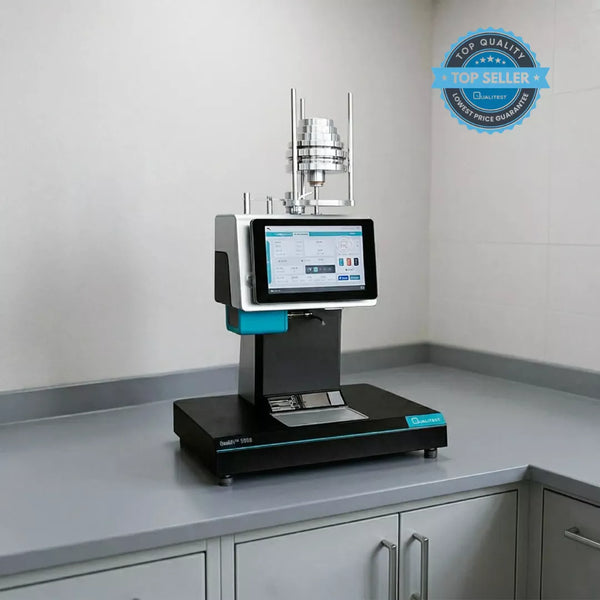
The QualiFi 5000 Galaxy Series offers an excellent, sweet-spot balance of necessary advanced features and genuinely helpful automation. This unit gives you the best of both automated and manual worlds without the absolute top-tier price tag.
A Side-by-Side Comparison: Manual vs Automatic MFI
For a quick, easy-to-read summary, here’s how the two hardware systems compare on the specific points that matter most:
| Feature | Manual MFI Testers | Automatic MFI Testers |
|---|---|---|
| Operator Effort | High: requires manual timing, cutting, and weighing. | Low: automated timing and internal measurement capabilities. |
| Repeatability & Error | More operator-dependent. | Better overall repeatability and significantly lower error rates. |
| Upfront Cost | Considerably Lower. | Considerably Higher, but offset by long-term labor savings. |
| Extra Analytics | Limited, often requiring completely offline calculations. | Much easier in-test density and viscosity-curve digital workflows. |
| Example Scenario | A regional recycling center running daily spot-checks on mixed scrap. | A round-the-clock medical tubing plant needing highly repeatable, error-free data. |
| Relevant Model | QualiFi-2000 Series | QualiFi 6000G-Auto / QualiFi 5000 Galaxy Series |
Find the Right Machine with Qualitest
As a North American supplier, we at Qualitest absolutely get that you need to properly balance high-end testing performance with your very real budgetary limits.
We firmly believe the most appropriate piece of equipment isn't just the most expensive one with all the shiny bells and whistles. It is the one that aligns flawlessly with your lab's specific daily testing volume and strict quality requirements.
Both manual and automatic MFI testers implement the same standardized principle. Automatic testers simply improve the timing, data capture, and repeatability to enable more precise quality control at a higher initial cost.
Having highly accurate flow data prevents extremely expensive production errors and massive piles of material waste. So, whether you have fully reviewed the manual vs automatic melt flow index testers comparison and decided the highly practical, cost-effective QualiFi-2000 Series is the right fit, or you desperately need the relentless efficiency of our QualiFi 6000G-Auto, we are right here to help you out.
We happily offer a completely full lineup of highly effective, budget-conscious products built specifically to ensure your material quality remains perfectly consistent.
Ready to stop second-guessing and start getting exact numbers? Explore our full collection and request a highly competitive quote that makes perfect sense for your business by visiting our product page right here: Qualitest Melt Flow Tester & Indexer Collection.
References:
- Chui, Q., Franciscone, C., Baptista, J., & Rosa, D. (2007). An interlaboratory comparison of the melt flow index: Relevant aspects for the participant laboratories. Polymer Testing, 26, 576-586.
- Doronin, F., Rudakova, A., Rytikov, G., & Nazarov, V. (2023). Simple Determination of the Melt Flow Index of Composite Polymer Filaments Used in Material Extrusion Additive Manufacturing. Coatings.
- Gufeng, C. (2011). Automatic Determination of Melt Flow Rates of PS and ABS. China Plastics.
- Liu, D., Basdeo, A., Gonzalez, C., Romani, A., Boudaoud, H., Nouvel, C., Sanchez, F., & Pearce, J. (2024). Low-Cost Open-Source Melt Flow Index System for Distributed Recycling and Additive Manufacturing. Materials, 17.
- Locati, G., Poggio, S., & Rathenow, J. (1996). The new melt flow rate testers: Not merely graders… but powerful polymer analyzers. Polymer Testing, 15, 443-454.
- Oubellaouch, K. (2024). A melt flow index-based approach for the viscosity curves determination. Materials Research Proceedings.
- Oubellaouch, K., Pelaccia, R., Orazi, L., Pozzi, P., Carmignato, S., Bonato, N., Donati, L., Raimondi, L., & Reggiani, B. (2025). A novel experimental–numerical procedure for the rheological characterization of thermoplastic polymers applied to injection molding. The International Journal of Advanced Manufacturing Technology, 140, 5419 - 5433.