It's a common point of confusion we see often: people getting mixed up in the barcol hardness vs Shore D debate. While they appear to serve a similar function, treating them as interchangeable can lead to inaccurate results.
As specialists in this equipment, we’ve seen the issues this can cause. So, let’s clarify the difference, from what sets them apart to the critical issue of conversion, whether it's a barcol hardness to Shore D conversion or the other way around.
So, What's the Purpose of Barcol Hardness?
Imagine you need to confirm a material's ability to resist penetration from a sharp point. That, in essence, is the Barcol test. It is the preferred method for verifying if composite materials, like fiber-reinforced plastics, have cured to the proper state.
The device's spring-loaded needle translates the material's resistance into a direct reading, which is why we find it's second to none for this application. Its portability means you can test large finished parts on the factory floor, not just small samples in a lab.
The official standard is ASTM D2583, and beyond composites, it’s also highly effective on softer metals like aluminum, brass, and copper.
Read more: A Guide to the Barcol Hardness Test Method & Standard
And What About Shore D?
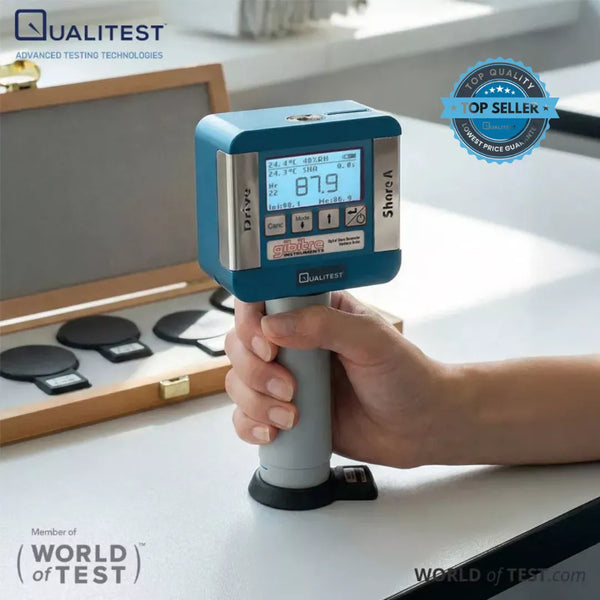
Now, the Shore D test is meant for materials that are firm but have some degree of flexibility. The instrument, a durometer—such as our digital DRIVE Series or analog models like the HD3000—measures the depth of penetration from its cone-shaped tip, where a full 100 indicates zero penetration.
This scale is part of a larger family; for context, the Shore A scale is used for very soft, rubbery materials. The Shore D scale picks up where Shore A leaves off, making it the right choice for harder polymers like rigid PVC, nylon, and epoxies.
For checking the quality of finished polymer products that people will use and handle, we feel this is the right instrument for the job.
The Showdown: Key Differentiators in Barcol Hardness vs Shore D
While both tests produce a number on a 0-100 scale, they are not measuring the same property in the same way.
The most significant factor that separates them is the physical shape of the indentor tip. This single difference in geometry is why the values from a Barcol test and a Shore D test on the same material can vary so much.
The table below breaks down the main points of distinction in the barcol hardness vs Shore D comparison.
|
Key Differentiators |
Barcol Hardness |
Shore D Hardness |
|
Primary Application |
Harder plastics, composites, and softer metals |
Hard rubbers and plastics with some give |
|
The Official Standard |
ASTM D2583 |
ASTM D2240 |
|
Indentor Type |
A pointy cone with a flat tip |
A 30-degree cone with a rounded tip |
|
The Score Range |
0-100 Barcol |
0-100 Shore D |
Where These Tests Are Used in Practice
You’ll find Barcol testers being used in fields where material integrity is non-negotiable.
For instance, a quality control technician using a portable device like the QualiHBA Digital Barcol Hardness Tester might press it against the aluminum skin of an aircraft wing to verify it meets strength specifications.
Likewise, in the marine industry, it’s used to confirm a fiberglass hull has fully cured. It's also common to see it used to check the hardness of large composite storage tanks or pipes after fabrication.
Conversely, the Shore D scale is a staple where firmness and a slight give are required. A perfect example is testing a new car's plastic dashboard with a durometer. The Shore D value ensures it's hard enough not to scratch easily but has enough flex not to shatter dangerously during an impact.
This same principle applies to manufacturing a hard hat or testing the polyurethane on industrial rollers to ensure they have the durability to perform under pressure without deforming.
Conversion Viability: Barcol Hardness to Shore D Conversion & Back
Let's be direct about this: a precise, reliable barcol hardness to Shore d conversion just isn't possible.
The core problem is that a material's elastic properties affect each instrument differently. This is supported by academic research, which highlights that practical conversions between different hardness methods are difficult because of differences in test principles and indentor geometry (Broitman, 2017).
The rounded tip of the Shore D durometer is more influenced by a material's ability to spring back, while the sharp Barcol indentor provides a more direct measure of its resistance to being pierced. This is why a direct Shore d to barcol conversion chart can't work for all materials.
In fact, formal studies often use one scale without any reference to the other, reinforcing that they operate independently (Csányi et al., 2020; Barros et al., 2019). The consensus in the available research is that while both Barcol and Shore D are used to assess hardness, their results are not directly interchangeable, and no standard conversion exists (Broitman, 2017).
However, because the question is so common, approximate comparison data does exist. We have to stress that this data should be approached with caution. Relying on these numbers for a final decision is a common source of error.
Approximate Hardness Conversion Values
|
Barcol Hardness (ASTM D2583) |
Shore D Hardness |
|
25 |
45 |
|
30 |
50 |
|
35 |
55 |
|
40 |
60 |
|
45 |
65 |
|
50 |
70 |
|
55 |
75 |
|
60 |
80 |
|
65 |
83 |
|
70 |
85 |
|
75 |
88 |
|
80 |
90 |
A necessary disclaimer: These values are for estimation purposes only. We strongly advise against using this for material acceptance or quality control.
Selecting the Right Instrument With Qualitest
We understand that verifying your materials is a crucial part of your process.
That’s why we offer a range of testing equipment that provides excellent value, from our high-performance QualiHBA Digital Barcol Hardness Tester to our comprehensive line of Shore D durometers, including the popular DRIVE Series and HD3000 models. Our instruments are built to deliver accurate, repeatable measurements you can depend on.
If you're determining which testing method is right for your application, or if you’d like to explore some cost-effective solutions, we encourage you to contact us. Our team of experts is always ready to discuss your specific needs and help you find the right tool.
References:
- Csányi, G., Bal, S., & Tamus, Z. (2020). Dielectric Measurement Based Deducted Quantities to Track Repetitive, Short-Term Thermal Aging of Polyvinyl Chloride (PVC) Cable Insulation. Polymers, 12.
- Broitman, E. (2017). Indentation Hardness Measurements at Macro-, Micro-, and Nanoscale: A Critical Overview. Tribology Letters, 65, 1-18.
- Barros, T., Cavalcante, D., Oliveira, D., Caluête, R., & Lima, S. (2019). Study of the surface properties of the epoxy/quasicrystal composite. Journal of Materials Research and Technology.