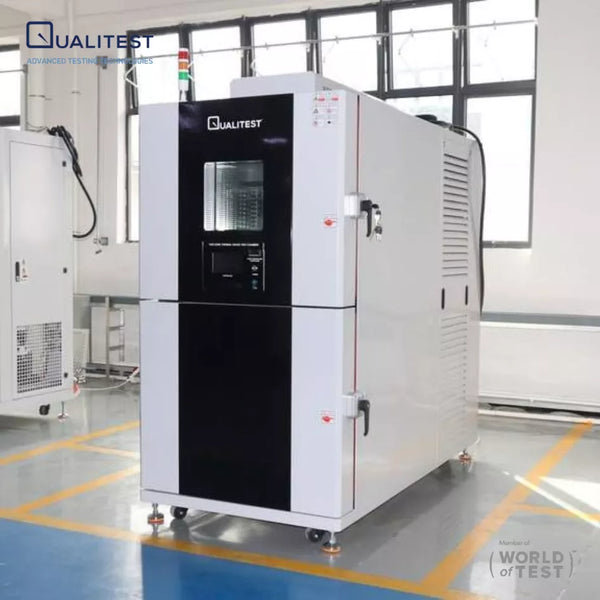
Choosing between 2-zone vs 3-zone thermal shock chambers is one of the most common dilemmas in reliability testing. Is "more zones" always better, or just more expensive?
At Qualitest, we believe the decision should be driven by compliance and ROI, not just specifications; it’s about selecting the right tool for the job. Here is a breakdown of the key differences between 3-zone vs 2-zone thermal shock chambers to help you select the right solution for your lab.
Key Takeaways
- 2-Zone Chambers are the go-to solution for rapid transitions and strict MIL-STD compliance where speed is critical.
- 3-Zone Chambers offer an ambient dwell phase and are ideal for testing delicate electronics or heavy assemblies.
- Mechanism Matters as 2-zone systems typically use a moving elevator basket, while 3-zone systems often keep the specimen stationary.
- Strategic Investment involves balancing immediate project needs with the long-term versatility required for a growing lab.
Understanding the Core Mechanism
Before diving into the comparison, it is important to clarify what "zones" represent in thermal shock test. These zones refer to the distinct temperature environments available within the chamber cabinet.
What is a 2-Zone Thermal Shock Chamber?
A 2-Zone Thermal Shock Chamber (often called an elevator style or air-to-air chamber) typically consists of two separate temperature zones, one hot and one cold, between which a test sample is rapidly transferred to evaluate its resistance to sudden temperature changes.
- Hot Zone: Maintained at a high temperature (e.g., +150°C).
- Cold Zone: Maintained at a low temperature (e.g., -65°C).
How it works: The test specimen is placed in a moving basket. This basket physically travels via a pneumatic or mechanical elevator between the hot and cold zones. The transfer happens rapidly (typically in less than 10 seconds) creating an immediate thermal shock.
This vertical lift mechanism is the core technology behind our QualiTSC-2Z Series, designed specifically to ensure the rapid recovery times essential for MIL-STD compliance.
Operational Insight: While mechanical complexity is a valid consideration, modern elevator designs have become exceptionally robust. We consider the 2-zone design to be the industry standard for rapid thermal cycling where transition speed is the primary performance metric.
Best For:
- Fast transition times.
- Strict compliance with standards requiring immediate temperature changes without ambient dwell.
- Smaller to medium-sized components.
What is a 3-Zone Thermal Shock Chamber?
A 3-Zone Thermal Shock Chamber adds an ambient or intermediate temperature zone between the hot and cold chambers. This design allows for a dwell period at a moderate temperature before transitioning to the next extreme, which can better simulate real-world thermal cycling conditions.
- Hot Zone
- Ambient Zone (Room Temperature)
- Cold Zone
How it works: Depending on the design, the product either moves through three physical chambers, or, more commonly, the product stays stationary while dampers open and close to circulate hot, cold, or ambient air into the testing space.
Our QualiTSC-3Z Series utilizes this sophisticated damper control to effectively manage the three-step cycle while keeping the specimen static.
Strategic Perspective: We view the 3-zone chamber as a strategic investment for growing laboratories. Even if current projects only require 2-zone capability, the ability to run 3-zone profiles provides a safeguard against evolving industry standards without necessitating the acquisition of a second unit.
Best For:
- Tests requiring an ambient dwell time (cooling to room temp before freezing).
- Testing larger, heavier products that are difficult to move in an elevator basket.
- Flexibility: Many 3-zone chambers can be programmed to operate as 2-zone chambers.
2-Zone vs 3-Zone Thermal Shock Chambers: Key Differences
When evaluating 2-zone vs 3-zone thermal shock chambers, the primary difference lies in the testing standards you need to meet and the physical nature of your specimen. As noted in industry literature, the choice between these chambers depends on specific testing requirements, such as the need for simulating gradual temperature transitions versus rapid shocks.
1. Testing Standards and Dwell Times
The most significant operational difference is the "Ambient Dwell."
- 2-Zone: This configuration creates a direct hot-to-cold shock. It is ideal for standards that simulate rapid deployment, such as military equipment transitioning from high-altitude cold to a hot desert environment.
- 3-Zone: This allows for a "three-step" cycle: Hot -> Ambient -> Cold. This is often required in specific automotive or consumer electronics standards where the device enters a standby or cool-down phase before freezing.
2. Specimen Stress
- 2-Zone: Provides the most aggressive thermal stress. The expansion and contraction occur instantly.
- 3-Zone: Can be more gradual if the ambient phase is utilized, allowing the material to stabilize slightly between extremes. However, if the 3-zone chamber is running in "2-zone mode" (skipping ambient), it can still provide significant stress.
Practical Application: Consider the difference between testing a ruggedized connector versus a complex PCB assembly. A ruggedized connector is often designed to withstand immediate contraction, making it a candidate for 2-zone testing.
Conversely, a PCB with multiple layers and delicate ceramic capacitors might suffer micro-cracking if subjected to the violent transition of a 2-zone shock without a stabilization period. In such cases, the 3-zone profile mirrors the more gradual temperature shifts seen in commercial logistics or automotive ignition cycles.
Technical Note: It is critical to align the testing severity with the product's intended environment. Subjecting a consumer device to military-grade shock (2-zone) when real-world usage only warrants a 3-zone cycle may constitute "over-testing," potentially leading to false failures and unnecessary delays in time-to-market.
3. Moving vs. Stationary Samples
In most 2-zone designs, the product moves vertically.
This creates a potential risk for highly sensitive mechanical assemblies that could be disturbed by vibration or movement. (Note: For facilities with specific spatial constraints or form-factor requirements, we also offer a Horizontal Two-Zone Thermal Shock Test Chamber that mitigates vertical height issues while maintaining 2-zone performance).
In 3-zone damper-type systems, the product remains stationary. This is a crucial advantage when analyzing 3-zone vs 2-zone thermal shock chambers for large battery packs or delicate sensor arrays that must remain static during testing.
According to Zagwyn (1985), citing Tenney Engineering, these chambers can be configured vertically or horizontally. The 3-zone design typically includes an ambient dwell area between hot and cold zones, while the 2-zone design transfers samples directly between hot and cold environments.
| Feature | 2-Zone (Vertical Lift) | 3-Zone (Damper / Stationary) |
|---|---|---|
| Transition Type | Hot ↔ Cold (Immediate) | Hot ↔ Ambient ↔ Cold |
| Sample Movement | Moving Basket (Vertical) | Stationary (Air flows to sample) |
| Thermal Stress | Extreme / Aggressive | Moderate to High (Adjustable) |
| Ambient Dwell | No | Yes (Programmable) |
| Primary Use Case | Component Level / Material Testing | System Level / Large Assemblies |
Industry Use Cases and Common Standards
The choice between 3-zone vs 2-zone thermal shock chambers often depends on your specific industry requirements and the standards you are mandated to follow.
Who Needs What?
- Aerospace & Defense: Typically prefer 2-Zone Chambers. Components such as avionics sensors or external missile fins must withstand rapid altitude changes and extreme temperature shifts without a "cooldown" period.
- Automotive: Often utilizes 3-Zone Chambers. Parts like Engine Control Units (ECUs) located near the engine block experience gradual heating and cooling cycles, making the ambient dwell feature crucial for realistic simulation.
- Consumer Electronics: Uses both, but 2-Zone is standard for chip-level (IC) testing to ensure solder joint reliability, while 3-Zone is preferred for complete device testing (like smartphones or laptops) to prevent mechanical damage from movement.
- Telecommunications: Infrastructure like 5G towers and outdoor enclosures endure constant environmental shifts. 3-Zone testing effectively simulates the natural day-to-night temperature cycles these units face.
- Medical Devices: Reliability is non-negotiable for life-saving equipment. 2-Zone chambers are often employed to test the durability of surgical instruments and implants against rapid temperature changes, such as those experienced during sterilization processes.
- Battery Technology: For Lithium-ion batteries used in EVs and grid storage, safety is paramount. 3-Zone chambers are frequently preferred to prevent thermal runaway, allowing for a controlled transition through ambient temperatures rather than a violent shock.
Compliance with Standards
Ensuring environmental test compliance is the main driver for purchasing thermal shock equipment. Here is how common standards align with the chamber types:
- MIL-STD-810H (Method 503.7): Often requires the aggressive shock of a 2-zone system to simulate rapid environmental changes.
- IEC 60068-2-14: Describes tests that can be met by both types, depending on whether the test is defined as "Na" (rapid change) or "Nb" (change with specified rate).
- JEDEC JESD22-A104: A critical standard for the semiconductor industry, outlining specific cycles that dictate whether a 2-zone or 3-zone profile is necessary.
Which Chamber Do You Need?
If your testing standard (like certain sections of MIL-STD-810 or JIS C 60068) strictly mandates a rapid transfer without room-temperature stabilization, the 2-zone configuration is the industry standard. It is generally more compact and energy-efficient for this specific purpose.
However, if you require the flexibility to perform ambient temperature exposure, or if your test specimen is too bulky for an elevator basket, the 3-zone chamber is the superior choice.
We generally advise clients to look beyond immediate project requirements; if your lab handles a diverse range of products, the versatility of a 3-zone system often offers a better ROI in the long run.
Choose Qualitest for Reliable Thermal Testing
At Qualitest, we bridge the gap between premium performance and cost-effectiveness for the North American market. Whether you need the robust vertical lift of our QualiTSC-2Z Series (from compact to high-capacity) or the versatile stationary design of our QualiTSC-3Z Series, we have a solution that fits your budget.
Our chambers deliver the stable recovery times and precise uniformity required for rigorous testing without the premium price tag.
Ready to upgrade your lab's testing capabilities? Explore our range of Thermal Shock Test Chambers (Two Zone) today. Contact our team for a consultation, and let us help you configure the perfect thermal testing solution for your products.
References:
Zagwyn, C. (1985). New Products Test. IEEE Design & Test of Computers, 2, 101-103.