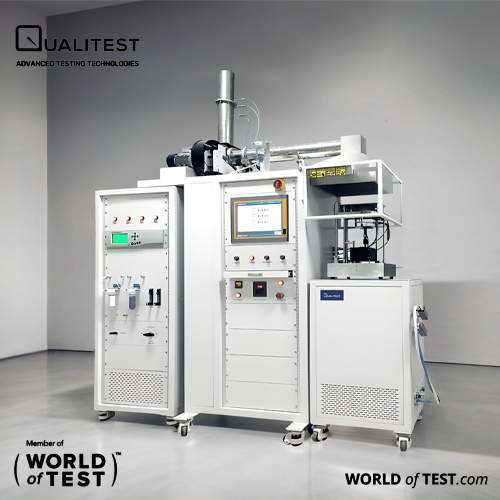
Selecting the wrong flammability testing setup can stall compliance certification and inflate capital costs. Deciding between a single gas vs multi gas cone calorimeter dictates whether your facility measures standard heat release rates or complete toxic gas evolution.
Evaluating single-gas vs multi-gas cone calorimetry requires matching measurement accuracy, operating budgets, and ASTM E1354 or ISO 5660 standards. Our technical analysis compares measurement metrics, total cost of ownership, and equipment specifications to help you choose the ideal system for your laboratory.
Comparison Overview: Single Gas vs Multi Gas Systems
For technical managers and procurement professionals needing a direct side-by-side breakdown, here is how both instrument configurations compare based on technical specifications and interlaboratory research data:
| Feature & Metric | Single-Gas Configuration | Multi-Gas Configuration (NDIR & FTIR) |
|---|---|---|
| Gases Analyzed | High-precision paramagnetic O2 (0 to 25%, response <4 seconds) | O2 PLUS dual NDIR CO (0 to 1%) & CO2 (0 to 10%), optional FTIR for HCN, HCl, SO2, NO2 |
| HRR Calculation Method | Direct oxygen depletion equations (13.1 MJ/kg +/- 5%) | Dynamic formulas adjusted for incomplete combustion mass balance |
| Toxic Fume Profiling | Skips toxic species identification | Real-time CO, CO2, and toxic gas yields (g/s or kg/kg ) |
| Measurement Reproducibility | 1.5% to 9.8% for combustion parameters | 12.9% to 27.9% for online gas analysis |
| Primary Suitability | Standard QA/QC, baseline compliance | Advanced R&D, EV battery safety, toxic smoke analysis |
| OpEx & Gas Supply | Lean (N2 and O2 span gas cylinders) | Higher (N2, O2, Methane, and certified CO/CO2 gas mixes) |
| Field Upgradeability | 19-inch rack cabinet houses selected gas analyzers | Fully equipped with optical analyzers directly from the factory |
| Standards Compliance | ASTM E1354, ISO 5660 | ASTM E1354, ISO 5660, ISO/TS 21397, BS 476-15, NFPA 264/271, FMVSS 302, FAA FAR 25.853 |
Cone Calorimetry Operating Principles
Historically developed at the National Institute of Standards and Technology (NIST) in Gaithersburg, Maryland, the cone calorimeter relies on oxygen consumption calorimetry. Heat release is computed directly from the mass of oxygen consumed during combustion, yielding an error margin under 5 percent for many organic fuels.
On average, organic materials yield roughly 13.1 MJ of thermal energy per kilogram of oxygen consumed (+/- 5%). Standard properties gathered during testing comprise heat release rate (HRR), mass loss rate (MLR), and effective heat of combustion (EHC).
In a standard test setup, such as our Qualitest Cone Calorimeter, a specimen measuring up to 100mm by 100mm by 50mm sits directly beneath a 5000W rated capacity conical heating element. This heater delivers anywhere from 0 to 100 kW/m2 of radiant thermal flux managed by a PID temperature controller.
As the material burns, an exhaust hood draws the combustion effluent through an exhaust duct fitted with a 0 to 50 g/s exhaust fan (0.1 g/s resolution). An annular gas sampler positioned 685 mm from the hood extracts a homogenized gas stream, directing it to high-precision sensors for real-time inspection.
The main distinction between configurations comes down to which combustion gases your instrumentation monitors within that exhaust stream.
Single-Gas Cone Calorimetry Analysis
When evaluating single-gas vs multi-gas cone calorimetry, think of the single-gas configuration as the dependable baseline for calculating heat release rate (HRR).
System Operation
A single gas cone calorimeter relies on a high-precision paramagnetic oxygen (O2) analyzer with a 0 to 25% measuring range and a response time under 4 seconds. Because oxygen depletion correlates with heat release, measuring O2 concentration alone yields key data points:
- Heat Release Rate (HRR) and Peak Heat Release Rate (pHRR)
- Time to Ignition (TTI) via a 10kV high-voltage spark generator with automatic positioning
- Mass Loss Rate (MLR) measured by a high-precision 0 to 2000g load cell (0.1g resolution)
- Total Heat Release (THR)
- Effective Heat of Combustion (EHC) (calculated assuming complete oxidation)
Delay Synchronization and Conditioning
Gas concentration measurements must be synchronized accurately in time with combustion events such as ignition and changes in mass loss rate to produce valid results.
Research shows that standard ASTM E1354 calibration methods for determining gas delay times can produce inconsistent results because analyzer delay times vary with both the sampling system and gaseous species production rates.
This timing sensitivity is precisely why our Qualitest Cone Calorimeter integrates dedicated gas pretreatment. By passing exhaust samples through a fine soot filter, a Peltier condenser (0 to 5 degrees Celsius operating range), a peristaltic drainage pump, and a moisture filter, our system stabilizes sample flow rates and prevents condensation from skewing gas delay calculations.
Advantages and Limitations
- Capital Cost Savings: Fewer optical gas benches lower initial equipment expenditure.
- Straightforward Calibration: Maintaining a single oxygen analyzer simplifies routine calibration using Methane burners for system C-factor verification.
- Ideal for Quality Assurance: For facilities focused on routine screening or pass/fail flammability compliance, this streamlined rig delivers dependable performance without unnecessary hardware.
However, single-gas O2 measurement alone cannot characterize toxic hazard or combustion chemistry. It assumes ideal combustion stoichiometry and cannot directly quantify toxic incomplete combustion products like carbon monoxide (CO) or carbon dioxide (CO2).
Multi-Gas Cone Calorimetry Analysis
For facilities formulating advanced flame retardants or testing materials for enclosed transit spaces, multi-gas instrumentation delivers extensive analytical capabilities.
NDIR and FTIR Integration
A multi gas cone calorimeter pairs the core paramagnetic O2 sensor with Non-Dispersive Infrared (NDIR) optical benches to continuously measure Carbon Monoxide (CO, 0 to 1% range) and Carbon Dioxide (CO2, 0 to 10% range) with response times under 2.5 seconds.
Simultaneously, an integrated optical smoke density system utilizing a Helium-Neon laser paired with main and auxiliary photodiode detectors tracks light attenuation through the exhaust duct.
For comprehensive toxicity profiling, FTIR (Fourier Transform Infrared) spectroscopy can be coupled to the cone calorimeter, enabling simultaneous measurement of multiple toxic gases (CO, CO2, HCN, HCl, SO2, NO2, and unburned hydrocarbons) from a single test.
After careful calibration, FTIR precision can match or exceed commercial online single-gas analyzers because overlapping impurities that confound single-gas instruments can be resolved spectroscopically. Heated sample lines and gas sampling cells prevent condensation of fire gas components en route to the analyzer.
Furthermore, running two analyzer types simultaneously (such as FTIR and NDIR) helps validate exhaust gas concentrations during complex material decomposition.
Key Data Outputs
In comparing single-gas vs multi-gas cone calorimetry, multi-gas configurations supply richer testing metrics:
- Enhanced HRR Precision: Adjusts heat calculations based on actual CO and CO2 mass generation.
- Quantitative Gas Yields: Provides real-time generation rates for CO, CO2, and toxic species (g/s or kg/kg ).
- Combustion Efficiency Profiling: Reveals the exact ratio of complete to incomplete oxidation.
- Toxic Fume Evaluation: Vital for meeting strict fire safety mandates in railway, aerospace, and marine applications.
Measurement Reproducibility and International Standards
When evaluating multi-gas setups, laboratory managers should keep measurement variability in mind. Interlaboratory round-robin studies reveal a clear hierarchy in measurement reproducibility:
- Combustion Parameters: Show the lowest variability across laboratories (1.5% repeatability and 9.8% reproducibility).
- Major Effluents (CO2 and CO): Display moderate variability, with CO2 showing higher consistency than CO.
- Minor & Acid Gases (NO, HCl, HCN, NO2): Exhibit higher dispersion (12.9% repeatability and 27.9% reproducibility for FTIR gas analysis overall). Minor species like HCN and NO2 can be detected inconsistently across facilities, requiring strict calibration controls.
Advanced Testing Protocols
- ISO/TS 21397 specifies FTIR coupling to the cone calorimeter for online fire gas measurement, providing reproducible data for major effluents while setting standardized rules for calibration.
- Controlled Atmosphere Cone Calorimetry extends gas analysis to under-ventilated and fuel-rich conditions, giving researchers deep insight into vitiated enclosure fires.
Industry Standards and Compliance Mapping
Choosing between a single gas vs multi gas cone calorimeter comes down to what specific industry regulations and North American standards demand:
| Industry / Application | Official Standards & Frameworks | Recommended System | Compliance Context |
|---|---|---|---|
| Building & Construction (US & Global) | ASTM E1354, ASTM E1740, IBC, NFPA 101, ISO 5660-1, GB/T 16172 | Single Gas or Multi Gas | Single gas handles standard ASTM E1354 pass/fail HRR rules; multi gas gives complete CO/CO2 toxicity reports. |
| EV Battery Safety & Automotive (US OEMs) | FMVSS 302, ASTM F1550, ISO 5660 / US OEM Battery Protocols | Multi Gas | US automakers (such as Ford, GM, and Tesla) evaluate EV battery pack enclosures where thermal runaway produces toxic off-gassing requiring real-time CO/CO2 tracking. |
| Aviation, Marine & Transit (US & Global) | FAA FAR 25.853 (Aviation), NFPA 130 (US Rail), EN 45545-2, IMO MSC 40(64) | Multi Gas | US Federal Aviation Administration and passenger rail codes enforce strict limits on toxic gas evolution. |
| Polymer & Additive Formulation | ASTM D6113, ASTM E1474, ISO/TS 21397 | Multi Gas | Formulating novel flame retardants requires tracking how char formation alters toxic gas outputs. |
| Factory Quality Control | In-House Batch Material Screening | Single Gas | Cost-effective pass/fail screening for incoming materials without unnecessary equipment overhead. |
Total Cost of Ownership Analysis
We frequently remind laboratory decision-makers that focusing exclusively on upfront instrument cost ignores long-term operational costs.
Capital Expenditures (CapEx)
- Single Gas: Lower initial capital outlay. Includes the conical heater assembly, paramagnetic O2 analyzer, laser smoke optical system, and load cell inside a movable 19-inch cabinet.
- Multi Gas: Higher upfront investment required for dual-channel NDIR CO/CO2 optical modules or coupled FTIR units.
Operational Expenses (OpEx)
- Electrical Infrastructure: North American testing laboratories typically require 220V, 50A electrical configurations (with 110V options also available).
- Facility Footprint and Installation Space: Equipment dimensions measure 2250mm by 1000mm by 2230mm with an overall weight of approximately 538kg, requiring facilities teams to verify floor area and structural load capacity prior to installation.
- Calibration Gases: Single gas units consume nitrogen and oxygen span gas. Multi-gas systems require certified calibration gas mixtures (CO and CO2 span gas cylinders), adding to recurring operational expenses.
- Maintenance & System Protection: Both configurations in our Qualitest Cone Calorimeter lineup incorporate an integrated gas pretreatment assembly featuring a sampling pump, fine soot filter, Peltier condenser (0 to 5 degrees Celsius range), peristaltic drainage pump, and moisture filter. Automated flow obstruction and humidity alarms warn technicians before optical cell windows experience particulate contamination.
- Water Cooling Infrastructure: To avoid external plumbing expenses, our systems include a self-contained portable water cooling unit alongside an SB-type Heat Flux Meter (0 to 100 kW/m2, +/- 3% accuracy), keeping facility overhead low.
Qualitest Technical Advantages
We believe high-precision fire testing equipment should remain cost-effective and accessible.
At Qualitest, we supply high-precision, cost-effective Cone Calorimeter testing equipment fully compliant with ASTM E1354, ASTM D6113, ASTM E1474, ASTM E1740, ASTM F1550, ISO 5660, BS 476-15, NFPA 264, NFPA 271, and IMO MSC 40(64) standards.
Key System Specifications:
- Cost-Effective Performance: Our instruments deliver high-output 5000W conical heaters (0 to 100 kW/m2), Helium-Neon laser smoke measurement, and intuitive 15-inch touchscreen controllers without high vendor markups.
- Integrated System Protection: Every cabinet includes complete sample gas conditioning (peltier chillers, fine soot filters, and peristaltic drainage pumps) to keep optical sensors clean and reliable.
- Dedicated North American Support: Comprehensive regional service coverage across North America, including on-site setup, operator training, calibration assistance, and complete warranty protection.
Consult Qualitest for Your Cone Calorimeter Testing
Whether your laboratory requires a cost-effective single gas unit for routine screening or a fully outfitted multi gas cone calorimeter for advanced toxicological research, our engineering team is ready to configure the ideal system for your facility.
Review our full Cone Calorimeter technical specifications or contact our technical team today to discuss your testing criteria and receive a customized, cost-effective quote.
References (Click to expand)
- Babrauskas, V. (1989). Smoke and gas evolution rate measurements on fire-retarded plastics with the cone calorimeter. Fire Safety Journal, 14, 135-142.
- Bray, R., Tretsiakova-McNally, S., & Zhang, J. (2023). The Controlled Atmosphere Cone Calorimeter: A Literature Review. Fire Technology, 59, 2203 - 2245.
- Choi, J., Park, K., & Jeong, J.-G. (2019). Results of a Round-Robin Test for the Draft International Standard on FT-IR Gas Analysis of Fire Effluents from a Cone Calorimeter. Fire science and engineering.
- DiDomizio, M., & Weckman, E. (2016). An Evaluation of Methodologies for Determining Delay Times in the Cone Calorimeter Fire Test. Journal of Testing and Evaluation, 44, 20140401.
- Dowbysz, A., & Samsonowicz, M. (2021). Smoke Generation Parameters from the Cone Calorimeter Method and Single-Chamber Test. Environmental Sciences Proceedings.
- Fourneau, C., Delvosalle, C., Breulet, H., & Brohez, S. (2016). Characterization of highly under-ventilated fires using the cone calorimeter. Fire and Materials, 40, 434 - 444.
- Guillaume, É., Flammier, D., Blomqvist, P., Sandinge, A., Rogaume, T., Luche, J., Fateh, T., & Knottnerus, B. (2026). Interlaboratory Evaluation of ISO/TS 21397: FTIR Gas Analysis Coupled With Cone Calorimeter. Fire and Materials, 50, 460 - 476.
- Kallonen, R. (1990). Smoke Gas Analysis by FTIR Method. Preliminary Investigation. Journal of Fire Sciences, 8, 343 - 360.
- Najmi, H., Luche, J., & Rogaume, T. (2021). Thermal decomposition of multilayer honeycomb core laminate sandwich composite panels in cone calorimeter apparatus. Journal of Composite Materials, 55, 2349 - 2368.
- Quigley, G., Cumber, P., & Houston, S. (2024). A novel inexpensive calorimeter as a thermodynamic laboratory experiment. International Journal of Mechanical Engineering Education, 54, 391 - 409.