Do you want to guarantee your fabrics hold their vibrant colors beautifully through years of everyday wear? Securing consistent rub fastness is one of the easiest ways to build lasting customer trust and boost your brand's market reputation.
To help you select the ideal equipment for your testing space, we have put together this guide comparing manual vs electronic crock meters so you can pick the right setup for your testing volume and your budget.
Quick Comparison: Manual vs. Motorized
If you are in a rush, here is the bottom line. When evaluating the primary differences, your choice mostly depends on your budget and how many tests you run every single day.
| Feature | Manual Crock Meter | Motorized (Electronic) Crock Meter |
|---|---|---|
| Initial Cost | Lower investment; excellent for tight budgets | Higher initial investment |
| Portability | Highly portable; does not require an electrical outlet | Stationary; requires a reliable electrical connection |
| Operator Effort | High; requires physical turning of a handle | Low; just set the digital counter and walk away |
| Test Consistency | Relies on steady human rhythm | 100% steady, motor-driven speed |
| Best Fit For | Occasional checks, small labs, field testing | High testing volume, strict daily quality audits |
| Qualitest Options | Manual Crock Meter Color Fastness Tester | Motorized Crock Meter: Color Fastness Tester, Crock Meter and Crocking Test Machine - Q-Crock100 |
Overview of Wet and Dry Crocking
Before comparing hardware, let us briefly look at how a rub test works. A crock meter clamps your fabric down and rubs it against a standard white cotton cloth with a specific downward force (usually nine Newtons) for a fixed number of turns. These evaluations are run in two ways depending on your needs: dry rubbing on normal surfaces, and wet rubbing using a moisture-conditioned test cloth.
These tests help you comply with international standards like AATCC 8, ISO 105-X12, and JIS, which define the procedures regardless of whether you use manual or motorized equipment.
(If you want to read all the details on how these tests are performed step-by-step, we have put together an in-depth guide on wet and dry crocking tests here.)
Industrial Applications and Use Cases
Color transfer is not just a headache for clothing brands. While fashion houses absolutely need this gear, rubbing testers are a big deal in other spots too:
- Car Interiors: Testing seat covers, door panels, and leather steering wheels so buyers do not end up with black dye on their trousers. For instance, a factory producing bright red leather steering wheels has to verify that the rich color stays put and does not stain a driver's hands during a hot, sweaty afternoon commute. We believe that automotive quality requirements are some of the most demanding in any industry, which makes these rubbing tests a total necessity for suppliers.
- Sofas & Chairs: Making sure the couch does not lose its color because people sit on it every single day. Consider heavily dyed velvet cushions in a busy hotel lobby; those fabrics endure endless daily friction and must hold their exact shade for years.
- Shoes & Leather Goods: Checking dyed leather on boots, belts, and bags that constantly rub against other things. A massive batch of dark indigo denim or a premium line of black suede boots requires strict testing so buyers do not ruin their light-colored socks on the very first wear.
Workflow Impact: Manual vs Motorized Crock Meters
If we compare manual vs motorized crock meters, the biggest difference is how much physical labor is involved and how that affects your team’s daily workflow.
Manual Crock Testing
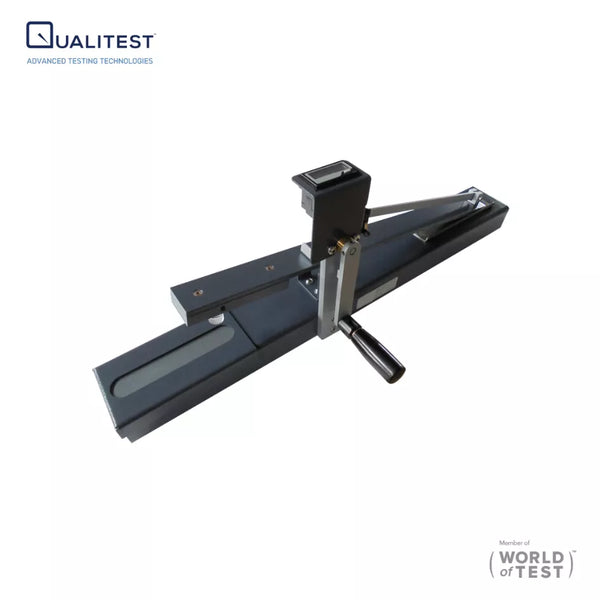
The hand-cranked unit is the traditional workhorse of the fabric lab. You turn a physical handle to move the rubbing finger back and forth.
Our honest take: Sometimes people write off hand-cranked machines as outdated. But we think units like our Manual Crock Meter Color Fastness Tester are incredibly handy, simple, and highly reliable for many testing setups.
Consider a small-scale, independent leather workshop that only completes a handful of custom-dyed batches every single week. For a smaller operation, spending thousands on automation does not make financial sense. A manual machine handles those five weekly tests perfectly without straining cash flow.
- Key Benefits: They require a lower initial financial investment, which is excellent for tighter budgets. Plus, since our Manual Crock Meter Color Fastness Tester does not require electricity, you can carry it anywhere on the production floor. They are highly intuitive to use, and there are basically no electrical components to maintain.
- Potential Limitations: If your team runs dozens of tests a day, turning that handle manually becomes tedious and physically tiring. Also, your technician must remain at the machine for the duration of the test.
Motorized Crock Testing
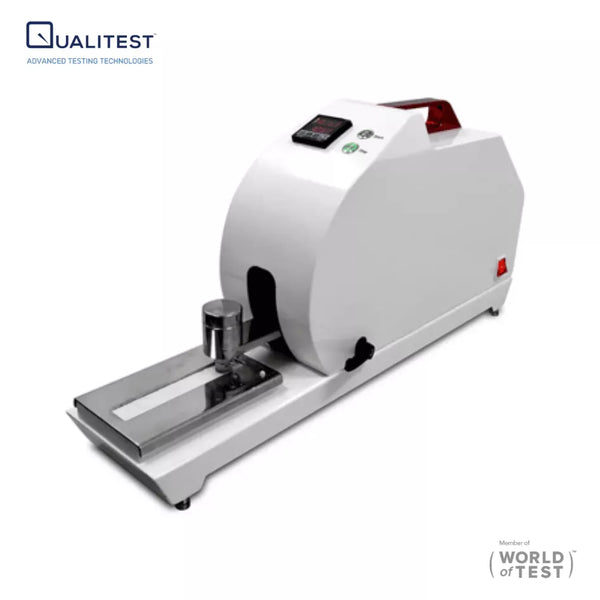
A motorized version automates the physical rubbing process. You just enter the number of rubs you want on a digital screen, press a button, and walk away.
Our honest take: If you manage a high volume of samples every day, the time your team saves by using an automated machine makes the extra cost well worth the investment.
Conversely, consider a high-volume textile mill processing hundreds of fabric rolls every single shift. Requiring a technician to manually crank a handle hundreds of times daily is highly inefficient. With an option like our Motorized Crock Meter: Color Fastness Tester, they load the sample, press the button, and prep the next batch while the machine runs.
- Key Benefits: It is a significant time-saver. Technicians can set the machine and focus on other laboratory tasks. Plus, the motor keeps a steady, consistent rubbing speed every single time, which cuts out any human variation.
- Potential Limitations: They require a higher upfront investment and must be stationed near a reliable electrical outlet.
Precision & Repeatability: Electronic vs Manual Crock Meters
We often get asked by buyers if one machine gives more accurate results than the other.
Interestingly, academic research focuses much more on how results are evaluated rather than directly comparing manual and electronic crock meters. In fact, existing papers do not report any head-to-head comparative evidence addressing performance differences between manual and motor-driven devices.
Instead, multiple studies emphasize replacing subjective visual gray-scale ratings with objective instrumental methods, such as calculating CIELAB color differences, to improve testing repeatability and inter-lab agreement.
However, regarding the machines themselves, when looking at electronic vs manual crock meters, both are built to apply the exact same weight and move the exact same distance.
But we believe the automated option is usually the more practical choice if you have multiple operators running your tests. Consider a facility running three continuous production shifts. A focused morning-shift technician might turn the handle with an energetic, brisk rhythm. Eight hours later, a tired technician finishing the night shift might operate the crank at a much slower, heavier pace.
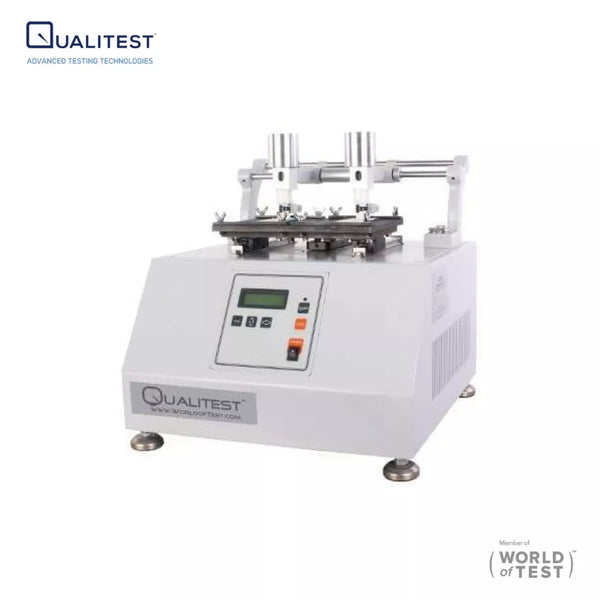
While these slight physical differences might not completely ruin a test, choosing an automated option like our Crock Meter and Crocking Test Machine - Q-Crock100 entirely removes that risk. It rubs at a steady, consistent rhythm every single time.
If you have to pass strict audits, automation is a brilliant safeguard. But if you are only checking a couple of batches a week, a manual one gives you the exact same result for a fraction of the price.
Maintenance, Calibration, & Ownership Costs
For anyone managing the company budget, buying the machine is only step one. You also have to think about keeping it running.
Thanks to durable manufacturing, both styles are incredibly easy to look after. Hand-cranked machines need almost zero attention; just clean the tracks and check the rubbing finger. Automated machines have a few more parts, but they are built to last for years.
Both types need a quick check now and then to make sure the weight and the stroke length are still accurate. We think some buyers stress way too much about calibration. We have found that setting up a simple, regular schedule is usually more than enough to keep your testing accurate and your auditors satisfied.
Selecting the Right Equipment
Choosing the right rubbing tester involves more than just checking price tags. To maximize your return on investment, we recommend evaluating three critical operational factors before making a purchase:
- Calculate Your True Labor Costs: Consider the actual hours your technicians spend physically operating the equipment. If you run fifty samples a shift, paying a skilled employee to stand and turn a hand-crank often exceeds the initial cost difference of buying an automated unit within the first twelve months.
- Assess Your Audit Environment: Third-party inspectors look for absolute consistency. If your facility undergoes strict, regular quality audits, removing the human variable entirely with a motorized unit provides an extra layer of undeniable data integrity.
- Plan for Future Scalability: Buying for your current capacity makes sense today, but forecasting your production for the next five years is a smarter financial strategy. If you anticipate landing larger manufacturing contracts, starting with an automated unit prevents a future bottleneck in your laboratory.
Once you evaluate those specific factors, picking the right machine is incredibly straightforward. Let us look at two vastly different situations:
Buyer Profile A: A highly specialized boutique manufacturer creating custom suede loafers. They test maybe three pieces of leather a week. They have a strict financial limit and plenty of extra time for manual quality checks. The obvious, cost-effective choice here is a simple hand-cranked machine.
Buyer Profile B: A massive production factory supplying thousands of yards of upholstery fabric for commercial airlines. They run dozens of daily tests, operate on tight, stressful production schedules, and face intense auditor scrutiny. For them, investing in an automated unit is the only logical move to save valuable time and guarantee absolute consistency.
Choose Qualitest for Rubbing Fastness Testers
At Qualitest, we believe that checking your quality should not mean draining your bank account. We are committed to supplying highly dependable, industrial-grade testing gear that complies with strict global rules without costing a fortune.
Whether you need a tough, old-school hand-cranked setup for occasional checks, or want to make life easier with a fully motorized unit, we have highly cost-effective products to match your workload. Our selection of manual and motorized models is built to make sure your materials easily pass every fastness test.
Ready to equip your testing space with gear that will not let you down? Explore our complete range of Crock Meters & Rubbing Fastness Testers today and let us help you improve your quality control process.
References (Click to expand):
- Badanov, K., Badanova, R. R., Badanov, I. K., Makhanbetaliyeva, K. T., Tulendieva, G. O., & Kasymova, G. A. (2023). Replacement of the visual method for assessing the stability of the coloring of fabrics with the instrumental. Mechanics and Technologies.
- Badanov, K., Badanova, R. R., Tulendieva, G. O., Badanov, I. K., Kasymova, G., & Makhanbetalieva, K. T. (2023). A new method for instrumental assessment of color stability. The Journal of Almaty Technological University.
- Harmon, J. (2022). Seasonal Dyeing- Color Extraction From the Leaves and Catkins of Cottonwood Trees. Breaking Boundaries.
- Hinsch, E., & Robinson, S. (2016). Mechanical Color Reading of Wood-Staining Fungal Pigment Textile Dyes: An Alternative Method for Determining Colorfastness. THE Coatings, 6, 25.
- Park, J. (2008). Colour‐fastness Assessment of Textile Materials. 71-78.
- Raluca, B. (2016). A REVIEW OF COLOR MEASURMENTS IN THE TEXTILE INDUSTRY. 19-24.
- Saeed, A., Hassan, K., & Sadaf, S. (2023). A Review on Colour Fastness of Natural Dyed Textiles. Pakistan Journal of Scientific & Industrial Research Series A: Physical Sciences.