We are going to call it straight: buying heavy magnetic hardware when standard optics deliver fully compliant numbers makes zero commercial sense. Stray molecular smoke will compromise your testing, making your choice between deuterium vs zeeman background correction the most consequential decision for your equipment budget.
While many facilities assume regulatory compliance requires expensive magnets, dependable continuum lamps and double-beam self-absorption satisfy strict detection limits at a fraction of the cost. Here is the no-nonsense breakdown of the physics, published literature, and bench economics to help you choose the right setup.
Key Takeaways
- In our assessment, Deuterium (D2) continuum setups are spot on for everyday ultraviolet determinations (190 nm to 420 nm) on digested samples, delivering compliance without extra capital outlay.
- Zeeman setups cover the entire spectrum (190 nm to 900 nm) and resolve structured background signals, but they carry a notable capital cost premium, draw higher electrical current, and can reduce analytical sensitivity by up to 35% in constant-field configurations due to magnetic line splitting.
- Double-beam Self-Absorption (the Smith-Hieftje method) bridges the gap cleanly, giving you full UV-visible background correction up to 2.0 Abs / 90x without mounting an electromagnet.
- For standard EPA, compendial, and ASTM testing on digested samples, we believe D2 and self-absorption deliver equivalent analytical precision at a fraction of the long-term operational cost.
- Zeeman configurations are primarily warranted for direct solid sampling, raw undiluted blood or serum, or severe spectral overlaps that cannot be cleared chemically.
Fundamental Operating Principles
Background absorption occurs when molecular vapors, furnace smoke, or tiny floating particles block light from the hollow cathode lamp (HCL). In electrothermal graphite furnace testing, this non-specific light attenuation creates serious measurement errors, making an effective correction setup mandatory to isolate the genuine elemental signal.
In our view, gaining complete clarity on the distinct physics behind these correction methods prevents facilities from taking on unnecessary hardware overhead.
Deuterium Continuum Systems
Deuterium-arc setups use an extra continuous glow discharge bulb operating right alongside the narrow-line hollow cathode lamp. The spectrometer toggles light pulses back and forth in a flash from both bulbs straight through the sample atomization cell.
Your target atoms absorb light exclusively across an ultra-thin slice of the spectrum from the HCL, while background molecules absorb light across both the HCL line and the much wider window of the D2 continuum. Subtracting the broad D2 signal from the total HCL signal leaves you with the real atomic absorption value.
Because this approach uses two separate light sources, it demands mechanical alignment between both optical paths, regular bulb changes, and reaches a hard optical cutoff above 420 nm in the visible spectrum.
While critics point to the demands of aligning two light paths, we consider modern double-beam optics to be dependable for routine laboratory work. On our QualiAAS series, this double-beam layout delivers verified correction of 1.0 Abs with a 90-fold reduction in background noise (1.0 Abs / 90x).
Zeeman Magneto-Optic Systems
Zeeman background correction leans on the magneto-optic Zeeman effect, firing up an external magnetic field to split atomic energy states. An electromagnet wrapped around the atomization cell (inverse Zeeman) or the primary lamp splits the atomic line into polarized components: a central pi component parallel to the magnetic field and shifted sigma components sitting perpendicular to the field.
By cycling the magnetic field and filtering the light through polarizers, the instrument logs total light absorption when the magnet is inactive, and background-only absorption when the magnet is energized. Because a single HCL handles both readings, beam alignment errors completely disappear.
Furthermore, when the magnet wraps directly around the atomizer, correction happens at the exact resonance wavelength, eliminating jagged, wavelength-dependent structured backgrounds. We view this single-lamp geometry as an impressive optical concept, but it saddles your facility with notable physical and financial overhead.
Technical Performance and Optical Architecture
When sizing up zeeman vs deuterium background correction in AAS, you have to look past the sales brochures. In our opinion, fixating solely on maximum absorbance numbers without checking optical stability or calibration curve behavior will lead straight to buyer's remorse:
| Evaluation Parameter | Deuterium (D2) Background Correction | Zeeman Background Correction |
|---|---|---|
| Radiation Source | Dual sources: Separate continuous discharge bulb (D2) and element-specific HCL. | Single source: Standard hollow cathode lamp. |
| Spectral Range | Ultraviolet spectrum only (190 nm to 420 nm); ineffective in visible wavelengths. | Full UV-visible spectrum from 190 nm up to 900 nm. |
| Correction Wavelength | Across a wide spectral window near the target line. | Exactly at the atomic resonance line. |
| Correction Capacity | Typically 1.0 to 2.0 Abs (QualiAAS D2 is verified at 1.0 Abs / 90x). | Frequently tops 2.0 Abs; direct trials showed correction of 2.0 Abs background down to < 0.005, versus ~0.02 for D2. |
| Structured Background | Ineffective against fine structured molecular absorption bands. | Corrects structured molecular bands when the magnet wraps around the atomizer. |
| Optical Alignment | Requires precise mechanical alignment between two distinct light paths. | Single-beam path straight through the magnetic field eliminates geometric alignment mismatches. |
| Calibration Linearity | Preserves standard lamp sensitivity; produces single-valued calibration curves. | Can reduce sensitivity by up to ~35% in constant-field units; curves can exhibit heavy curvature if linear ranges are exceeded. |
| System Footprint & Utilities | Compact, lightweight, runs on standard 110 V / 220 V laboratory electrical circuits. | Demands heavy electromagnets, dedicated water chillers, and pulls heavy electrical current. |
Self-Absorption: The Full-Spectrum Alternative
A recognized drawback of D2 setups is their inability to correct background past 420 nm, leaving visible-spectrum elements exposed to uncorrected matrix interference. In our perspective, double-beam Self-Absorption background correction (the classic Smith-Hieftje technique) is one of the most practical, overlooked solutions to sidestep bulky magnetic hardware.
Instead of paying for an extra continuum bulb or an electromagnet that adds substantial physical bulk, self-absorption pulses the standard hollow cathode lamp with a brief, high-amperage current burst. This electrical surge creates a dense cloud of unexcited atoms right in front of the lamp cathode, causing the center of the emission line to self-reverse.
In this self-reversed state, true atomic absorption in the atomizer drops out, allowing the machine to read non-specific background absorbance right at the resonance line across the entire UV-visible range.
We consider this approach an exceptionally practical engineering compromise. On our QualiAAS platforms, double-beam self-absorption correction is verified at 2.0 Abs with 90-fold attenuation (2.0 Abs / 90x).
In our view, this gives your team the full-spectrum reach and heavy background capability you require, completely avoiding the purchase premium, cooling requirements, and mass of an electromagnet.
Total Cost of Ownership and Operational Economics
In the ongoing industry debate of deuterium vs zeeman, capital expenses and day-to-day facility utilities will affect your balance sheet directly. To help laboratory managers evaluate capital procurement realistic for the US market, the table below outlines representative industry cost tiers alongside ongoing facility demands:
| Instrument Configuration Tier | Indicative US Market Purchase Range | One-Time Facility Setup Considerations | Recurring Annual Operating Items |
|---|---|---|---|
| Dedicated Flame Systems (Air-Acetylene) | 15,000 to 35,000 USD | Standard 110 V or 220 V circuit, air compressor, acetylene exhaust ducting | Acetylene fuel, clean air supply, hollow cathode lamps (approx. 200 to 450 USD per element), burner maintenance |
| Dual Flame + Graphite Furnace (D2 / Self-Absorption) | 30,000 to 65,000 USD | Dedicated 220 V circuit, high-purity argon line, standard furnace cooling-water circulator, exhaust ducting | Pyrolytic graphite tubes (lasting approx. 100 to 300 firings), high-purity argon cylinders, hollow cathode lamps |
| Furnace Systems with Zeeman Magnetics | 55,000 to 95,000 USD | Dedicated high-amperage 220 V circuit, external water chiller plumbing, magnetic clearance | Pyrolytic graphite tubes, high-purity argon, chiller coolant upkeep, higher electrical utility consumption |
(Note: Purchase brackets reflect indicative US market price ranges for modern analytical systems. Qualitest QualiAAS packages are configured and priced strictly via customized quotation based on chosen autosampler trays, hydride extensions, and optical options).
When reviewing these financial brackets, we believe taking a systematic look at total ownership costs reveals substantial operational differences that lab managers simply cannot overlook:
- Capital Expense: Adding massive electromagnets, high-amperage switching boards, and magnetic shielding results in substantially higher capital expenditure for Zeeman instruments compared to equivalent D2 or self-absorption platforms.
- Upkeep and Utility Footprint: A Zeeman electromagnet generates continuous resistive heat that requires a high-capacity refrigerated chiller running steadily to cool the magnetic coils on top of the furnace cooling loop. In contrast, standard graphite furnace models require only a basic water-cooling loop for the furnace electrode blocks, while dedicated flame units need no water service whatsoever.
- Sensitivity Losses and Curve Inversion: Research on constant-field Zeeman optics demonstrates that calibration curves exhibit pronounced curvature and can invert at elevated analyte concentrations if samples exceed the dynamic linear range, producing double-valued curves that require careful dilution verification to prevent under-reporting.
- Spectral Overcompensation Traps: Published studies prove Zeeman instruments face their own spectral challenges. Because an energized magnet splits neighboring matrix lines, stray sigma components can create artificial absorption during the magnetic cycle, triggering negative systematic errors for gallium and zinc in iron matrices, or mercury and gold in cobalt matrices.
In our opinion, high-throughput commercial testing labs managing tight margins per sample must determine whether a Zeeman unit generates a true return on investment. While academic medical teams with dedicated research funding may justify Zeeman hardware for direct, raw blood runs, commercial labs processing acid-digested samples hit regulatory targets consistently with continuum and self-absorption optics.
We argue your budget is far better directed toward high-capacity autosamplers and automated sample preparation than toward magnetic hardware that compliance protocols rarely utilize.
Regulatory Compliance and Matrix Selection Guide
For laboratory directors comparing zeeman vs deuterium AAS platforms, the primary question is straightforward: does your sample preparation protocol genuinely demand magnetic line splitting? From our standpoint, modern microwave digestion has largely leveled analytical requirements, making the operational need for Zeeman correction far rarer than marketing literature suggests.
US Municipal Water and Environmental Compliance (EPA)
For environmental monitoring of industrial waste effluents, soils, and groundwater under Resource Conservation and Recovery Act protocols, laboratories frequently execute EPA Method 7000 (flame) and EPA Method 7010 (graphite furnace), alongside ISO 15586 and ASTM D3919 for trace element determination in water by graphite furnace atomic absorption.
When evaluating digested aqueous samples and routine environmental extracts, chemical matrix modifiers and furnace thermal programming drive off volatile dissolved salts before atomization, leaving minimal residual background. In these digested aqueous streams, D2 and self-absorption optics provide verified analytical recovery without requiring magnetic line splitting.
State Cannabis and Agricultural Testing
State commercial cannabis testing regulations (such as those in California, Michigan, and Colorado) require strict screening for the "Big Four" toxic heavy metals: Arsenic, Cadmium, Lead, and Mercury. Because state compliance rules mandate closed-vessel microwave acid digestion, samples enter the graphite furnace as clear liquid solutions.
In our assessment, standard graphite furnace runs and hydride generation resolve these action levels without encountering severe spectral backgrounds.
Pharmaceutical and Dietary Supplement Quality Control (USP and FDA)
In FDA-regulated quality control suites, raw excipients, active ingredients, and botanical dietary supplements are screened against elemental impurity limits established under USP <232> using testing protocols validated under USP <233>.
Crucially for laboratory capital planning, USP <233> explicitly permits validated alternative procedures beyond ICP-OES and ICP-MS, allowing facilities to deploy atomic absorption for target elements while maintaining compendial compliance.
For international distribution, these testing protocols align with harmonized guidelines under ICH Q3D and European Pharmacopoeia Ph. Eur. 2.4.20. When pharmaceutical raw materials undergo closed-vessel microwave acid digestion, organic matrices are destroyed, allowing D2 and self-absorption optics to deliver reproducible trace quantitation that readily satisfies compendial validation criteria.
Petrochemical and Refining Testing (ASTM)
Regional petrochemical refineries and oil-blending facilities monitor catalyst poisons and contaminant metals under ASTM D5863, the standard flame atomic absorption method for determining Nickel, Vanadium, Iron, and Sodium in crude oils and residual fuels. This method allows laboratories to run samples either via acid decomposition (Test Method A) or direct organic solvent dilution (Test Method B).
For lubricating oil blending, facilities utilize ASTM D4628 to verify additive elements including Barium, Calcium, Magnesium, and Zinc. Because these petroleum workflows focus on defined target metals in prepared organic or digested streams, dual-mode flame and graphite furnace instruments handle these analyses without requiring the added expense of Zeeman hardware.
Clinical and Biological Matrix Findings
Peer-reviewed clinical research demonstrates that D2 setups match Zeeman performance across diverse biological samples when prepared systematically:
- In urinary cadmium runs, deuterium-arc correction delivered fast, precise numbers that tracked Zeeman values closely (correlation coefficient r = 0.997).
- For serum aluminum checks, virtually identical detection limits (3.0 to 4.1 ug L-1) were logged between deuterium and Zeeman instruments, confirming straightforward continuum setups are sufficient for routine clinical screening.
- It was confirmed that lead and cadmium in whole blood and urine ran cleanly on deuterium AAS, tracking Zeeman results tightly once chemical modifiers and platform tubes were applied.
- In urinary cobalt tests, it was demonstrated that deuterium AAS paired with liquid extraction yielded detection limits, precision, and recovery matching direct Zeeman analysis.
Specialized Research Matrices Requiring Zeeman Correction
Published literature shows Zeeman correction delivers its primary benefit in specialized research niches burdened by severe, unresolvable background signals:
- Direct Solid Sampling: When analyzing arsenic in raw pharmaceutical barium sulfate powders, it was found that direct solid-sampling ETAAS with Zeeman correction produced accurate readings, avoiding severe light scattering from raw particulates.
- Severe Structured Backgrounds: In marine biological tissues, it was observed that D2 setups encountered spectral distortion, whereas Zeeman correction handled arsenic, selenium, and cadmium without issue.
- Complex Soil Digests with Spectral Overlap: During soil selenium runs, it was found iron and phosphorus interferences triggered heavy overcorrection on D2 units, an effect eliminated on a Zeeman graphite furnace.
- Direct Biological Fluids Without Extraction: If you attempt to measure urinary cobalt directly from the sample tube without solvent extraction, direct deuterium AAS hits an analytical limit with an inadequate detection threshold of 6 ug L-1, whereas direct Zeeman AAS reaches the necessary sensitivity.
QualiAAS Series: Performance for US Laboratories
We purposely built our QualiAAS series around dependable, field-proven optical components rather than costly magnetic assemblies, because we believe laboratories deserve uncompromised data without overextending their capital equipment budget:
- High-Resolution Optical Engine: Features a 277 mm focal length Czerny-Turner monochromator, an 1800 grooves/mm diffraction grating blazed at 250 nm, and an imported high-sensitivity photomultiplier tube (PMT) detector.
- Broad Element Coverage: Quantifies over 70 metallic and non-metallic elements (70+ elements) with automated spectral bandwidth selections of 0.1 / 0.2 / 0.4 / 0.8 / 1.6 nm auto (with the QT-AAS series overview also documenting 0.1 / 0.2 / 0.4 / 0.7 / 1.4 nm auto, and 0.1 to 1.6 nm auto).
- Optional Oxygen-Enriched High-Temperature Flame: Available as an optional system, this oxygen-rich configuration determines refractory elements including Aluminum (Al), Barium (Ba), Molybdenum (Mo), and Vanadium (V) without nitrous oxide. This allows facilities to substitute an N2O cylinder with an oxygen supply, while routine determinations continue on the standard air-acetylene burner.
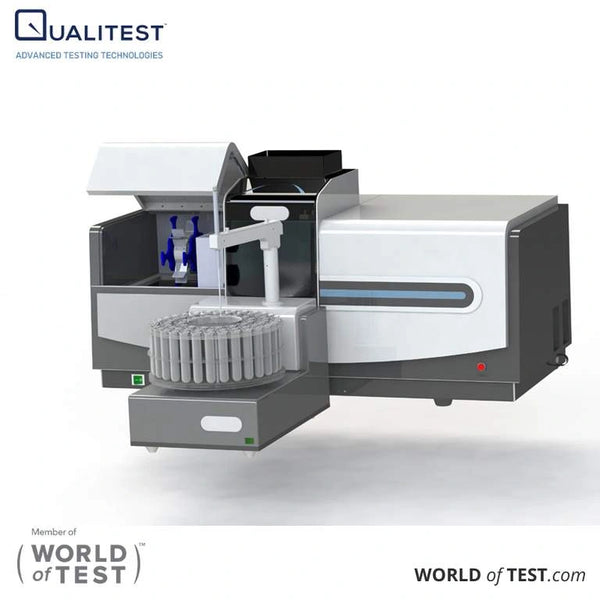
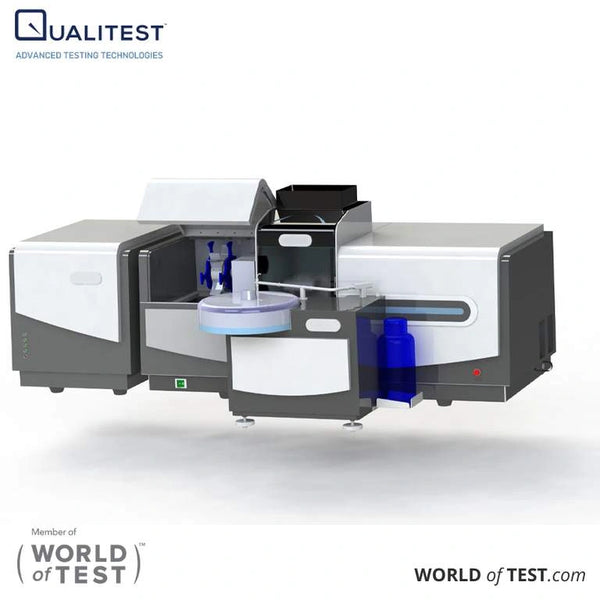
- US Facility and Utility Integration: Built standard for 220 V / 50 Hz circuits, with 110 V electrical options ready for North American facilities upon consultation. While graphite furnace models utilize a standard closed-loop circulator for the furnace electrodes, they completely avoid the high-capacity refrigeration chillers mandated to dissipate continuous heat from Zeeman electromagnets, and the flame-only 3000F requires no water utilities at all.
QualiAAS 3000F: Dedicated Flame System
Configured for dedicated air-acetylene flame testing, the 3000F delivers a Copper detection limit of Cu <= 0.002 ug/mL (ppm range). It features an 8-lamp automated turret with 1-8 simultaneous preheating, 1-99x repeat runs, and data export directly into Word and Excel.
This configuration supports waste effluent screening under EPA Method 7000, crude oil analysis under ASTM D5863, and lubricating oil additive testing under ASTM D4628, while handling high-concentration agricultural nutrient and screening workflows. Because state cannabis regulations require parts-per-billion quantification of Lead, Cadmium, Arsenic, and Mercury, facilities testing cannabis or ultra-trace matrices must deploy the dual-mode 3000FG with graphite furnace or the 3000FG-Pro with hydride generation rather than flame-only atomization.
Graphite furnace atomization, autosamplers, and 21 CFR Part 11 software features are not applicable to this model.
QualiAAS 3000FG: Dual Flame and Graphite Furnace
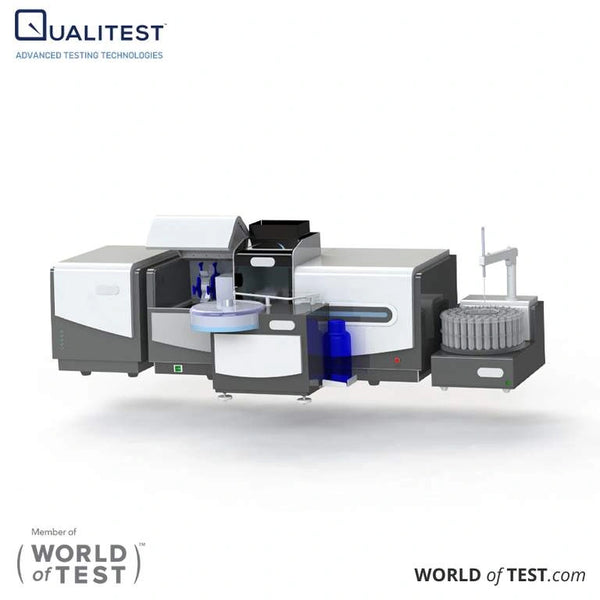
The 3000FG pairs air-acetylene flame testing (Cu <= 0.002 ug/mL) with electrothermal graphite furnace atomization reaching Cadmium detection limits of Cd <= 0.4 pg (ppt range). It switches automatically between flame and furnace modes at the push of a button and features an 8-lamp turret with 1-6 simultaneous preheating.
For automated runs, the system supports an optional graphite furnace autosampler featuring a standard 60+6 position tray (expandable to 150+5 positions) with dual-pump injection delivering repeatability error <= 0.5%, as well as an optional 70-position flame autosampler utilizing >= 20 mL cups.
The software includes an audit trail, electronic signatures, and user permission tiers for FDA 21 CFR Part 11 and GMP compliance, supporting EPA Method 7000, EPA Method 7010, ISO 15586, and ASTM D3919.
QualiAAS 3000FG-Pro: High-Sensitivity Hydride Configuration
Our advanced configuration pairs dual-mode automated switching with an 8-lamp turret supporting 1-8 simultaneous preheating, support for the high-capacity 150+5 position graphite furnace autosampler (standard 60+6 tray) and 70-position flame autosampler, and a native standard extension for hydride generation.
This setup delivers trace sensitivity for hydride-forming elements including Arsenic (As), Selenium (Se), Mercury (Hg), Antimony (Sb), Bismuth (Bi), Tin (Sn), Tellurium (Te), and Lead (Pb). It includes full FDA 21 CFR Part 11 compliance software, audit trail tracking, and regulatory method coverage.
(Note: While scientific literature examines both continuum and Zeeman designs, Zeeman background correction is Not Documented in QualiAAS configurations. Our systems rely on verified D2 lamp correction and double-beam self-absorption).
Optimize Your AAS Budget with Qualitest Solutions
In our view, analytical success comes from matching equipment to your active compliance methods rather than overpaying for idle magnetic hardware. For labs running digested samples, our cost-effective products pair standard D2 correction (1.0 Abs / 90x) with double-beam self-absorption (2.0 Abs / 90x) to deliver compliant trace detection without the steep purchase and utility overhead.
Contact Qualitest today to review your target elements, confirm method compliance, and receive a direct quotation for your bench.
References (Click to expand)
- Grassam, E., Dawson, J., & Ellis, D. J. (1977). Application of the inverse Zeeman effect to background correction in electrothermal atomic-absorption analysis. Analyst, 102, 804-818.
- Loos-Vollebregt, M. D. (2006). Background correction methods in atomic absorption spectrometry. Encyclopedia of Analytical Chemistry, 1-17.
- Loos-Vollebregt, M. D., & Galan, L. (1979). The Shape of Analytical Curves in Zeeman Atomic Absorption Spectroscopy. I. Normal Concentration Range. Applied Spectroscopy, 33, 616-626.
- Smith, S. B., & Hieftje, G. (1983). A New Background-Correction Method for Atomic Absorption Spectrometry. Applied Spectroscopy, 37, 419-424.
- Welz, B., & Schlemmer, G. (1986). Determination of arsenic, selenium and cadmium in marine biological tissue samples using a stabilised temperature platform furnace and comparing deuterium arc with Zeeman-effect background correction atomic absorption spectrometry. Journal of Analytical Atomic Spectrometry, 1, 119-124.