Relying solely on basic pass/fail flammability checks leaves engineering teams blind to real-world fire risks. First pioneered at NIST, oxygen consumption calorimetry established that net heat release correlates directly with oxygen depletion.
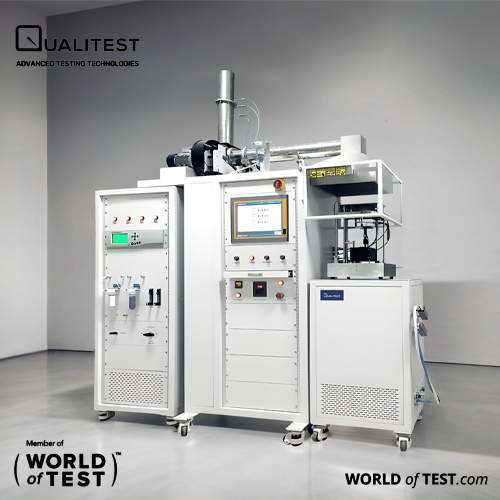
Selecting a versatile system like our Advanced Cone Calorimeter for Combustion Testing ensures full compliance with ASTM E1354 ISO 5660 frameworks while protecting your capital budget.
Key Takeaways
- Quantitative Fire Benchmarking: Cone calorimetry relies on oxygen depletion principles to deliver exact Heat Release Rate (HRR), Mass Loss Rate, and dynamic smoke production metrics.
- Dual Standard Compliance: ASTM E1354 (North America) and ISO 5660 (International) share harmonized 100 mm x 100 mm specimen geometries, making dual-compliant hardware essential for global market access.
- Cost-Effective Screening: Internal bench-scale fire testing prevents expensive full-scale burn trial failures and eliminates third-party lab testing backlogs.
- Critical Hardware Features: High-accuracy testing requires a 0 to 100 kW/m² cone heater, paramagnetic O2 sensors, laser photometer smoke optics, and optional NDIR CO/CO2 gas analysis.
- Qualitest Solution: Our Advanced Cone Calorimeter for Combustion Testing combines dual-protocol software, self-contained water cooling, and automated touchscreen controls to lower your total ownership costs.
ROI Analysis: Bench-Scale vs. Full-Scale Fire Testing
Let's talk about return on investment (because keeping a strict eye on operational expenditure is vital for every lab). Equipping your facility with an in-house bench-scale setup yields impressive financial payback compared to continually paying third-party testing facilities.
For US laboratories aiming to comply with International Building Code (IBC Chapter 8) or NFPA guidelines, relying exclusively on commercial US test labs (such as UL Solutions, Intertek, or Southwest Research Institute) can quickly accumulate substantial fees while waiting weeks for external lab availability.
| Testing Phase | Relative Cost | Failure Risk & Impact |
|---|---|---|
| Micro-Scale (e.g., UL 94) | Low ($) | High (Fails to capture real Heat Release Rate) |
| Bench-Scale (Cone Calorimeter) | Moderate ($$) | Low (Delivers accurate Heat Release Rate prediction) |
| Full-Scale (e.g., Room Burn) | High ($$$$) | Critical (Causes severe financial loss & project delay) |
Full-scale room burn trials require significant financial expenditure. If a newly formulated compound fails during a large-scale room burn, your project faces substantial financial losses and extended development delays!
Running routine ASTM E1354 testing right on your own laboratory bench allows your team to evaluate small specimens under controlled heat, identify peak fire intensity early, and refine flame-retardant formulations long before committing to costly external burn trials.
Furthermore, cone calorimeter data serves as direct input data for performance-based fire modeling, saving substantial software validation expense. Bringing this capability in-house quickly pays for itself over a remarkably short timeline.
Standards Comparison: ASTM E1354 vs. ISO 5660
The initial step involves determining whether your customer base demands North American certification, European approval, or dual compliance.
| Target Region & Sector | Primary Standard | Key Output Focus |
|---|---|---|
| North America (ASTM / NFPA) | ASTM E1354 | Heat Release Rate, Ignition Time, Mass Loss |
| Europe & Global (ISO / EN) | ISO 5660-1 & 2 | Heat Release Rate, Smoke, Gas Yields |
| Global OEM Supplier | Dual-Compliant System | Unified Multi-Standard Testing |
ASTM E1354 Standard Overview
First adopted in 1990, the ASTM E1354 cone calorimeter standard serves as the primary North American benchmark for measuring heat release rate and visible smoke release rates using oxygen consumption principles.
In the US, compliance with this method is widely mandated across key regulatory frameworks, including NFPA 130 for passenger rail systems, alongside widespread use in performance-based fire engineering and computer modeling. National variants also include AS/NZS 3837 in Australia and CAN/ULC-S135 in Canada.
ISO 5660 Standard Overview
First published in 1993 following research by Marc Janssens, the ISO 5660 cone calorimeter standard governs international fire reaction testing. Part 1 covers standard 100 mm x 100 mm specimens, while Part 2 addresses dynamic smoke production, and Part 4 accommodates larger 150 mm x 150 mm specimens.
Dual Compliance: ISO 5660 ASTM E1354
We strongly advise against purchasing an apparatus restricted to a single test standard; dual-standard capability keeps your laboratory versatile and prepared for global client demands. Ensure your chosen hardware natively handles ISO 5660 ASTM E1354 standard dimensions (100 mm x 100 mm specimens, radiant heat flux from 0 to 100 kW/m²).
Hardware architectures like our 538 kg heavy-duty testing frame provide the physical stability necessary to execute both test protocols on one unified platform without manual component swaps.
Technical Evaluation Criteria
Not all cone testing rigs deliver identical performance. Some function as dependable daily workhorses, while others demand frequent troubleshooting. When comparing specifications, look for hardware integrated into a centralized 19-inch rack cabinet featuring an industrial 15-inch touchscreen PC interface.
| System Component | Core Specification | Technical Benefit |
|---|---|---|
| Radiant Heating | 0 to 100 kW/m² Cone Heater | Smart temperature loop for uniform exposure |
| Gas Analysis | Fast-Response Paramagnetic O2 & NDIR CO/CO2 | High accuracy with automated flow management |
Radiant Heating Precision
Select a high-output radiant cone heater capable of generating a steady, uniform heat flux up to 100 kW/m², preferred for research and acceptance criteria. Standard cone heaters compliant with ISO 5660-1 achieve radiant flux uniformity within ±2% across the central 5 cm x 5 cm area.
Oxygen Sensor Accuracy
Because heat release calculations rely directly on Thornton's oxygen consumption principle (~13.1 MJ released per kg of O2 consumed), sensor accuracy remains paramount. Selecting lower-cost electrochemical sensors often leads to long-term drift; a fast-response paramagnetic oxygen analyzer delivers dependable measurement stability over extended testing schedules.
Exhaust & Optical Smoke Analysis
The exhaust assembly requires precise differential pressure transmitters and a Helium-Neon (He-Ne) laser photometer system that measures smoke optical density and extinction coefficients consistently during high-temperature events.
System Cooling & Diagnostics
Equipment built with an internal self-contained water-cooling loop eliminates reliance on external plumbing lines. Look for integrated diagnostic warnings that notify operators when filters, soot traps, or optical windows require servicing before data integrity is compromised.
Toxic Gas Analysis & Atmospheric Expansion
When evaluating materials for mass transit, aerospace, or maritime applications, measuring heat and smoke generation alone is insufficient. In North America, standards like NFPA 130 for passenger rail transit demand detailed carbon monoxide (CO) and carbon dioxide (CO2) emission profiles. Analyzing these gases alongside oxygen also improves heat release calculation accuracy.
| Configuration Type | Operational Setup | Primary Testing Purpose |
|---|---|---|
| Standard Open Cone | Ambient air intake | Baseline well-ventilated HRR & smoke analysis |
| Controlled-Atmosphere (CACC) | ISO/TS 5660-5 compliant enclosure | Variable O2 vitiation for underventilated fire simulation |
We anticipate that global regulatory bodies will enforce stricter limits on toxic combustion emissions across commercial sectors. Choosing an apparatus configured with integrated Non-Dispersive Infrared (NDIR) sensors for carbon monoxide (CO) and carbon dioxide (CO2) detection enables your laboratory to measure toxic gas yields today.
Furthermore, modern setups can expand toward controlled-atmosphere cone calorimetry (CACC) under ISO/TS 5660-5:2020 for under-ventilated fire studies.
Lab Operations, Calibration & Applications
For facilities conducting continuous testing routines, daily operational efficiency and straightforward calibration procedures keep laboratory productivity high.
| Workflow Stage | Primary Tasks | Key Outputs |
|---|---|---|
| 1. Calibration Setup | Methane C-Factor, O2 span check, optics zeroing | Verified baseline system metrics |
| 2. Sample Preparation | 100 mm x 100 mm cutout, foil/wool wrap, grid mounting | Standardized specimen mount |
| 3. Test Execution | Automated data acquisition, ISO 5660 test run | Live graphs & automatic report export |
Sample Prep & Industry Applications
Executing a standard ISO 5660 cone calorimetry test involves preparing uniform 100 mm x 100 mm sample specimens (up to 50 mm thick) wrapped in aluminum foil with ceramic wool backing.
For example, US automotive manufacturers in the Midwest evaluating EV battery pack enclosures, or Gulf Coast industrial plants testing hydraulic fluids, benefit from adaptable sample holders. Specialized holders exist for vertical orientation testing of polyurethane foams, edge-protected composite materials, and industrial fluid pans up to 100 mm diameter.
Automated System Calibration
Technicians should not spend hours tuning instrumentation every morning. Systems equipped with a 15-inch touchscreen PC interface automate calibration routines for the mass flow orifice plate (C-factor) via a 5 kW methane burner, load cell zeroing, and optical laser verification. Automated software routines turn routine daily setup into a streamlined process, maintaining audit-ready record logs without hassle.
Achieve ASTM & ISO Compliance with Qualitest Systems
Selecting a cone calorimeter extends beyond fulfilling immediate compliance criteria; it involves securing a dependable, cost-effective testing platform that grows alongside your facility's requirements.
At Qualitest, we believe laboratories should not have to choose between high measurement accuracy and reasonable capital expenditure. Our Advanced Cone Calorimeter for Combustion Testing is engineered specifically to handle the requirements of ASTM E1354 ISO 5660 testing routines without inflating your operational budget.
Why Partner with Qualitest:
- Dual Protocol Compatibility: Configured for both North American (ASTM E1354) and international (ISO 5660-1 & 2) protocols right out of the box via intuitive software options.
- High-Grade Instrumentation: Equipped with a high-duty cone heater (up to 100 kW/m²), responsive paramagnetic O2 sensor, Helium-Neon laser smoke detection system, and integrated NDIR CO/CO2 gas modules.
- Centralized Control Architecture: Houses a compact 19-inch main cabinet with a 15-inch industrial touchscreen PC, self-contained water-cooling loop, and intelligent diagnostic alarms.
- Cost-Effective Products: We specialize in supplying high-performance testing instruments that reduce total cost of ownership while maintaining exact measurement accuracy.
Whether your team is replacing older equipment or establishing a new fire testing lab, our technical specialists are ready to support your specification review.
Explore our Advanced Cone Calorimeter Specifications or Contact Our Team for a Consultative Quote Today!
References (Click to expand)
- Babrauskas, V. (1995). The Development and Evolution of the Cone Calorimeter: A Review of 12 Years of Research and Standardization. ASTM STP 1233.
- Guillaume, É., & Saragoza, L. (2016). Methane calibration burner and C-factor determination with cone calorimeter - validation of the standardized calibration protocol. Fire and Materials, 40, 511-515.
- Lindholm, J., Brink, A., & Hupa, M. (2009). Cone Calorimeter - a Tool for Measuring Heat Release Rate. Abo Akademi University Report.
- Östman, B. (2022). Acceptance criteria for products according to the cone calorimeter. Fire and Materials, 47, 848-850.
- Schartel, B., & Hull, T. (2007). Development of fire-retarded materials - Interpretation of cone calorimeter data. Fire and Materials, 31, 327-354.