Product failure in the field is a direct hit to your hard-earned brand equity. Choosing the wrong Taber vs DIN abrasion testing method means your materials might not survive real-world friction.
We believe that identifying the right DIN vs Taber test logic is the fastest path to ensuring your hardware holds up under pressure.
Key Differences: Taber vs DIN
For professionals who need a rapid answer to assist in selecting the right equipment immediately, we have distilled the primary differences into the breakdown below.
| Feature | Taber Test | DIN Test |
|---|---|---|
| Wear Mechanism | Rotary rubbing action (crisscross pattern) | Continuous sliding and high-pressure grinding |
| Abrasive Medium | Replaceable abrasive wheels | Rotating drum wrapped in standardized sandpaper |
| Primary Metric | Mass loss or Wear Index | Volume loss (compared against a reference material) |
| Ideal Applications | Surface wear on coatings, textiles, rigid plastics | Deep-seated wear on rubber, elastomers, and outsoles |
| Intensity Level | Generally more moderate, mimicking surface scuffing | Intensely aggressive, mimicking heavy sliding friction |
| Qualitest Solutions | QualiTA-III Series (Models A & B) | QualiDIN™ 1000 Series |
Taber Abrasion Testing Fundamentals
The Taber configuration is a globally recognized method for verifying how flat specimens manage the stress of being scuffed over time. This test mimics that repetitive rubbing action that materials encounter in everyday use.
It adheres to several high-profile international rulebooks, including ASTM D4060 (for organic coatings), ASTM D3884 (for textiles), and ISO 5470 (for rubber- or plastics-coated fabrics).
Test Methodology and Equipment
During a Taber sequence, a flat specimen is secured onto a rotating turntable.
We are certain that getting your sample preparation handled with total precision is the one step you cannot afford to overlook if you want data that reflects the truth; samples must be as flat as a tabletop and perfectly circular. You will want to utilize a specialized sample cutter or a heavy-duty punch press to ensure every single specimen is identical in its dimensions.
As the turntable rotates, two abrasive wheels are lowered onto the sample with a precisely calibrated downward force. The wheels rotate in opposite directions driven by the specimen itself, creating a distinct "X" pattern of crisscross wear.
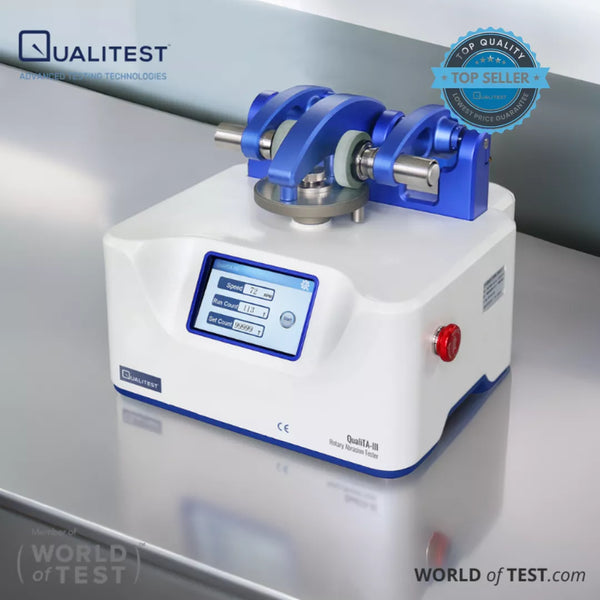
Setups like our Taber-type Rotary Abrader - Abrasion Tester QualiTA-III utilize a built-in vacuum system that actively pulls debris away from the contact point as it runs, while a color touch screen makes operation incredibly straightforward.
In our professional view, this specific "X" appearance is what makes the Taber method so effective at mimicking the multi-directional wear patterns seen in the real world, such as foot traffic moving across a floor.
To capture the tiny amounts of mass that disappear during this process, we always recommend using a high-precision analytical balance.
Data Metrics and Analysis
The data points typically appear in two formats:
- Mass Loss: You weigh the specimen before and after a specific number of rotations to see how much of the material has been rubbed away.
- Wear Index: This calculates the rate of wear over a specific count of rotations (usually 1,000). A lower numerical score here indicates your material is far superior at resisting surface damage.
Application Case Study: Surface Wear
Consider the production of high-traffic luxury vinyl flooring. If that top wear-layer cannot withstand thousands of shoes scraping across it daily, the product fails. The Taber method applies that exact type of localized, repetitive friction.
To handle thick, heavy-duty planks (ranging from 20-25mm), you would utilize a machine outfitted as our Model A variant. Conversely, if you are testing wafer-thin films or delicate organic coatings (0-6mm), a Model B setup holds the material perfectly flat without warping, giving manufacturers the hard data they need to guarantee a twenty-year warranty.
Primary Industry Applications
Since it focuses on surface-level damage, the Taber method is a perfect fit for:
- Paints, powder coatings, and decorative finishes.
- Apparel and technical textiles (such as verifying the reinforced knees of heavy-duty work pants resist premature thinning).
- Rigid plastics and polymers.
- Paper products and high-density cardboard.
- Leather goods.
- Hard-surface flooring materials.
DIN Abrasion Testing Standards
While the Taber method focuses on the top layer, the DIN abrasion test found in the ISO 4649 and ASTM D5963 rulebooks is engineered to determine how much volume a material loses when it is forced against a relentless, non-stop rubbing motion.
We view this as the gold standard for verifying the toughness of rubber and elastomeric materials when deep, structural wear is the primary concern.
Operational Overview
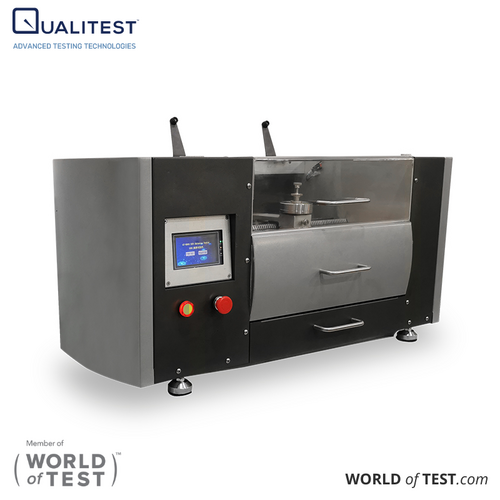
In a DIN sequence, utilizing a heavily reinforced machine like our DIN Abrader - QualiDIN™ 1000 Series, a cylindrical test piece is pressed against a rotating drum wrapped in standardized abrasive paper.
As the drum turns, the specimen is moved laterally across the rough surface under a constant load. This creates a non-stop, high-intensity wearing action.
Just as with the Taber method, the quality of your sample at the start is everything. We suggest utilizing top-tier specimen cutting tools or precision punch presses to ensure the circular edges are sharp and clean because ragged edges lead to inconsistent friction and highly unreliable data.
Quantifying Material Performance
Unlike the Taber test, which primarily looks at weight, the DIN test is centered entirely on volume loss. The amount of material worn away is calculated by looking at the mass loss in relation to the density of the material.
We are convinced that volume loss is a much more honest number for resilient materials because it accounts for the fact that different compounds have different weights, providing a highly accurate look at how various rubber mixes truly compare.
Application Case Study: Structural Wear
Consider the thick rubber tracks on a mini-excavator operating on jagged concrete. If that specific rubber compound skips rigorous friction testing, massive chunks will tear away on the job site.
The DIN method replicates that brutal, grinding punishment, ensuring the material can survive the harshest environments without falling apart.
Recommended Use Cases
The aggressive nature of the DIN test makes it the definitive choice for verifying:
- Footwear outsoles (particularly rubber compositions).
- Vehicle tires.
- Heavy-duty conveyor belts (such as predicting how long a rubber belt can transport sharp, crushed gravel before requiring a replacement).
- Industrial hoses.
- O-rings and high-pressure seals.
Comparative Research and Field Performance
While laboratory testing provides essential baseline data, independent academic research demonstrates that Taber and DIN methods load and damage materials in distinctly different ways:
- Taber Damage Mechanisms: This test produces two-body abrasive wear that can cause aggressive crosswise cutting and removal of surface layers in polymers and wood. For organic coatings, the Taber test typically causes scratching, whereas falling abrasive tests primarily thin the coating.
- DIN Damage Mechanisms: In contrast, the DIN test relies on high contact friction, which generates rough, irregular wear particles.
- Conflicting Rankings: Because of these differing mechanisms, the two tests frequently rank the exact same materials in completely different orders. For instance, testing rubber, PVC, and cork flooring yields distinct abrasion rates depending on the chosen method.
- Variations from Field Data: Studies indicate that both Taber and DIN can sometimes demonstrate unrealistically high wear and intensive tearing compared to actual field tests. In tire tread compounds specifically, the DIN test produces larger debris and rougher particles than what is typically seen on real roads, resulting in rankings that differ from other specialized tests.
This research highlights that Taber and DIN are highly useful comparative lab methods, but they can occasionally overestimate wear or produce damage morphologically unlike real conditions. For design and material selection, these tests perform best as comparative indicators, ideally combined with additional application-specific evaluations.
Selecting the Optimal Test Method
Deciding between a DIN vs Taber test really comes down to the specific material you are analyzing and its intended environment. We often observe organizations making the mistake of selecting a test based on the initial equipment cost rather than the logic of the material, which leads to data that simply fails to predict how the product will perform in the field.
Choose the Taber Test if: You are checking how the outer surface of a product manages daily life. For instance, if you are manufacturing the protective clear coat on a high-end smartphone screen and need to verify it resists pocket friction from keys and coins, the Taber method delivers the highly relevant data you require.
Choose the DIN Test if: You are producing components from rubber or elastomers that will face continuous grinding. For example, if you are pouring the solid rubber for a fleet of warehouse forklift tires and must guarantee they will not shred against rough concrete floors, the DIN method is exactly what you need to calculate volume loss with total precision.
Related article: Complete Abrasion Test Guide: Methods & Tester Choice
Total Cost of Ownership and Maintenance
As you weigh these two methods, we suggest carefully calculating the long-term expenditure on the parts that will be used up during testing. Taber setups require you to purchase new abrasive wheels regularly and keep them in peak condition using diamond refacing tools.
We specifically built the Abrasive Wheel Refinisher - QualiTab™ Trim 100 to make this exact resurfacing job incredibly fast, highly precise, and completely repeatable. Conversely, DIN setups utilize standardized abrasive paper that must be replaced after a specific number of cycles to ensure every test remains fair and consistent.
In our view, attempting to squeeze extra life out of these components once they are spent is a terrible deal that results in data you cannot trust and a significant amount of frustration. At Qualitest, we put massive effort into producing equipment that does not drain your budget while remaining perfectly accurate and adhering completely to all major international standards.
Qualitest: Your Source for Accurate Abrasion Testing
Securing equipment that delivers spot-on accuracy is non-negotiable for your quality assurance process.
We provide high-performance abrasion hardware built to meet international benchmarks without draining your budget. Whether you require a versatile rotary tester for coatings or a heavy-duty DIN abrader for rubber applications, our selection ensures your materials survive the real world.
Check out our full range of Abrasion Testers today or reach out to our team to find the exact configuration you need for reliable, repeatable results.
References (Click to expand)
- Baptista, A., & Vaz, M. (1993). Comparative wear testing of flooring materials. Wear, 990-995.
- Brischke, C., Ziegeler, N., & Bollmus, S. (2019). Abrasion Resistance of Thermally and Chemically Modified Timber. Drvna industrija.
- Chae, E., Yang, S., & Choi, S. (2024). Abrasion Behaviors of Silica-Reinforced Solution Styrene–Butadiene Rubber Compounds Using Different Abrasion Testers. Polymers, 16.
- Kovalev, M., Alekseeva, E., & Shaposhnikov, N. (2020). Investigation of hydroabrasive resistance of internal anti-corrosion coatings used in the oil and gas industry. IOP Conference Series: Materials Science and Engineering, 889.
- Liu, H., Yao, X., Wang, K., Yukun, Z., Bian, H., & Wang, C. (2024). Research on Tire Tread Abrasion Performance Considering the Patten and Slippage with Verification. Polymer Testing.
- Rossi, S., Deflorian, F., & Fedel, M. (2008). Comparison of different abrasion mechanisms on the barrier properties of organic coatings. Wear, 265, 1820-1825.
- Theeratatpong, K., Danchaivijit, S., & Boonyongmaneerat, Y. (2013). Comparison of ball-on-disc and Taber wear tests in assessing wear performance of electrolessly-deposited alloys. Journal of metals, materials and minerals, 23.